No products in the basket.
Branded Workwear
Best Polos for Embroidered Uniforms in the UK
23
Jul
Jul
A polo that looks smart on day one but twists, fades or loses its shape after a month creates a uniform problem, not a clothing problem. The best polos for embroidered uniforms need to carry your logo cleanly, stand up to regular washing and give every member of the team a consistent appearance – whether they work in a reception, on a building site, in a warehouse or at an event.
For most organisations, the right choice comes down to the working environment, the size and detail of the logo, and how often the garment will be worn. Price matters, particularly on larger orders, but the lowest unit cost is rarely the best value if staff need replacements sooner than expected.
What makes a polo suitable for embroidery?
Embroidery puts more demand on a polo than an undecorated garment. The fabric must be stable enough to support the stitching, while still being comfortable for a full shift. A good embroidered logo should sit flat, remain clear from a normal viewing distance and retain its shape through repeated laundering.
Piqué knit is a dependable starting point. Its textured surface is familiar in workwear polos, breathable enough for active roles and generally provides a good base for embroidery. Cotton-rich piqué polos have a softer, more traditional feel, while polyester or polycotton options tend to dry faster and hold their colour well. Neither is automatically better. The right fabric depends on the job.
For customer-facing teams, a heavier cotton or cotton-rich polo often gives a more substantial, premium appearance. For trades, logistics, cleaning teams and outdoor event staff, a polycotton or polyester polo can be the more practical option because it is easier to wash, dries quickly and is less prone to shrinking. In hot working conditions, look for breathable or moisture-wicking styles, but check that the knit is dense enough for the intended embroidery.
Fabric weight also matters. Lightweight polos can be useful for summer, hospitality or high-activity roles, but very thin material may show backing behind a large embroidered design. Midweight and heavier garments usually provide better structure, particularly where the logo has solid filled areas or multiple thread colours.
Best polos for embroidered uniforms: choose by workplace
A single polo range can work across many roles, but it should not be chosen solely because it is available in your company colour. Start with the conditions staff actually face and work backwards from there.
Trades, construction and field teams
Tradespeople need polos that cope with movement, dirt and frequent laundering. A hard-wearing polycotton piqué polo is often the sensible choice, particularly where garments are washed several times a week. Reinforced shoulder seams, a ribbed collar and side vents help the polo keep its form during physical work.
Consider darker colours for roles where marks are unavoidable, with a high-contrast embroidered logo for recognition. Navy, black, charcoal and bottle green are common for a reason: they are practical without looking untidy by mid-shift. If visibility is a requirement, use certified hi-vis garments rather than treating a standard bright polo as safety wear.
Office, retail and customer-facing staff
For reception, showroom, retail and service teams, appearance can take priority over abrasion resistance. A cotton-rich polo with a neat collar and a closer retail-style fit can give a more polished result. The embroidery should be proportionate. A small left-chest logo is usually more effective than an oversized design that makes the garment look promotional.
It is worth offering both men’s and women’s fits where available. A unisex polo may simplify purchasing, but it does not always provide the best fit across a mixed team. Better-fitting uniforms are more likely to be worn properly and retained by staff.
Warehousing, logistics and active teams
For staff who are lifting, loading, picking or moving between warm and cold areas, comfort and wash performance tend to matter most. Polyester-rich polos are useful here because they are lightweight, colourfast and quick drying. A classic fit allows easier movement, while a longer back can help keep the garment covered during bending and lifting.
Avoid placing dense embroidery too low on the chest or across an area that will rub against harnesses, seatbelts or carrying equipment. The left chest remains the standard placement because it is visible, professional and less likely to receive constant friction.
Events, promotions and short-term campaigns
Event uniforms need to look consistent quickly, often across a large number of sizes. A good-value polycotton polo is usually appropriate for short campaigns, stewarding and promotional teams. If staff will wear the garment over several days, do not compromise too far on fabric weight or collar quality. Photographs, client-facing activity and repeat wear can expose a poor-quality polo very quickly.
For large event orders, planning the packing is as useful as planning the garment. Per-person packaging, labelled by name, department or size, can remove hours of sorting when uniforms need issuing on site.
Match the embroidery to the polo
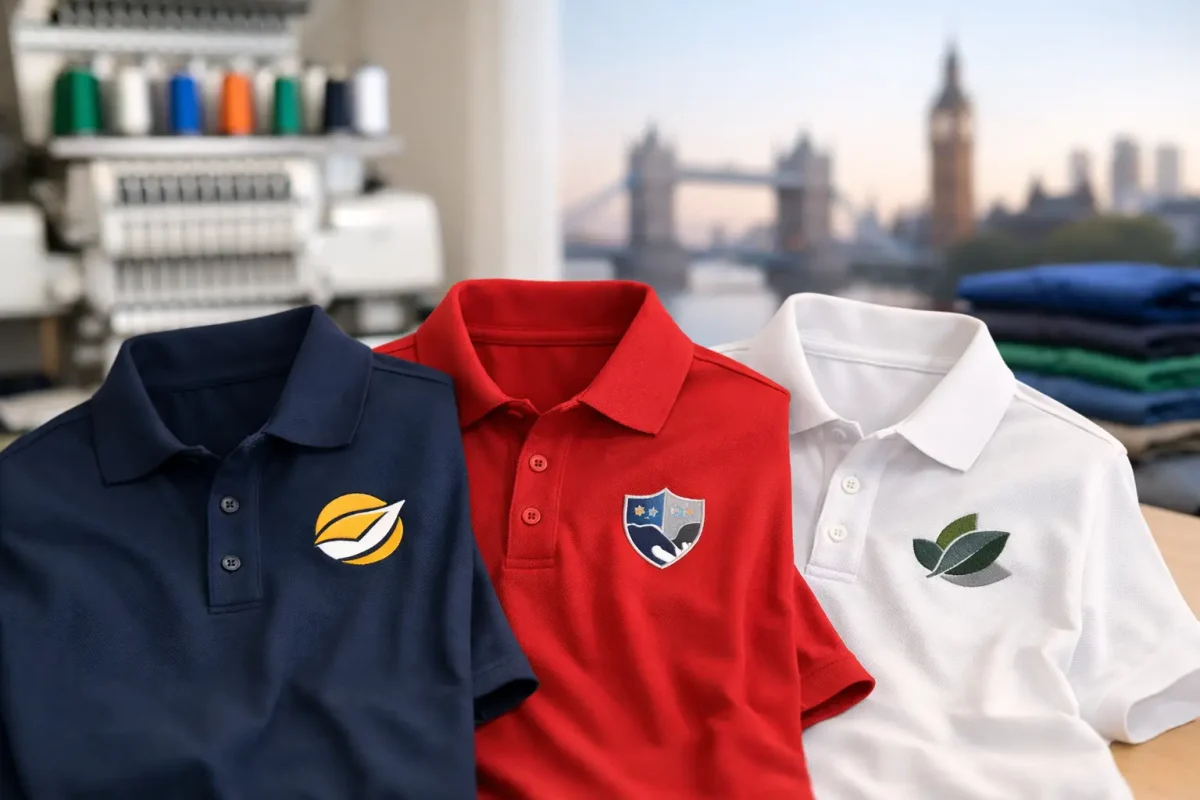
The garment and logo have to work together. A detailed logo with tiny lettering, colour gradients or fine lines may need simplifying before it can be embroidered clearly. Embroidery uses thread, not ink, so it cannot reproduce every feature that appears in a digital logo file.
A competent supplier will convert the artwork into an embroidery-ready stitch file and advise if small text needs enlarging, colours need matching to thread, or a different decoration method would give a cleaner result. This is not a cosmetic detail. Poor digitising can leave gaps, puckering or lettering that cannot be read.
For most polos, the left chest is the default position. It is practical, recognisable and economical across a mixed uniform order. Sleeve embroidery can work for web addresses, initials or a short department identifier, although it adds cost and should remain simple. Large back embroidery is possible, but it can make a polo heavy and stiff, especially on lightweight fabric. A printed back logo may be more suitable where the design is large or contains fine detail.
The same principle applies to waterproof outerwear. Embroidery creates needle holes, so print is generally the better option for waterproof jackets. Polos do not have this concern, which is one reason they remain a reliable choice for embroidered workwear.
Check the practical details before placing an order
A polo can look similar in a catalogue and perform very differently in use. Before committing to a full roll-out, check the product specification, size range and care instructions. A sample is particularly worthwhile for larger teams, new branding or garments that will be worn daily.
Focus on four areas:
- Shrinkage and wash instructions: Cotton-rich garments may shrink if washed too hot or tumble dried heavily. Match the care guidance to the reality of how staff will wash their uniforms.
- Colour continuity: If you expect to reorder, choose an established range with dependable colour availability. This helps new starters match the existing team.
- Sizing coverage: Check that the range accommodates the people who will wear it. A broad size run avoids forcing staff into an unsuitable fit.
- Collar and placket construction: Ribbed collars, quality buttons and well-finished plackets make a visible difference after repeated wear and washing.
Ask staff who wear uniforms every day for input before standardising a range. A site manager may focus on durability, while wearers may notice that the collar curls, the sleeves are too tight or the fabric feels too warm. Both views are useful, because the uniform needs to work operationally and be accepted by the people wearing it.
Order for consistency, not just the first delivery
Most uniform issues arise later: a new starter needs one polo, a team expands, or a supervisor orders a different style in a nearly identical shade. Setting a clear uniform specification avoids this. Record the approved polo style, garment colour, logo position, embroidery size and thread colours. That gives procurement and site teams a straightforward reference for repeat orders.
It also helps to think about stock allocation. Teams with dirty or physical roles often need more garments per person than staff working in clean, customer-facing settings. Ordering too few polos can lead to inconsistent substitutes and rushed purchases. Ordering a sensible quantity at the outset usually protects the uniform standard and reduces administration.
For organisations managing several sites or departments, structured packing can make a substantial difference. Vivid Promotion can prepare orders by employee, location or team so garments arrive ready to issue rather than as mixed cartons needing internal sorting. This is especially useful for start dates, site roll-outs and event deadlines.
The best polo is the one your team can wear confidently, wash regularly and reorder without uncertainty. Choose a fabric and fit that suit the job, keep the embroidery clear and proportionate, and approve the specification before the order grows. That small amount of planning keeps branded uniforms looking consistent long after the first delivery has been unpacked.