No products in the basket.
Branded Workwear
Branded Headwear That Works Harder for Your Team
01
Oct
Oct
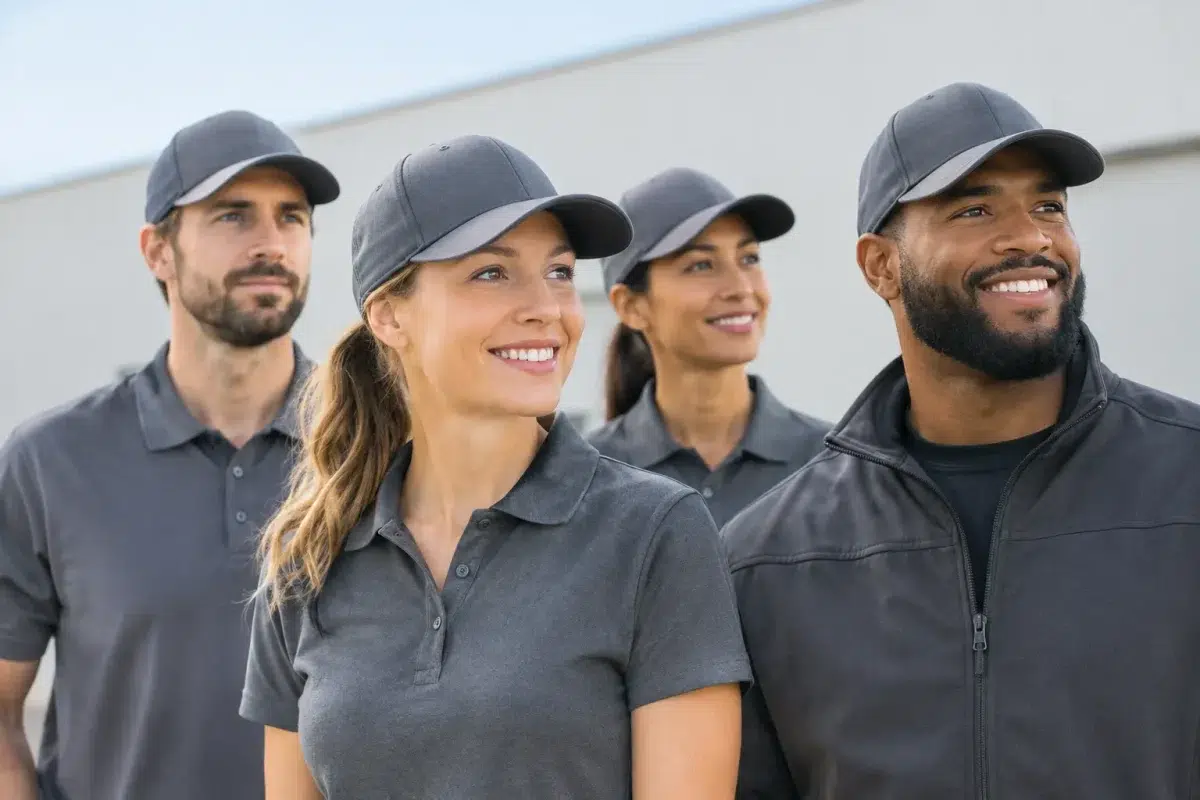
A cap is often the first part of a uniform a customer notices. On a building site, at an event entrance or across a delivery team, branded headwear puts your logo at eye level while giving staff a practical layer for the conditions. The right choice is not simply the cheapest cap with an embroidered badge. It needs to suit the job, the season, the wearer and the way your team works.
For businesses ordering uniforms at scale, headwear also solves a straightforward presentation problem. It brings mixed garments together, gives casual staff a consistent look and provides a useful branded item for teams who do not need a full uniform. Getting the garment and decoration method right at the outset avoids poor logo reproduction, uncomfortable headwear and repeat ordering issues later.
Choose branded headwear by the job
Start with the working environment rather than the logo position. A smart, structured cap can work well for retail, hospitality, facilities teams and event crews. It holds its shape, presents neatly and offers a clear front panel for branding. For trade teams, a hard-wearing baseball cap or work cap is usually a more practical fit, particularly where staff are moving between vehicles, site work and customer-facing jobs.
Beanies are the sensible option for outdoor work in colder months. They are widely used by construction, landscaping, logistics and security teams because they add warmth without getting in the way. A cuffed beanie gives a reliable area for an embroidered logo, while a close-fitting style may be better under a hood or helmet, depending on site rules.
Sun protection matters as much as warmth for teams working outside. A cap with a curved peak is useful for grounds maintenance, events, courier work and field-based sales teams. Where greater coverage is needed, look at legionnaire-style caps or broad-brimmed options, but check that the design will not interfere with other required PPE.
Hi-vis headwear has a different job. It should support visibility requirements, not replace compliant hi-vis clothing. For workers near traffic, plant or low-light areas, select colours and reflective detailing that fit the wider PPE issue. Check the relevant product specification and site policy before treating any item as part of a compliance-led uniform.
Fit, adjustment and day-long comfort
One-size headwear can reduce ordering complexity, but it still needs to fit a varied team. Adjustable strap-back, hook-and-loop and buckle closures are useful where staff will share stock or where sizes are unknown. Flex-fit styles can feel more secure, although they usually require specific sizing and more careful allocation.
Think about the working day too. A heavy cap may be durable but uncomfortable during long summer shifts. A lightweight, breathable fabric can be the better choice for active teams, while a fleece-lined beanie is better suited to cold starts and outdoor winter work. If employees will wear headwear with ear defenders, helmets, safety glasses or hoods, test a sample before placing a large order.
Embroidery or print for branded headwear?
Embroidery is the standard choice for most caps, beanies and structured work headwear. It is durable, has a professional finish and holds up well through regular wear. A simple logo in solid colours generally produces the cleanest result, especially on a cap front or beanie cuff.
However, embroidery has limits. Very small text, fine lines and detailed gradients can lose definition when converted into stitches. Dense embroidery can also make lightweight fabric stiff, particularly on a soft cap panel. In those cases, a printed transfer or woven patch may give a clearer result, depending on the item and logo artwork.
Print can be effective on certain headwear, especially where a larger graphic, fine detail or a flatter surface is required. The key point is garment construction. Curved panels, seams and heavily textured knitted fabrics can make print less suitable. Waterproof or technical fabrics also need the right method. As with outerwear, embroidery can create needle holes in some waterproof materials, so a suitable print process is often the safer route where weather protection must be retained.
A good supplier will assess the artwork before production rather than forcing every logo into the same process. Artwork may need converting into an embroidery-ready stitch file or print-ready format. That setup work affects how accurately colours, outlines and lettering reproduce, which is why it pays to use an approved logo and keep it consistent across future orders.
Logo placement needs a practical check
Front-centre branding is familiar and visible, but it is not always the best option. A large, detailed logo may sit better on the side of a cap, while a small embroidered mark on a beanie cuff can look cleaner than trying to fill the whole panel. For teams using headwear as part of a broader uniform, match the logo scale to polos, jackets and hi-vis garments so the identity looks consistent rather than oversized.
Avoid placing key detail too close to seams, vents, fasteners or the peak. These areas can distort embroidery and reduce legibility. If names, departments or roles are required, consider whether they are genuinely useful on headwear. On most workwear orders, a company logo alone is clearer, easier to re-order and more versatile when staff move roles.
Order for the season, not just the first issue
Many uniform orders fall short because they only cover the weather at the time of purchase. A summer event team may need caps now and beanies for early-morning set-up later in the year. Outdoor contractors often need both options available, while warehouse and delivery teams may need different headwear depending on whether they work inside, outside or between the two.
A practical approach is to set an approved headwear range with one warm-weather option, one cold-weather option and, where relevant, a hi-vis or specialist item. This gives managers a controlled choice without creating a different look across every department. It also makes repeat ordering faster because the garments, logo positions and decoration method are already agreed.
For schools, clubs and leavers groups, the priorities may differ. Budget, colour matching and a finish that will still look good after frequent wear tend to matter more than technical performance. For event merchandise, consider whether the item is for crew use, resale or giveaway. A giveaway cap may call for a simpler construction and bold print; staff headwear needs better durability and a fit people will actually wear through a full shift.
Make large uniform issues easier to manage
Headwear is small, but it creates admin when it arrives as mixed bulk stock with the rest of a uniform order. If you are issuing garments to multiple sites, departments or new starters, decide early how the order needs to be packed. Sorting items by employee, team or location can save hours of unpacking and prevent stock going missing before it reaches the wearer.
Keep a clear record of approved colours, product codes, logo files, placement details and decoration colours. This is particularly useful when teams are based across several locations or when procurement is handled by more than one person. Consistency is easier to maintain when repeat orders do not depend on someone trying to match an old cap by eye.
Vivid Promotion can support this type of uniform issue with branded garments prepared for distribution, including per-employee packing where required. For larger event and trade orders, pallet delivery can also reduce handling at the receiving end.
Before committing to a high-volume order, check a sample or visual proof where the logo, fabric and application method are unfamiliar. Confirm the peak shape, adjustment type and branding position with the people who will wear it. A small check at this stage is far cheaper than discovering that a cap does not sit comfortably with site PPE or that fine lettering cannot be read from a sensible distance.
The most useful headwear is the item employees reach for without being told. Choose for the job first, apply the logo with the right method, and make repeat supply straightforward for the person responsible for issuing it.