No products in the basket.
Branded Workwear
What Garments Suit Cleaning Teams at Work?
07
Oct
Oct
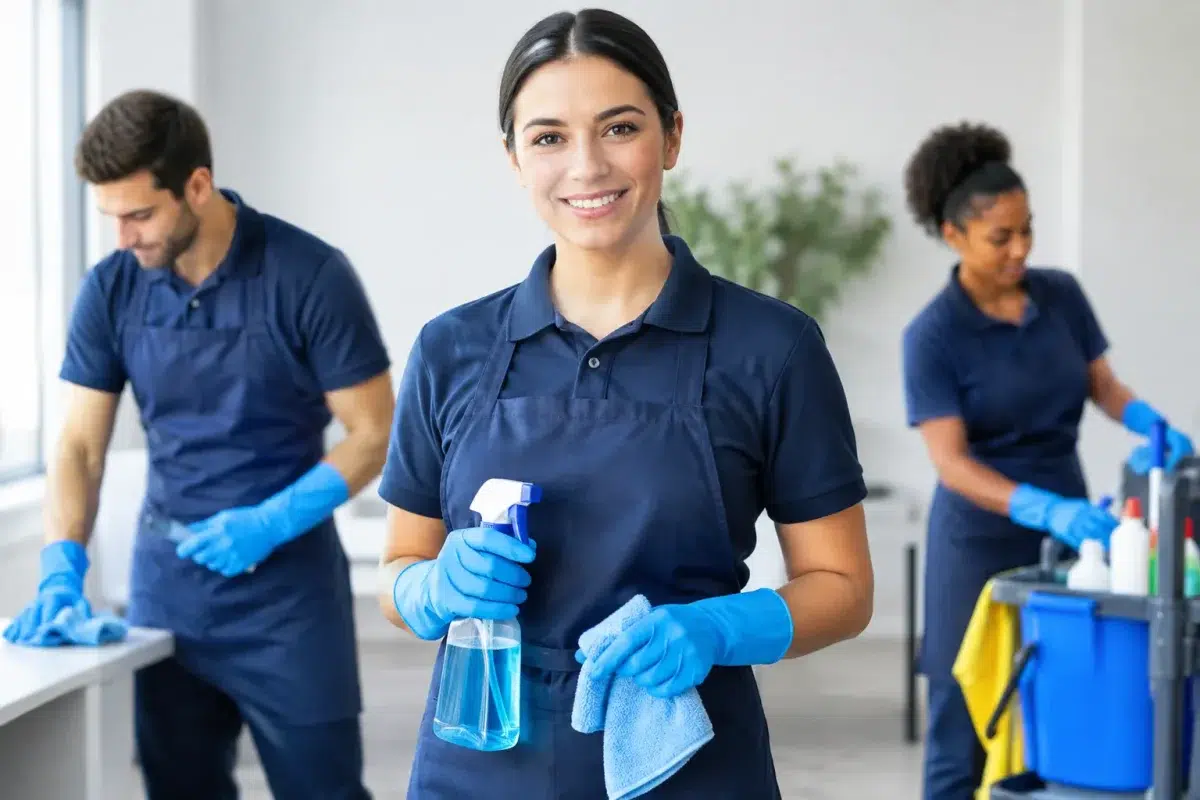
A cleaner moving between washrooms, corridors, kitchens and external entrances needs more from a uniform than a logo on a basic T-shirt. When deciding what garments suit cleaning teams, start with the work being done, the building environment and how often garments will be washed. A practical uniform keeps staff comfortable, presents a tidy and recognisable team, and stands up to repeated use without creating unnecessary replacement costs.
For most commercial cleaning teams, a small, coordinated range works better than issuing one garment for every possible situation. A branded polo or T-shirt, hard-wearing trousers and a suitable outer layer will cover the majority of routine contracts. Add hi-vis, waterproof protection or specialist PPE only where the risk assessment and site requirements call for it.
What garments suit cleaning teams on a normal shift?
For indoor cleaning, polos and T-shirts are usually the starting point. They are light, easy to layer and straightforward to launder. A polo gives a slightly smarter appearance for front-of-house teams, hotel housekeeping, schools, offices and care environments. A T-shirt may be the more comfortable, cost-effective choice for high-output cleaning, particularly where staff work in warm plant rooms, kitchens or busy public areas.
Choose fabrics that feel comfortable over a full shift and retain their shape after regular washing. Cotton-rich garments are breathable and familiar to wear, while polyester or polycotton options dry faster and can be a sensible choice where uniforms are laundered frequently. There is a trade-off: heavier cotton can feel more substantial, but it may take longer to dry; lightweight polyester is practical but may not suit every wearer or workplace preference.
For the lower half, work trousers are generally more suitable than jeans or casual joggers. Look for a comfortable fit, useful pockets for keys, cloths and small supplies, and a fabric that can cope with kneeling, bending and movement. Elasticated or part-elasticated waistbands are often appreciated by teams on active shifts. In hospitality and some care settings, tailored trousers or practical tunics may better match the required standard of presentation.
Colour also needs thought. Navy, black, charcoal and bottle green are common choices because they hide everyday marks better than pale colours. However, darker is not always best. Teams working in healthcare, education or food-adjacent environments may need colours that make cleanliness easier to assess, or colours assigned to particular departments and areas. Colour coding can help managers quickly identify washroom, clinical, housekeeping or facilities staff, provided it is kept simple and consistent.
Build the uniform around the workplace
A cleaning contractor working across several client sites may need a more flexible issue than an in-house office cleaner. Consider where staff spend most of their time, whether they travel between buildings, and whether they meet customers or the public.
Offices, schools and public buildings
A polo or branded T-shirt with durable trousers is normally sufficient for internal work. A fleece, sweatshirt or softshell jacket gives staff an extra layer for early starts, cooler corridors and journeys between sites. A softshell is a good option for supervisors and mobile teams because it looks smart while providing wind resistance and light weather protection.
Where staff clean outside entrances, bin stores or car parks, a waterproof jacket may be necessary. Select a garment designed for the weather conditions rather than expecting a fleece to do both jobs. A fleece provides warmth but will not keep rain out; a waterproof shell protects against rain but may need a mid-layer beneath it during colder months.
Retail, leisure and customer-facing sites
Presentation matters more where cleaners work while a site is open. Coordinated polos, trousers and outerwear give the team a clear identity without looking over-formal. Branded garments can also reassure visitors that staff are authorised to be in the area, particularly in shopping centres, leisure venues and large office blocks.
It is worth keeping the logo position consistent across garments. A left-chest logo is familiar and practical on polos, sweatshirts and fleeces. Larger back prints can improve identification in spacious public buildings, but they are not always necessary. A simple uniform is often easier to reorder and maintain across changing staff numbers.
Industrial, external and roadside work
Cleaning teams working near vehicles, loading bays, warehouses or public highways may require hi-vis clothing. This must be selected to the relevant risk assessment and site policy, not simply because it looks more professional. Hi-vis waistcoats are a quick outer layer for occasional exposure, while hi-vis polo shirts, sweatshirts and jackets may suit teams working in these areas every day.
If a garment needs to meet a recognised hi-vis standard, the placement and size of decoration must be checked before production. Logos should not cover reflective tape or reduce the garment’s compliant visible area. Standard branded workwear is not automatically PPE, and a logo does not turn a non-compliant garment into protective clothing.
Healthcare, care and hygiene-led environments
Care homes, clinics and healthcare settings often need a more structured uniform approach. Tunics, scrub tops and trousers may be more appropriate than general workwear, especially where infection-control procedures, role identification and laundering arrangements are set by the organisation. Department colours and embroidered names can help residents, patients and visitors identify staff, but policies on personal names should be considered before ordering.
For teams using chemicals, the cleaning product safety data and risk assessment should lead the decision on gloves, aprons, eye protection and any other protective equipment. Workwear can provide a professional base layer, but it is not a substitute for chemical-resistant PPE where that is required.
Choose layers that staff will actually wear
Cleaning often begins early, continues through winter and involves moving between warm and cold areas. Issuing sensible layers helps staff adapt without losing a consistent appearance. Sweatshirts work well indoors and under a jacket. Fleeces are useful for dry, cold environments. Softshells suit mobile teams, while padded jackets and waterproof coats are better for regular outdoor work.
Avoid overloading every employee with every option. A site-based issue is more cost-effective: indoor cleaners may need polos and sweatshirts, while mobile or external staff may need an additional waterproof layer. Replacement ordering is also easier when garment choices are controlled by role.
Footwear should be addressed alongside clothing, even when it is sourced separately. Cleaners regularly encounter wet floors, stairs and uneven external surfaces. Slip-resistant footwear that suits the site and task is often a more significant safety decision than adding another branded layer.
Branding methods for cleaning uniforms
Embroidery gives polos, fleeces, sweatshirts and work jackets a durable, professional finish. It is especially effective for simple company logos and text on chest areas. Printed branding can be preferable for larger, more detailed logos or where a lighter finish is needed on T-shirts and performance fabrics.
The garment itself should influence the decoration method. Avoid embroidery on waterproof garments where possible, because needle holes can compromise the fabric’s water resistance. Print is normally the better route for waterproof jackets and shells. On hi-vis garments, decoration must be positioned with care to preserve visibility and compliance.
Before placing a larger order, make sure the logo is checked for the chosen method. Fine lines, small lettering and colour gradients can behave differently in print and embroidery. Getting the artwork conversion right at the start prevents inconsistent results when uniforms are reordered later.
Make issuing and repeat orders easier
Uniform planning often fails at the final step: boxes arrive, then someone in the office has to sort sizes, names and departments. For teams with several sites or regular starters, order by role and employee wherever possible. A clear size record, approved garment list and agreed logo position reduce delays when replacements are needed.
Vivid Promotion can provide per-employee packing for organisations that want garments sorted and ready to issue, rather than leaving site managers to divide up a bulk delivery. This is particularly useful for contract cleaners, multisite facilities teams and employers bringing in a new workforce at once.
Start with the jobs your cleaners carry out most often, then build a uniform range that fits those conditions rather than buying on appearance alone. The right garments are the ones staff can move in, managers can reorder confidently and teams are willing to put on at the start of every shift.