No products in the basket.
Branded Workwear
Summer Workwear Essentials for Outdoor UK Teams
03
Oct
Oct
A uniform that is acceptable at 8am can become a problem by midday on a hot site, at an outdoor event or during a long delivery round. Summer workwear essentials need to do more than look consistent: they must help staff stay comfortable, visible where required and able to carry out the job without constant adjustments. For employers, the practical question is how to build a warm-weather uniform that holds up to regular washing, displays the company logo properly and is straightforward to reorder.
The answer is rarely one lightweight T-shirt for every role. A care worker moving between homes, a grounds team working in direct sun and warehouse staff stepping in and out of loading areas all have different requirements. Start with the job, the environment and any safety obligations, then select garments and decoration methods that suit them.
Start with the job, not the weather forecast
Summer conditions change across a working day. Staff may begin in a cool warehouse, work outside in full sun and finish in a customer-facing setting where a tidy appearance matters. The right uniform needs to cope with that variation rather than leaving teams over-dressed or under-protected.
For office-based, retail, hospitality and event teams, branded polos and quality T-shirts are usually the core garments. They provide a clear, consistent identity without the weight of a sweatshirt or fleece. Polo shirts are particularly useful where staff need a smarter finish, while T-shirts are often better for active teams and high-volume promotional use.
For trade, construction and facilities teams, consider what is worn alongside the top layer. Lightweight work trousers, shorts where the role and site rules permit them, and suitable headwear can make a material difference to comfort. Do not assume that shorts are appropriate simply because temperatures rise. Site policy, kneeling work, moving machinery, exposure to debris and client-facing standards may all make full-length trousers the better choice.
Where a team moves between indoor and outdoor duties, layering still has a place in summer. A lightweight softshell or bodywarmer can be useful for early starts, evening work and changeable British weather. The aim is not to issue every possible garment, but to give staff practical options that match their shift pattern.
Choose fabrics that earn their place
Fabric weight and composition affect comfort, durability and how well branding performs. Cotton feels familiar and breathable, making it a strong choice for general-purpose T-shirts and polos. However, a 100% cotton garment can hold moisture for longer during physically demanding work. Polycotton blends often offer a more durable option for regular commercial laundering, with better shape retention across repeated wear.
Performance fabrics can be the right choice for active roles, event crews and teams working in heat. Moisture-wicking materials move perspiration away from the skin more effectively, helping staff feel drier during physical tasks. The trade-off is that the garment and decoration method need to be chosen carefully. Some technical fabrics require specific print processes to achieve a clean, durable result, particularly on darker colours or stretch materials.
Weight matters too. A lightweight garment may be more comfortable in hot conditions, but it can be less hard-wearing if staff carry equipment, work around rough surfaces or need frequent industrial washing. For a team with mixed duties, it may be better to specify a durable midweight polo for daily wear and a lighter T-shirt for particularly active or outdoor shifts.
Colour should be decided with the workplace in mind. Dark colours can look smart and hide day-to-day marks, but absorb more heat in direct sun. Lighter colours are often cooler but may show dirt more readily. Navy, charcoal and black remain popular for trade uniforms, while white, light grey and colour-matched branded options can suit indoor, healthcare and promotional teams. Check that logo colours retain enough contrast before placing a full order.
Summer workwear essentials for visible teams
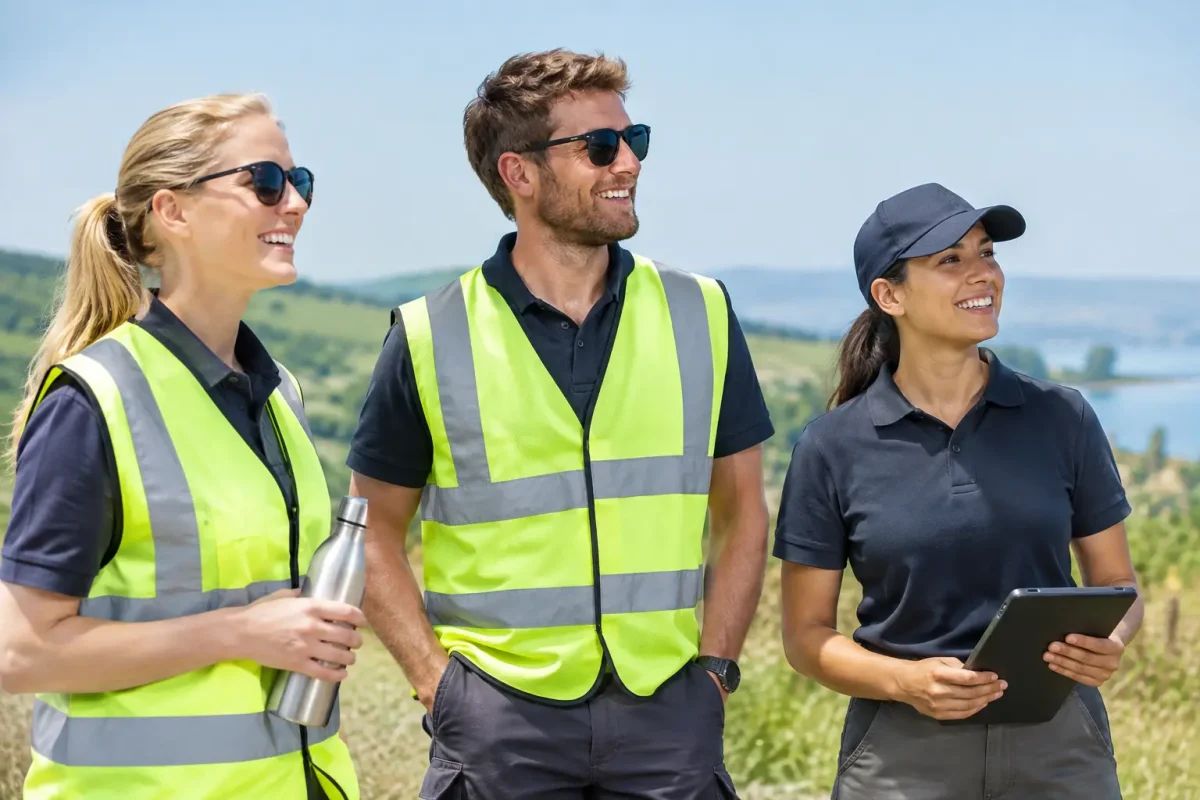
If staff work near traffic, plant, loading bays or other vehicle movements, comfort cannot override visibility requirements. Hi-vis clothing must be selected to the relevant standard and used in line with the risk assessment. A standard branded T-shirt is not a replacement for compliant hi-vis, even if it is made in a bright colour.
Warm-weather hi-vis options include lightweight waistcoats, breathable polos and T-shirts designed for the role. For teams needing full hi-vis coverage throughout the shift, a compliant polo or T-shirt can reduce the need to wear an additional waistcoat in the heat. That said, the required class of garment, sleeve length, background material and reflective tape configuration will depend on the job and site rules.
Keep branding within the areas permitted by the garment specification. Oversized decoration across reflective tape can affect visibility and may compromise compliance. A supplier should confirm suitable logo positions before production, rather than treating a hi-vis garment like any other printed shirt.
Sun exposure is also a workplace consideration. A branded cap, legionnaire-style cap or suitable neck protection may be useful for outdoor teams, subject to the task and required PPE. Headwear should never interfere with hard hats, hearing protection or other safety equipment. For workers who must wear a helmet, focus instead on breathable base layers and planned access to shade and hydration.
Match embroidery and print to the garment
A logo that looks good on a sample is not necessarily the best decoration choice for every garment. Embroidery gives polos, work shirts, fleeces and caps a durable, professional finish. It is particularly effective for chest logos and names on garments that need to look smart over a long service life.
Printing is often the better route for lightweight T-shirts, technical fabrics and larger artwork. It keeps the garment more flexible and can reproduce detailed designs, colour gradients and larger back prints more cleanly. For event crews, promotional staff and teams needing clear role identification, print can be more practical than a dense embroidered design.
Waterproof outerwear requires extra care. Embroidering through a waterproof shell creates needle holes, which can reduce its ability to keep water out. Printing is generally the more suitable option for these garments. The same principle applies to selecting a decoration size: a large, heavy logo on a lightweight performance top may affect comfort and drape, even if it is technically possible to produce.
Provide your logo in the best available format and allow time for artwork set-up. A proper logo conversion for embroidery or print avoids rough edges, lost detail and inconsistent colours between garment types. This is especially important when uniforms are ordered in stages, as the approved artwork should be used consistently for future additions.
Build a uniform range staff will actually wear
A sensible summer issue is based on enough rotation. One or two tops per employee may look economical at the point of purchase, but it creates problems when garments need washing after physical work or consecutive shifts. Issuing sufficient tops improves presentation and can extend garment life because each item is worn less often.
It is also worth offering fit and size options across the team. A uniform that pulls across the shoulders, rides up during manual work or is too loose around moving equipment will not be worn comfortably. Where roles permit, unisex and fitted options can sit within the same branded range while giving staff a better choice of fit.
For larger teams, keep the core range controlled. Too many garment styles, colours and logo positions make reordering harder and can weaken the uniform standard. A simple structure works well: approved T-shirt or polo options, an outer layer for variable conditions, role-specific trousers or PPE, and relevant headwear. Departments can then have clear colour or print variations without creating a separate uniform system for every team.
Plan fulfilment before the busy period
Summer recruitment, event schedules and seasonal contracts can turn a manageable uniform order into an admin task quickly. Confirm quantities early, including likely new starters and spare sizes. It is usually more efficient to order a small contingency than to place several urgent top-up orders once work is underway.
Think about how garments will be issued, not just delivered. Per-employee packing, labelled by name, department or size, reduces sorting time for managers and helps staff receive the correct kit first time. Bulk pallet delivery may suit event organisers and trade customers receiving large quantities, while individually sorted packs are often a better fit for multi-site teams, care providers and growing businesses.
Before approving an order, check garment sizes, colours, logo placement and the decoration method against the intended use. A sample or clear visual approval is worthwhile where the uniform is new, the logo is detailed or multiple garment types are involved. It prevents the common and costly issue of discovering that a practical decision was missed after the full run has been produced.
Well-chosen summer workwear should make the working day easier, not give managers another problem to solve. Vivid Promotion can help turn a clear garment brief and approved logo into a consistent, ready-to-issue uniform package for teams across Great Britain.