No products in the basket.
Branded Workwear
Woven Badges Versus Logo Printing for Workwear
12
Nov
Nov
A chest logo can look excellent on a sample and still be the wrong choice for a working uniform. When comparing woven badges versus logo printing, the right answer depends on the garment, the logo artwork, how the team uses the clothing and how often you expect to reorder.
For trades, care providers, schools and event teams, decoration is not just a branding decision. It affects comfort, garment life, wash performance, lead times and cost. Choose the method that suits the job rather than applying the same finish to every item.
Woven badges versus logo printing: the practical difference
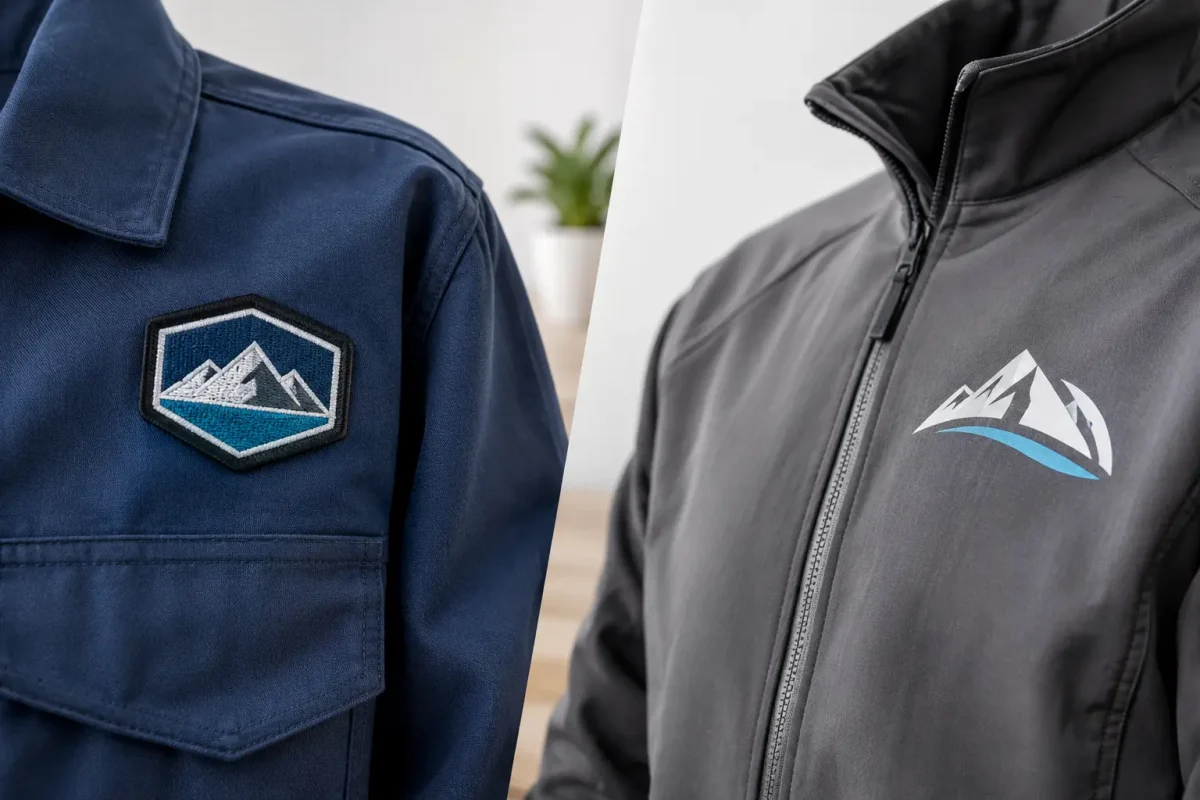
A woven badge is made by weaving fine threads together to form a logo, text or emblem. It is then attached to the garment, normally by stitching, although some badges can be supplied with heat-seal backings for suitable applications. The finished badge has a neat, flat textile surface and a defined edge.
Logo printing applies ink or a printed transfer directly to the garment. Depending on the artwork, fabric and quantity, this may use screen printing, digital transfer printing or another garment-print method. The logo sits on the fabric rather than being made as a separate component.
Neither option is automatically more professional. A compact, detailed crest may suit a woven badge. A large, bold back print on a hoodie, hi-vis vest or event T-shirt is usually better printed. The decision starts with the intended result, not with a preference for one method.
When woven badges are the better fit
Woven badges work particularly well when a logo contains small lettering, fine lines or detailed artwork that may be difficult to reproduce cleanly in embroidery. Because the design is woven rather than stitched into the garment, a badge can hold close detail without the raised texture associated with embroidery.
They are a strong choice for uniform pieces where a formal, established appearance matters. Think security teams, hospitality staff, clubs, schools, service technicians and departments that use a crest or shield-style logo. A badge can also give a consistent finish across different garment weights, from polos and fleeces to outerwear.
There is a practical benefit for repeat uniform programmes too. Once the badge design is agreed, it can be used across approved garment lines without recreating the logo directly on every product. This can be useful where several teams need the same identity but wear different garments for different roles.
However, a woven badge adds another layer to the garment. On lightweight T-shirts, close-fitting healthcare tunics or garments worn under PPE, that extra layer may not be ideal. Placement matters as well. A stitched badge is well suited to stable areas such as the chest or sleeve, but it is less suitable for large branding areas or positions that flex heavily.
Consider the attachment method
Sewn-on badges are durable and give a traditional uniform finish, but stitching requires needle penetration. That makes them unsuitable for many waterproof and weather-resistant garments because the stitch holes can compromise the fabric’s protective performance.
Heat-seal attachment avoids sewing holes, but it still needs to be assessed against the fabric and care instructions. Some coated, stretch or highly textured garments are not suitable for heat application. Always select the garment and badge attachment together rather than treating them as separate decisions.
Where logo printing performs best
Printing is usually the most flexible route for larger artwork, bold designs and multi-colour logos. It works well for front chest prints, full back branding, sleeve text, names, campaign messages and event graphics. For a construction firm needing its logo on the front and contact details on the back of work T-shirts, printing is often the sensible option.
It is also normally the better solution for waterproof jackets, softshells and other garments where sewing could damage the fabric. A correctly selected print process can apply branding without putting needle holes through the outer layer.
Printed logos are particularly useful on hi-vis clothing, where the decoration position must be planned around reflective tape and visibility requirements. A print can be placed precisely in approved printable areas, helping maintain a clear, compliant garment layout. The specific product and application should always be checked before production, especially where PPE performance is part of the purchasing requirement.
For event workwear and promotional clothing, print gives more scope. Large back designs, short-term campaign graphics, sponsor logos and variable details are all easier to achieve with print than with badges. If each employee needs an individual name or role, digital printing can be a practical way to manage that variation.
Print quality depends on the artwork and garment
A printed logo is only as good as the file and the production method chosen for it. Fine gradients, photographic imagery and complex colour transitions can be reproduced in print where a woven badge may simplify them. Conversely, very small text needs sufficient size and contrast to remain readable after printing and repeated washing.
Fabric also changes the result. Cotton, polyester, polycotton and performance fabrics do not all accept print in the same way. The best method for a cotton promotional T-shirt may not be the best option for a moisture-wicking polo or a hard-wearing work hoodie. This is why supplying the original logo file before ordering is worthwhile. It allows the artwork to be converted correctly for the chosen decoration process.
Durability: match the finish to the working day
Both woven badges and logo printing can last well when specified and applied correctly. The more useful question is what the uniform will face each week.
A sewn woven badge is highly resistant to everyday abrasion and holds its shape well over time. It is a dependable choice for polos, sweatshirts, fleeces and work jackets that are washed regularly. Its edge remains clear, which can be an advantage for logos with a recognisable outline.
A quality print should also withstand regular laundering when matched to the right garment and wash instructions. But high-friction areas need care. Branding placed where tool belts, harnesses, rucksack straps or repeated rubbing occur may wear faster than a logo positioned on a protected chest area. Large prints can also feel heavier on lightweight fabric, especially if the garment is worn through a long shift.
For teams working outdoors, do not assume that a badge is always tougher. Waterproofness, breathability and the outer fabric’s finish may be more important than the perceived durability of a stitched attachment. On a rain jacket, a suitable print is generally the better operational decision.
Cost, quantity and reordering
Budget is rarely just about the unit price. A badge has its own production and attachment stages, so it can be more cost-effective where the same detailed logo will be used repeatedly across a substantial uniform programme. It can also create a premium, consistent look on garments that stay in service for a long time.
Printing is often more economical for large logo areas, variable designs and orders with several different graphics. It is particularly useful for short-run events, staff names, time-specific promotions and campaign clothing that does not need the same long service life as a core uniform.
For mixed orders, it may make sense to use both. A facilities team could have woven badges on standard polos and fleeces, then printed logos on waterproof jackets and hi-vis outer layers. This keeps the brand presentation consistent while respecting the requirements of each garment.
When ordering for several sites or departments, standardise the approved logo size, placement and decoration method for each garment category. It reduces approval delays and makes repeat orders easier to manage. It also prevents a logo from looking different simply because it has been applied to another garment without a defined specification.
A straightforward way to decide
Start with the garment rather than the logo. Check whether it is waterproof, stretch, lightweight, hi-vis or subject to a particular care regime. Then consider where the branding needs to sit and how large it needs to be.
Next, look closely at the artwork. Detailed crests and small woven-style lettering often favour a badge. Large logos, multi-colour graphics, names and back prints normally favour printing. Finally, consider how the uniform is issued. For a long-term core range, consistency and repeat ordering may carry more weight. For an event or seasonal team, flexibility may matter more.
Vivid Promotion can help assess artwork, garment fabric and branding position before production, including orders that need to be packed by employee or department. Getting those details right at the start means the uniforms arrive ready to issue, with a finish that suits the work rather than just the first impression.
The best choice is the one that still looks clear, wears comfortably and performs properly after the uniform has done a full week’s work.