No products in the basket.
Branded Workwear
Your Guide to Ordering Branded Bodywarmers
25
Oct
Oct
A bodywarmer is often the layer staff reach for first when the temperature drops but a full jacket feels too restrictive. This guide to ordering branded bodywarmers covers the decisions that affect day-to-day wear: warmth, movement, logo durability, sizing and how the finished garments are issued to your team. Get these details right before placing the order and you avoid a uniform that looks good in a catalogue but stays in the cupboard.
Start with the job, not the garment colour
Branded bodywarmers suit a wide range of teams, from tradespeople moving between vehicles and site work to warehouse staff, event crews, grounds teams and front-of-house personnel. However, there is no single best style. The right choice depends on where the wearer works, what they do while wearing it and what sits underneath.
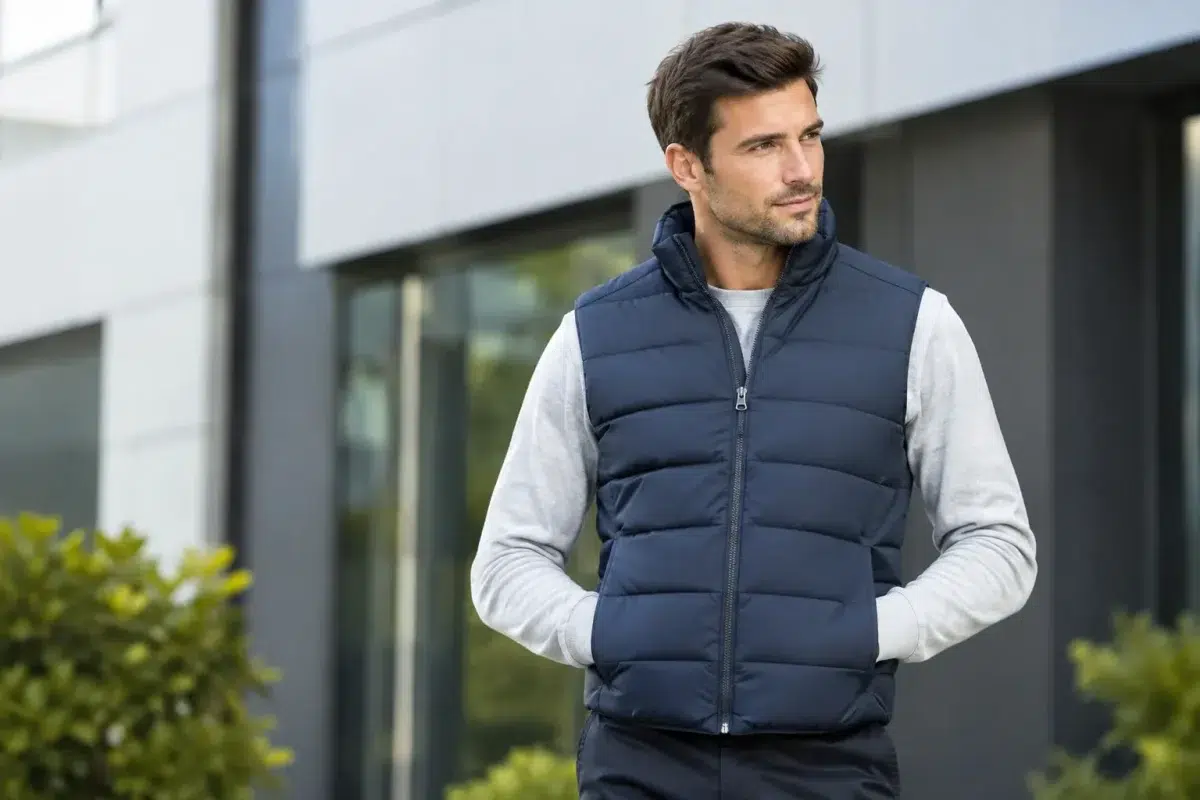
For active outdoor teams, a softshell bodywarmer is usually a sensible starting point. It offers a degree of weather protection, has useful stretch in many ranges and does not restrict the arms while lifting, driving or using tools. A fleece bodywarmer provides warmth and a familiar workwear appearance, but it is less suitable where staff regularly face wind or light rain. Padded and quilted bodywarmers give more insulation for lower-activity roles, such as gatehouse, delivery or event stewarding work, although they can feel too warm for busy manual tasks.
Consider the working environment as well. A dark navy or black garment can be practical in workshops and engineering settings, while a hi-vis bodywarmer may be needed where visibility requirements apply. If staff work near moving vehicles or on roadsides, do not assume any bright garment is compliant. Choose a certified hi-vis style where the risk assessment and site rules require it, and check that the garment remains suitable after decoration.
Choose fabric and features for real wear
The fabric tells you more about a bodywarmer than the product photograph. Look at its weight, outer finish, lining and care instructions before deciding on a range. A lightweight fleece may be right for indoor-outdoor use through spring and autumn, while a padded style is better for winter issue. For teams expected to work in wet or exposed conditions, water resistance and wind protection matter more than extra bulk.
Pockets are another operational detail that is easy to overlook. Zip pockets keep phones, keys and site passes more secure than open hand pockets. Chest pockets can be useful for staff who carry small tools, but think carefully about logo placement if a pocket sits where the embroidery would normally go. An internal pocket may matter to sales teams, supervisors and visitors carrying a phone or paperwork.
Also check the zip type, collar height and hem adjustment. A high collar adds warmth but can feel restrictive for some wearers. An adjustable hem helps keep out draughts, although dangling cords may not suit every workplace. If your team wears a harness, tool belt or radio equipment, test how the bodywarmer performs with that kit rather than assessing it in isolation.
Plan for layers and movement
Bodywarmers are normally bought as part of a uniform system, not as a standalone item. A wearer may have a polo shirt underneath in summer and a sweatshirt or hoodie underneath in colder months. Ordering a close-fitting bodywarmer because it looks smart over a T-shirt can create problems once the weather changes.
Ask staff what they normally layer underneath and use the supplier’s size guide for the specific garment. Sizing varies between brands, so a medium in one range is not necessarily a medium in another. For a larger order, a sample or size set is worthwhile, particularly where you have a mixed team or staff wearing additional PPE. It costs less to check fit before production than to replace a run of personalised garments.
A guide to ordering branded bodywarmers with the right decoration
The branding method should suit both the garment and the logo. Embroidery is a strong choice for most fleece, softshell and padded bodywarmers. It creates a durable, professional finish and works particularly well for company names, simple emblems and logos with solid shapes. A left-chest embroidered logo is the standard position for workwear because it is clear without interfering with the garment’s function.
Print can be the better option where a logo contains fine detail, colour gradients or large areas of coverage. It is also worth considering for waterproof garments. Embroidery involves needle holes, which can compromise the water-resistant outer layer. A suitable print avoids that issue and may give a cleaner result on certain technical fabrics.
Do not simply reuse the artwork from a business card or social media profile. Low-resolution files can look poor once enlarged or converted for stitching. Supply the best available version of your logo, ideally vector artwork such as AI, EPS or PDF, or a high-resolution original. The artwork should then be assessed for the chosen decoration method. Fine text may need simplifying for embroidery, while very small logo elements may not reproduce clearly on textured fleece.
Placement needs a practical check too. Left chest, right chest and upper back are common positions. A large back print can work well for events, delivery teams or site visitors who need to be identifiable at a distance. On a padded bodywarmer, however, the panel construction and seams may limit the available decoration area. Confirm the final placement against the actual garment, not just a generic visual.
If the bodywarmer will carry multiple marks, such as a company logo, staff role and accreditation badge, keep the hierarchy clear. Too much decoration can make a garment look cluttered and may increase cost without improving recognition. Usually, one consistent chest logo and a back mark where needed is enough.
Build an order that is easy to manage
A well-organised order begins with a simple wearer list. Record each employee’s name, size, garment colour and any role-specific requirements before the order is submitted. This is particularly useful when different departments need different colours, or when supervisors require a different style from the main team.
Think about quantities beyond the immediate headcount. New starters, replacements and seasonal workers can quickly turn a tightly calculated order into a second production run. Holding a small number of unbranded spare garments can be useful, but branded stock is more consistent for presentation. The right approach depends on staff turnover, budget and whether your logo is likely to change soon.
For larger teams, per-employee packing removes a considerable amount of internal admin. Instead of receiving cartons of mixed sizes that someone must sort in a meeting room or store cupboard, each wearer’s items can be packed together and labelled ready to issue. This is especially useful when bodywarmers are ordered alongside polos, hoodies, trousers or hi-vis items.
Bulk delivery also needs planning. If the garments are going to a busy site, school, depot or event venue, make sure there is someone available to receive them and a dry, secure place to store the cartons. Give enough time for artwork approval, garment availability, production and delivery. Last-minute orders often reduce your choice of styles and can create unnecessary pressure around proofing and size checks.
Keep repeat orders consistent
Once you have found a bodywarmer that works, record the garment brand, style code, colour, decoration positions and approved artwork. This avoids repeat orders drifting away from the original specification. A near-match in colour or a slightly different logo size may not sound significant, but it becomes obvious when staff stand together.
Consistency matters particularly for organisations with several locations or staggered recruitment. Centralising the specification means a new starter in Stafford, Telford or elsewhere in Great Britain can receive the same uniform standard as the original team. It also makes budget planning more straightforward because you know the garment and decoration combination you are reordering.
Check the order before production
Before approval, review the artwork proof, garment colour, sizes, quantities and decoration positions line by line. Check spelling on names, job titles and department references. Confirm whether prices include set-up, personalisation, VAT and delivery, rather than comparing headline garment costs alone.
This is also the point to flag special requirements. Some staff may need a longer fit, maternity options, a higher-visibility specification or garments suitable for a particular care, food or construction environment. A bodywarmer that suits one department may not suit another, and forcing one product across every role can lead to poor take-up.
For a first order, choose a specification that staff will genuinely wear, not just one that looks uniform on a spreadsheet. A dependable bodywarmer, correctly branded and properly packed, gives your team a useful extra layer and gives you one less uniform issue to chase when the weather turns.