No products in the basket.
Branded Workwear
How to Size Staff Uniforms Accurately at Work
29
Oct
Oct
A uniform order can look straightforward until a box of branded polos arrives and half the team need different sizes. That means delays, returns, extra admin and staff starting a shift in clothing that does not fit the job. Knowing how to size staff uniforms accurately before production starts is one of the simplest ways to protect your budget and get a consistent result.
The right approach is not to ask everyone for their usual T-shirt size and hope for the best. Garment cuts vary by brand, range and purpose. A unisex hoodie, fitted healthcare tunic and waterproof hi-vis jacket should not be sized in the same way. Use the garment’s own size chart, collect the right information and allow for how it will actually be worn on site.
Start with the garment, not the size label
A medium is not a universal measurement. One supplier’s medium polo can have a noticeably different chest width, body length or sleeve fit from another. Even within one brand, a regular-fit sweatshirt and a slim-fit workwear polo may fit differently.
Choose the garment first, then work from that product’s size chart. Check whether the measurements shown are for the wearer’s body or for the garment laid flat. This distinction matters. A chest measurement on a garment chart is often the width across the front when laid flat, which must be doubled to compare it with a body chest measurement.
The intended job should guide the choice. Office reception staff may want a neater, closer fit. Construction teams often need room to move, bend and layer clothing underneath. Care staff may need tunics and trousers that allow unrestricted movement through a full shift. For outdoor teams, a softshell or coat may need to fit over a polo, sweatshirt or fleece.
Do not switch between brands purely to save a small amount per garment without checking sizing. Consistency is usually more valuable on a team order, particularly when you expect repeat purchases later.
How to size staff uniforms accurately before ordering
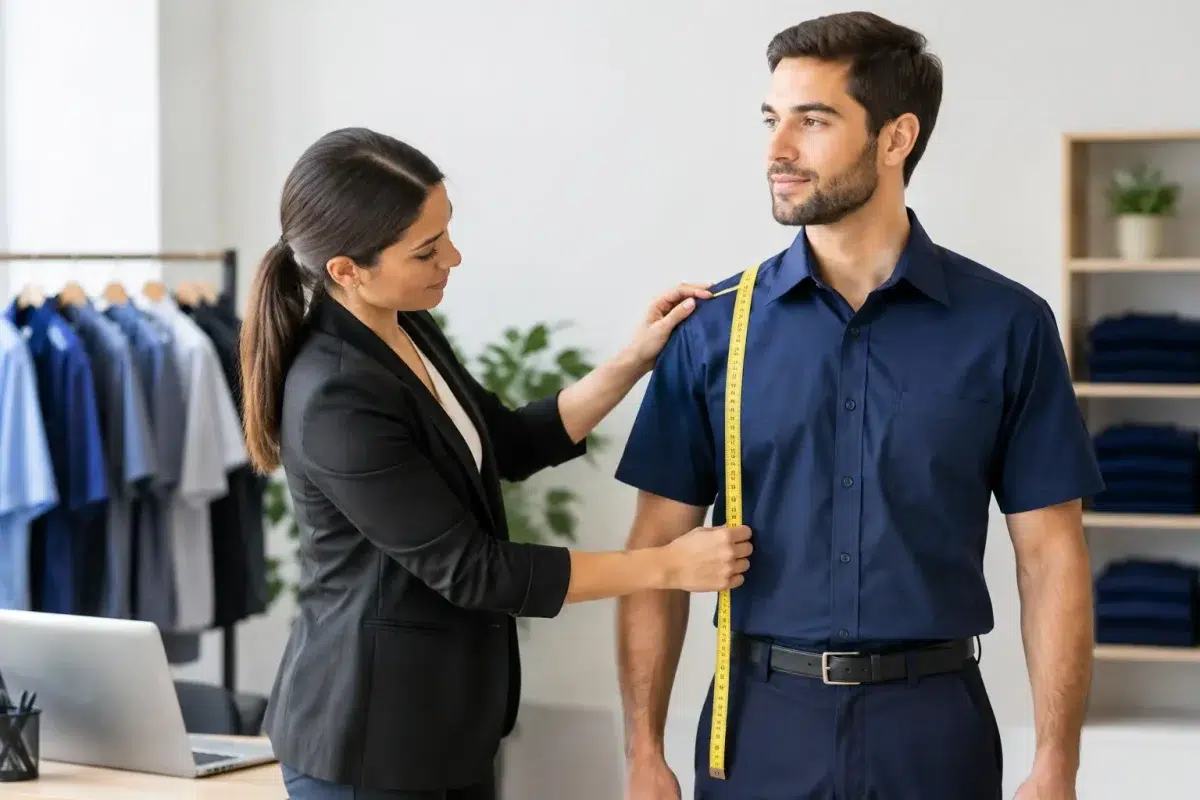
The most reliable method is to issue a measurement guide and ask staff to measure themselves over light clothing. Where possible, provide a sample size run for staff to try on. This is particularly useful for larger first orders, mixed-gender teams, fitted garments, safetywear and any role with physical demands.
For most workwear, the key measurements are straightforward:
- Chest or bust: measure around the fullest part, keeping the tape level and comfortable.
- Waist: measure around the natural waist or the point specified on the garment chart.
- Hips: essential for fitted trousers, tunics and women’s workwear.
- Inside leg: measure from the crotch seam to the desired trouser length.
- Height and body length: useful when selecting coveralls, long coats and tall or regular trouser options.
Ask staff not to pull the tape tightly or add extra room themselves. The garment size chart already includes ease – the additional space built into clothing to allow movement. Their task is to provide an accurate body measurement; your task is to select the right garment size and fit.
For a small team, a manager can collect sizes on a simple order form. For larger teams, use a standard spreadsheet with the employee name, department, garment, fit, size, quantity and any notes. This prevents a common problem: receiving a list that says only “large” without confirming whether it relates to a men’s polo, women’s fleece or unisex jacket.
Use samples when fit affects performance
Size charts are essential, but samples remove doubt. They are worth considering when uniforms are being introduced for the first time, when changing garment brands, or when you are buying items that staff will wear for long shifts.
A try-on session does more than identify sizes. It highlights practical issues before you commit to decoration and production. Staff can check whether a jacket lifts at the waist when reaching overhead, whether a polo is long enough when bending, or whether a tunic pulls across the shoulders when moving patients or equipment.
For roles that require PPE, fit can affect safety as well as comfort. Hi-vis clothing should allow normal movement and layering without being excessively loose around machinery. Coveralls must be long enough in the body and leg, but not so oversized that sleeves or hems create a snagging risk. If a garment is required to meet a particular safety standard, do not alter its intended use by choosing an unsuitable fit or covering reflective areas with decoration.
Samples also help when teams have strong preferences around cut. Offering a choice of men’s, women’s or unisex fits can improve uptake and presentation, but it creates more lines to manage. For a highly mobile workforce or a time-sensitive rollout, one dependable unisex range may be easier to issue and reorder. It depends on the workforce, the garment and how much choice your process can support.
Allow for layers, movement and the working environment
The right uniform size is not always the closest fit. Think about what sits underneath and what the person does during a normal shift.
A warehouse operative may wear a base layer and sweatshirt under a bodywarmer in winter. A site engineer may need a waterproof jacket over several layers. Ordering an outer layer in the same size as a lightweight polo can make it restrictive, especially across the shoulders and upper arms.
Conversely, adding unnecessary extra room to every garment can look untidy and affect comfort. Oversized polos can catch when lifting; loose trousers can become a trip hazard. The goal is functional ease, not simply a bigger size.
Ask a few operational questions before finalising the order. Will the team work indoors or outdoors? Is the uniform worn all year or only during warmer months? Does the role involve driving, climbing, kneeling, lifting or frequent reaching? Are staff expected to wear personal protective equipment over or under the garment? The answers should shape both garment selection and size allowance.
Treat trousers, coveralls and healthcare uniforms separately
Upper-body garments are often easier to size than lower-body workwear. Trousers need a waist and leg measurement, and different cuts can change the fit considerably. Cargo trousers may be worn more comfortably with room through the thigh, while smart healthcare trousers may need a more precise waist and hip fit.
Where possible, offer regular and long leg options rather than asking taller staff to size up at the waist just to gain length. A larger waist does not solve a short inside leg, and it produces a poor fit.
Coveralls need particular care because chest, waist, height and inside leg all interact. A wearer who is broad in the shoulders may need a different size from the one suggested by their waist alone. Always refer to the specific coverall chart and use a sample if the team will be wearing them for physical work.
Healthcare uniforms have their own considerations. Tunics should fasten comfortably without pulling across the bust, back or hips, while trousers need sufficient movement for long shifts. Staff should try bending, sitting and reaching during a sample fitting rather than judging the garment only while standing still.
Build sizing into the ordering process
The best sizing process is one that can be repeated without relying on memory. Keep a record of confirmed sizes by employee and garment range, including whether the item is men’s, women’s or unisex and whether it is regular or long leg. This makes top-up orders far quicker and reduces the risk of ordering a familiar size in a different fit.
For new starters, use the same measuring guide and garment range as the original order. Avoid substituting a similar-looking item if the original is still available, as it may fit differently and produce an inconsistent appearance across the team.
Before approving branded production, check the final order against your staff list. Look for unusual patterns: a whole department requesting one size, a person ordering radically different sizes across similar items, or an outer jacket smaller than the sweatshirt intended to go beneath it. These are not always errors, but they are worth confirming.
If you are ordering for events, schools or a temporary workforce, build in a modest contingency across the most common sizes rather than guessing heavily at either end of the size range. Spare garments are useful, but a large surplus of unsuitable sizes ties up budget and storage space.
Decoration can affect comfort and garment choice
Embroidery and print do not normally change the size required, but they can affect how a garment feels. A large embroidered design can add weight and stiffness, particularly on lighter polos or thin work shirts. Positioning and design scale should suit the garment as well as the logo.
On waterproof garments, print is often the better option because embroidery requires needle holes through the fabric. This is a garment-performance decision, not just a branding preference. The same practical thinking should apply across your order: select the right garment, decoration method and fit for the working environment.
For larger rollouts, per-employee packing can make issuing uniforms much easier. When each person’s approved garments are grouped and labelled, site managers are not left sorting mixed sizes and departments from a bulk delivery.
Getting sizing right is not about chasing a perfect number on a label. It is about giving each member of staff clothing that works through a full shift, supports the role and presents your organisation properly from day one.