Branded Workwear
College Leavers Hoodie Project Example That Works
Jul
A leavers hoodie order can look straightforward until the name list arrives: duplicate spellings, late joiners, pupils wanting different sizes, and a deadline fixed by the final day of term. This college leavers hoodie project example shows how to set up an order that is easy to approve, accurate to produce and practical to hand out.
The aim is not simply to put a year group design on a hoodie. It is to give students a garment they will wear, while giving the college administrator a controlled process with clear artwork, one confirmed data source and delivery arranged around the academic calendar.
The brief: a realistic college leavers hoodie project example
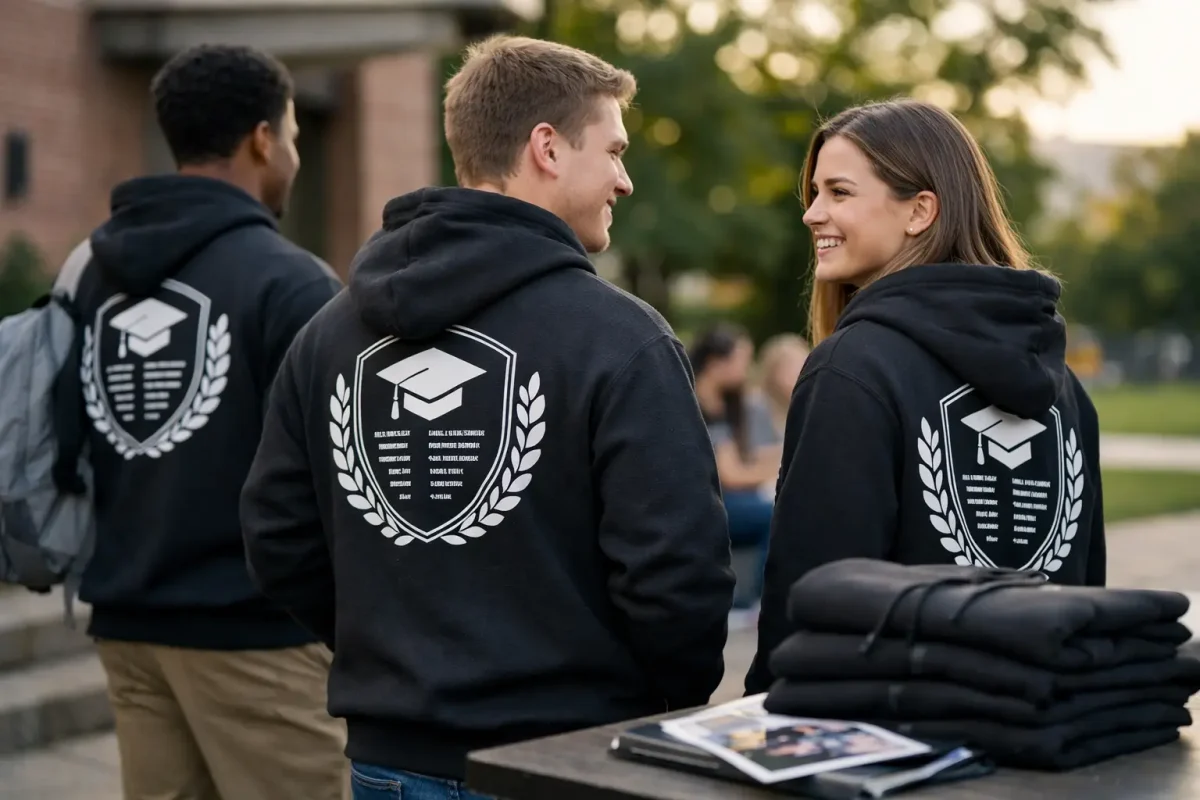
A sixth form college has 180 Year 13 students leaving in June. The student committee wants a dark hoodie with the college crest on the front left chest, a large `Leavers 2026` design on the back, and every student’s surname worked into the back artwork. The college needs the hoodies ready for collection two weeks before the final celebration event.
The committee initially asks for four hoodie colours, individual nicknames on sleeves and a different back design for each tutor group. All are possible, but each variation adds decisions, artwork checks and a greater chance of an incorrect garment being issued. For this size of order, the more dependable route is one garment colour, one approved front print and one shared back design containing surnames.
The final brief is agreed as follows: a navy heavyweight hooded sweatshirt in a unisex size range, white print on the back, a two-colour college crest on the chest, and individual clear bags labelled by student name and tutor group. This protects the design, keeps the order manageable and removes most of the sorting work from college staff.
Start with the garment, not the artwork
The design gets attention first, but the hoodie is the item students will judge after the photographs have been taken. Choose a garment with enough weight to hold its shape, a good range of adult sizes and a colour that gives the print sufficient contrast. A lightweight promotional hoodie may meet a tight budget, but it is less likely to feel like a keepsake or stand up to regular wear.
For a typical college order, a cotton-rich or cotton-faced hoodie gives a reliable surface for printed artwork and a familiar feel. Consider whether a pullover style is right for the cohort. Zip hoodies are useful for staff or practical work settings, but the front zip breaks up chest artwork and normally costs more. A pullover is usually the cleaner choice for a leavers design.
Colour needs a practical sign-off too. Black, navy, burgundy and charcoal are popular because they suit most students and make light print stand out. Pastel shades can work well for a particular college identity, but pale garments can show marks more readily. If the design includes many names in fine lettering, avoid a colour combination with weak contrast. It might look acceptable on a screen and become difficult to read on a finished garment.
Build artwork that can be checked properly
A leavers back print often uses a large year number filled with student surnames. It is an effective format, provided the name data is correct before artwork is finalised. The largest risk is not print quality. It is a misspelt name, an omitted student or a name included when that student has opted out.
Use one spreadsheet as the master record. It should show the student’s preferred printed surname, garment size, tutor group, payment or eligibility status where relevant, and whether the name is approved for the design. Do not combine separate class lists just before production. Ask the college to nominate one person to own the final spreadsheet and set a firm cut-off date for amendments.
The front crest should be supplied in the best available format, ideally a vector artwork file or a high-resolution original. A screenshot copied from a website can appear blurred or jagged once printed. Where a logo needs converting for print or embroidery, allow time for artwork preparation and approval rather than treating it as an automatic step.
For this project, a print proof would show the front crest at actual placement size, the back design at scale and a readable list of all names. The approver should check every detail against the master sheet, not simply approve the overall look. Once the proof is signed off, changes can mean revised artwork, extra setup and delays.
Print or embroidery for leavers hoodies?
For a large name-filled back design, garment printing is the sensible method. It keeps fine names legible and allows the whole design to sit flat on the fabric. Printing is also generally better suited to detailed, multi-element artwork across a large area.
Embroidery can be a strong choice for a simple crest or small college logo on the chest. It gives a raised, durable finish, but it is not appropriate for dozens or hundreds of tiny names. Combining an embroidered chest logo with a printed back is possible, though it increases production steps and cost. It depends on the budget, the detail in the crest and whether a more formal finish is worth the additional spend.
Set a timetable backwards from the hand-out date
The hand-out date is the important date, not the day the order is placed. Work backwards and leave room for internal collection, size queries and the occasional late correction. For an order of 180 hoodies, the college should aim to finalise data and artwork well before the final fortnight of term.
A workable schedule might allow two weeks for collecting sizes and names, several days for artwork proofing, a defined production period once approval is received, then time for delivery and distribution. The exact lead time will vary with garment availability, decoration complexity and the time of year. April to June is busy for leaverswear, so delaying approval until the last moment limits the available options.
Do not promise students a specific delivery day until the garment, artwork and order data are confirmed. A supplier can only produce accurately from an approved brief. A clear deadline message to students is more useful than repeatedly reopening the list for late requests.
Make size collection easier to manage
Sizing is one of the few details that cannot be fixed after the garment has been printed. Publish the garment size guide alongside the order form and, where possible, provide sample sizes for students to try. A size marked as medium is not identical across every brand or fit, so avoid collecting vague responses such as “usual size”.
A simple form should collect the student’s full name, printed name confirmation, hoodie size, tutor group and contact details if the order is individually paid. If the college is funding the order, the payment field is not needed, but a clear confirmation process still matters. Keep the data in a format that can be checked and transferred without retyping.
For cohorts with mixed needs, consider whether a unisex garment covers the required size range. It often does, but do not assume. Check the actual chest measurements and availability of smaller and larger sizes before the design is approved. Ordering a small number of spare plain hoodies can help with late enrolments or a genuine sizing issue, although they cannot carry the full name design unless they are planned in advance.
Plan delivery around distribution, not just transport
A completed order still creates work if 180 hoodies arrive in mixed boxes that must be sorted in a college office. Specify the packing requirement at the beginning. Individual packaging labelled with the student’s name, and grouped by tutor group where useful, allows staff to issue garments quickly and makes missing items easier to identify.
For the example project, the college provides the final list sorted by tutor group. Each hoodie is packed separately, labelled with the student’s name and placed into the relevant group carton. The administrator can hand each carton to a tutor rather than spend an afternoon checking garments against a printed list.
Check the delivery address, site access and term-time opening arrangements early. A reception desk may not be able to accept multiple cartons without notice, and a college site can have restricted delivery times. If the hoodies are needed for an event, arrange delivery before the event week wherever possible. That gives the team time to resolve any genuine issue without putting the celebration at risk.
Keep student choice from becoming order complexity
Students value choice, but unlimited choice is rarely a good fit for a shared college order. Every additional colour, sleeve print, personalised nickname or garment style creates another version to check, pick and pack. It can also make the final artwork feel less consistent.
If the committee wants individualisation, use one controlled option. For example, offer either a standard surname within the back design or a separately printed first name on the sleeve. Set one spelling rule and one deadline. Do not accept requests through informal messages, as these are difficult to audit against the final order sheet.
A good leavers hoodie project balances a memorable design with a production process that can be controlled. Vivid Promotion can support that process with suitable garment options, print-ready artwork checks and packing arranged for straightforward issue. Get the master list, sample approval and delivery plan settled early, and the final hand-out becomes a positive end-of-term job rather than a last-minute sorting exercise.