No products in the basket.
Branded Workwear
Guide to Branded Workwear Fulfilment UK
27
Jun
Jun
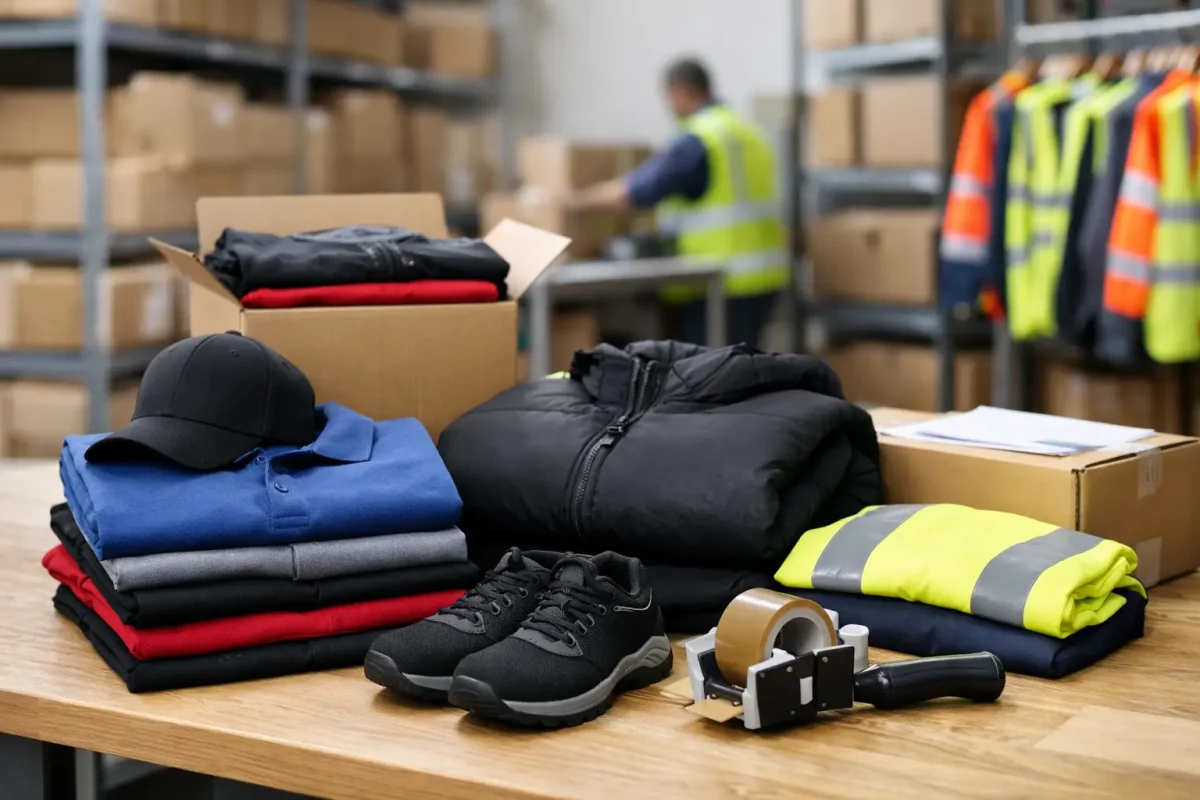
If your team uniform arrives as mixed sizes in open cartons, with logos that vary from one batch to the next, the problem is not only clothing. It is fulfilment. This guide to branded workwear fulfilment UK is for employers and buyers who need branded garments ordered, customised, packed and delivered in a way that saves time once they land on site.
For most organisations, the pressure point is not choosing a polo shirt or fleece. It is getting the right items to the right people, in the right branding format, without creating extra admin for office staff, depot managers or site supervisors. That matters whether you are ordering embroidered polos for a trade team, hi-vis PPE for a contractor, tunics and scrubs for care staff, or leavers hoodies for a school.
What branded workwear fulfilment actually covers
Workwear fulfilment starts well before dispatch. It includes garment selection, logo setup, choosing the correct decoration method, approving artwork, managing stock, applying branding consistently, and packing orders in a way that makes sense for your organisation.
That last part is often where buyers feel the difference. Bulk pallet delivery may suit events, trade resellers or a central stores operation. Individually packed employee orders are usually better for distributed teams, new starter issue, healthcare departments and any business trying to avoid sorting garments by hand in the office.
A supplier that only prints or embroiders garments is not necessarily handling fulfilment properly. A supplier with a proper fulfilment process is set up to reduce friction after production, not add to it.
A practical guide to branded workwear fulfilment UK buyers can use
The best place to start is with how your team will actually use the clothing. Office buyers sometimes begin with logo size or garment colour, but operationally that is backwards. First decide what the wearer needs the garment to do.
Trades and construction teams usually need durability, easy movement and weather protection. Healthcare teams need practical uniforms that can be reordered by role or department. Event teams may need strong visual branding and fast bulk delivery to one venue. Schools often need size runs and named packing that make handout straightforward.
Once the use case is clear, garment choice becomes easier. T-shirts and polos are common for light daily wear. Sweatshirts, hoodies and fleeces suit cooler conditions or layered uniforms. Softshells and coats are better for outdoor teams. Trousers, coveralls and hi-vis ranges need a closer look at compliance, site rules and wear rate.
This is also where it pays to buy by category rather than by one-off product. If you need a full uniform, it is better to build a set that works together across seasons than to order isolated items and patch the gaps later.
Choose decoration around the garment, not habit
A lot of buyers default to embroidery because it feels durable and smart. Often that is the right call, especially on polos, sweatshirts, fleeces, bodywarmers and many jackets. It gives a clean, professional finish and holds up well in repeated wear.
But embroidery is not right for everything. Waterproof garments are the obvious example. Stitching through a waterproof layer can create needle holes, which is not what you want from outerwear designed to keep staff dry. In those cases, print is often the better option.
Print also works well for larger logos, back prints, event branding and garments where a lighter finish is preferable. The point is simple: the decoration method should suit the fabric, the use and the logo. A good fulfilment process catches that early, before production starts.
Get the logo setup right first time
Bad logo setup causes delays, weak branding and inconsistent reorders. If your logo has been lifted from an old email signature or website screenshot, it may not convert cleanly for embroidery or print. Fine lines, tight lettering and low-resolution artwork can all cause problems.
For embroidery, the logo needs converting into a stitch file that holds its shape at the size you need. For print, it needs to be prepared so colours and edges reproduce properly across different garments. That is skilled production work, not an afterthought.
If you expect repeat orders, this stage matters even more. Once the logo is set up correctly and approved, future orders become faster and more consistent.
Fulfilment decisions that save time later
The main reason businesses review their uniform supply is usually not price alone. It is the wasted time around ordering, sorting and issuing. A cheaper garment can become an expensive purchase if your team spends hours breaking down boxes and matching sizes to staff names.
Per-employee packaging is one of the clearest ways to remove that burden. If each person’s order is packed separately, labelled properly and delivered ready to issue, your admin load drops immediately. This is especially useful for multi-site teams, onboarding waves, healthcare staff by department, and seasonal recruitment.
Bulk pallet delivery still has its place. For exhibitions, events, resellers and larger rollouts, a consolidated delivery can be the most efficient route. It depends on who will receive the goods and how they will be distributed afterwards.
The right option is the one that fits your operation. Fulfilment is not only about getting garments out of the door. It is about reducing handling at your end.
Lead times, stock and repeat ordering
Uniform buying gets messy when nobody plans for repeat demand. New starters join, garments wear out, departments change, and seasonal peaks arrive earlier than expected. If your first order is treated as a one-off, the second order often exposes the weak spots.
Ask practical questions early. Is the garment a stable line or likely to be replaced? Are core colours consistently available? Can the same branding setup be reused across multiple garment types? How quickly can top-up orders be turned around?
For UK buyers, reliable nationwide shipping matters just as much as production quality. If you are coordinating teams across Great Britain, lead times need to be consistent, not vague. A supplier based in the Midlands with strong production and dispatch processes can often support that well because distribution is workable in every direction.
This is where an organised ecommerce-led catalogue also helps. If buyers can reorder by garment type, profession, department or bundle, purchasing becomes quicker and less prone to error. That is useful for procurement teams and just as useful for smaller firms where the owner is also doing the buying.
Compliance and suitability are part of fulfilment
Branded workwear is not always just branded clothing. In many sectors, compliance sits alongside presentation. Hi-vis garments need to be appropriate for the task and environment. Healthcare uniforms need to suit role requirements, laundering expectations and staff comfort. Work trousers and outerwear need to match actual site conditions.
That means fulfilment should not treat every garment the same. A printed hoodie for a promotional team and a high-visibility jacket for roadside work are different purchases with different risks if specified badly.
It is worth slowing down at this stage. The wrong garment may still look branded and presentable, but if it is not suitable for the work, you will be replacing it sooner or dealing with complaints from the people wearing it.
What to look for in a workwear fulfilment partner
A proper partner should be able to guide you through garment choice, advise on embroidery versus print, prepare your logo correctly, and offer packing options that reflect how your organisation issues clothing. That is the operational baseline.
It also helps if the catalogue is broad enough to cover day-to-day uniform, outerwear, hi-vis PPE, healthcare clothing and accessories in one place. Buyers do not want to juggle separate suppliers for polos, jackets and specialist items if consistency matters.
Vivid Promotion is built around that practical model – custom branded workwear, clear decoration advice, and fulfilment options that help businesses issue uniform without creating extra sorting work internally.
Common mistakes in branded workwear fulfilment UK orders
The most common mistake is ordering around unit price instead of total handling cost. The second is choosing garments before thinking about the job role. The third is assuming one branding method suits every item.
Another common issue is failing to plan for growth. If you are ordering for 25 staff today but expect 40 within six months, your setup should make repeat ordering easy. A good system at the start avoids patchwork uniform later.
The best branded workwear fulfilment UK setups are usually the least dramatic. Orders are clear, branding is consistent, deliveries arrive as expected, and your team can issue garments without turning the stockroom into a sorting bench.
If you are reviewing your current setup, focus less on who can simply put a logo on clothing and more on who can get the right garments branded, packed and delivered in a way that makes the next order easier than the first.