No products in the basket.
Branded Workwear
Case Study Per Employee Uniform Packing
19
Jun
Jun
A uniform order for 80 staff can look straightforward on paper, then turn into half a day of sorting polos, checking size swaps and chasing missing items across departments. That is exactly where case study per employee uniform packing becomes useful. It is not just a packing preference. It is a fulfilment method that cuts internal handling, reduces issue-day mistakes and helps teams get branded clothing into use faster.
For operations managers, school administrators, care providers and site supervisors, the real cost of uniform is rarely only the garment. It is the admin wrapped around it. Someone has to split the order, label it, check names, handle late starters and answer the inevitable question of who has not received what. If each employee pack arrives already grouped, that process changes from sorting stock to issuing stock.
What per employee uniform packing solves
Bulk uniform delivery works well in some settings. If every team member wears the same product in the same colour and there is a stores person on site, cartons by garment type can be efficient. But that is not how many businesses buy. Most orders include a mix of sizes, garment types and branding positions, with some staff needing extras such as hi-vis outerwear, healthcare tunics or department-specific colours.
That complexity is where errors creep in. A sweatshirt ends up with the wrong person because two employees wear the same size. One starter receives everything except their fleece because it was packed in a different carton. A manager then spends time opening boxes, counting pieces and rebuilding sets. The packing line may have done its job, but the employer is still left doing the last stage of fulfilment.
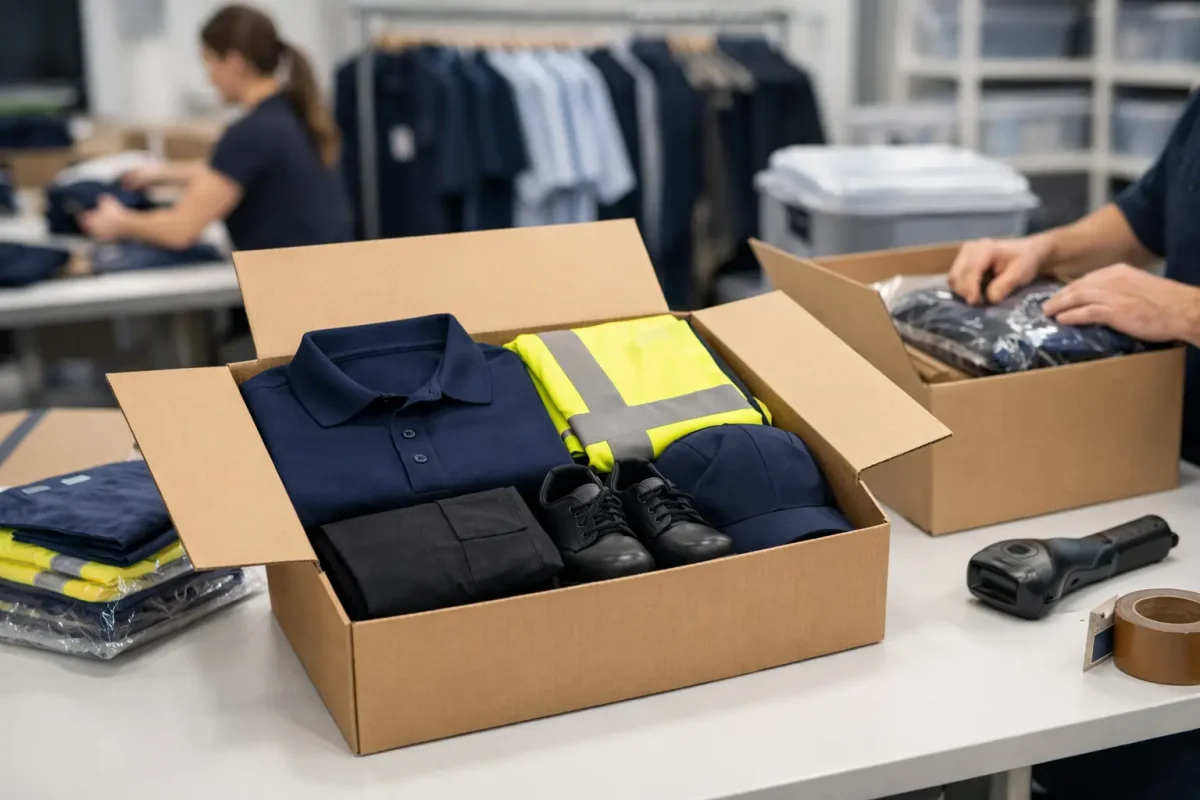
Per employee packing shifts that stage back to the supplier. Each worker’s allocation is grouped together so the employer receives complete issue-ready packs rather than loose stock. It sounds simple because it is simple. The value sits in the time it saves and the accuracy it improves.
A practical case study per employee uniform packing example
Take a regional care provider onboarding 46 staff across two locations. The order included embroidered polos, fleeces, softshell jackets and healthcare trousers, with different combinations depending on role. Senior carers needed one set, support staff another, and supervisors had an additional outer layer. A standard bulk delivery would have produced separate cartons by product, then left the customer to sort the contents at both sites.
Instead, the order was built around individual named packs. Each employee’s garments were checked against the approved order, decorated, matched by size and role, and packed together for issue. The customer did not need to create an internal spreadsheet to reconcile products against people because the packaging already reflected the intended allocation.
The result was less friction on day one. Site managers were not opening mixed cartons and laying garments out on tables to work out who was missing a medium fleece or which navy polo belonged to which starter. They were simply handing over the right pack to the right employee.
That matters more than it might appear. In healthcare and care settings, managers do not usually have spare time to run a mini warehouse operation. The same applies on construction sites, at events and in schools. Uniform is necessary, but sorting it is not productive work.
Where the time savings actually come from
The main saving is not in transport. It is in internal handling after delivery. If a business receives 46 employee packs instead of 12 mixed cartons, there is far less need to count, sort and relabel. Admin staff spend less time cross-checking delivery notes against individual requirements. Line managers spend less time issuing garments one by one from a pile of stock.
It also reduces the hidden back-and-forth that follows many bulk orders. When packs are pre-sorted, there are fewer calls saying an item is missing when it is actually sitting in another carton. There are fewer size disputes caused by garments being issued to the wrong person. And if a replacement is genuinely needed, it is easier to identify because the original allocation is clearer.
Accuracy improves because the pack matches the employee
Uniform errors are often small but disruptive. One wrong size in a polo can be inconvenient. One wrong size in a hi-vis waterproof or embroidered tunic can delay use and create extra cost. Per employee packing gives the final quality check a clearer focus. Instead of only verifying total quantities, the packing process verifies the contents of each named set.
That is particularly useful where orders include mixed decoration methods. For example, embroidery may suit polos, sweatshirts and fleeces, while print may be the better option for waterproof garments where needle holes are best avoided. If one employee’s pack includes both types, it helps to assemble the complete set around the person, not around the product line.
When case study per employee uniform packing makes the most sense
This approach is most useful when the order has multiple variables. Different staff roles, varied garment combinations, several delivery points or phased onboarding all increase the value of sorted packs. New starter packs are another clear fit because each person needs a defined issue rather than access to general stock.
It is also a strong option for businesses with no dedicated stores function. Plenty of SMEs, care groups and event operators do not have a warehouse manager waiting to break down pallets. Uniform may be received by reception, admin or a site lead. In those cases, packaging needs to do more of the work.
That said, it depends on the order profile. A simple run of 300 identical printed T-shirts for a one-day event may not need per employee sorting. Bulk pallet delivery could be the cleaner and more cost-effective method. The right packing structure should follow how the clothing will be issued, not a one-size-fits-all rule.
The operational details that make it work
Good per employee packing starts long before the goods are boxed. The garment list needs to be structured correctly at order stage, with clear names, sizes, product allocations and any department differences. If the input data is weak, the output will be weak as well.
Decoration approval matters too. Logos should be converted properly for embroidery or print so production is consistent across the whole order. There is little point in packing each employee’s items perfectly if the branding differs between garments or the chosen method is not right for the fabric.
The final step is disciplined pick and pack. This is where a supplier earns their keep. Matching garments by employee, not just by SKU, requires control on the packing bench. It is not glamorous, but it is the part the customer notices when issue day runs smoothly.
What buyers should ask before placing the order
If you want per employee packing to save time, be clear about how your team is structured. Confirm whether packs need to be named, grouped by department or split by site. Explain whether you are issuing everything at once or holding some stock for staged starters.
You should also flag exceptions early. Some employees may need specialist PPE, maternity fit, tall sizes or additional layers for outdoor work. Those are exactly the details that cause delays when they are added late or buried in a spreadsheet note.
For repeat orders, the process gets easier if the original structure is retained. Once a supplier understands that your supervisors need one combination, your engineers another and your office staff a third, reordering becomes more predictable. That consistency is part of the service, not an extra.
Why this matters beyond packing
Per employee packing is really about reducing friction in uniform management. It helps businesses issue branded clothing faster, with fewer errors and less internal effort. That is useful whether you are kitting out ten people or several hundred.
At Vivid Promotion, the practical advantage is simple: the uniform arrives in a format that matches how employers actually need to hand it out. For buyers responsible for staff presentation, compliance and admin time, that is often the difference between a straightforward rollout and a long morning spent sorting boxes on the floor.
If your next order includes mixed garments, multiple roles or more than one location, it is worth treating packing as part of the solution rather than an afterthought.