Branded Workwear
How to Choose Embroidered Scrubs Properly
Jun
A scrub top that looks fine on a product page can become a problem the moment it hits a real shift. Necklines sit awkwardly, pockets are too shallow, fabric runs hot, and the embroidery ends up too stiff or too large for the chest panel. That is usually where buyers realise that knowing how to choose embroidered scrubs is not just about picking a colour and adding a logo. It is about getting the garment, decoration and ordering process right from the start.
For care providers, clinics, dental practices and healthcare teams, scrubs have to work hard. They need to be comfortable across long shifts, present a consistent brand image and stand up to frequent washing. If you are ordering for a team rather than for one person, the decision matters even more because small mistakes get multiplied across every pack, every department and every reorder.
How to choose embroidered scrubs for daily use
Start with the job the scrubs need to do. A GP surgery, care home, hospital department and beauty clinic may all wear scrubs, but they do not use them in exactly the same way. Some teams need lightweight fabric for warm indoor settings. Others need more structure, stretch and storage because staff are constantly moving, lifting or carrying essentials during a shift.
That is why fabric should be one of your first checks, not an afterthought. Polyester-rich blends tend to hold colour well and cope with regular commercial laundering, while cotton blends can feel softer and cooler against the skin. Stretch fabrics are useful for roles with a lot of movement, but they can change how embroidery sits if the logo area pulls across the chest. There is a trade-off here. A very soft, flexible scrub may feel better to wear, but it may not give the cleanest surface for embroidery.
Weight matters too. Heavier fabric can feel more substantial and often looks smarter for longer, but it may be too warm for some indoor healthcare settings. Lighter fabric is easier to wear over a long shift, although it may show creasing sooner and can feel less durable if the garment is at the lower end of the market. If your team works in a demanding care environment, it usually makes sense to prioritise durability over the lowest unit price.
Fit matters more than buyers expect
Poor fit causes more complaints than embroidery ever does. If staff are pulling at sleeves, adjusting waistbands or finding the tunic too short when bending, the uniform is not doing its job. For that reason, sizing and cut need careful attention before you approve a full order.
Unisex scrubs can simplify ordering, especially for mixed teams, but they are not always the best answer for comfort or appearance. Some organisations get better results from offering men’s and women’s fits, particularly where presentation matters and staff are customer-facing. That said, separate fit options can add admin if you are collecting sizes across a larger workforce. It depends on whether your priority is maximum simplicity or a better tailored result.
Look closely at the practical features as well. Side vents, elasticated waists, drawcord trousers and pocket layout all affect day-to-day use. A team in a care setting may need enough pocket space for gloves, pens and handover notes. In other environments, a cleaner profile may be preferred. These details are not minor. They often decide whether a scrub set gets worn willingly or only because there is no alternative.
If you are buying at scale, sample sizes are worth the effort. Size charts help, but they do not tell you how a garment feels over a twelve-hour shift or after repeated washing. A short trial with a few staff members will usually save time and cost later.
Choosing the right embroidery for scrubs
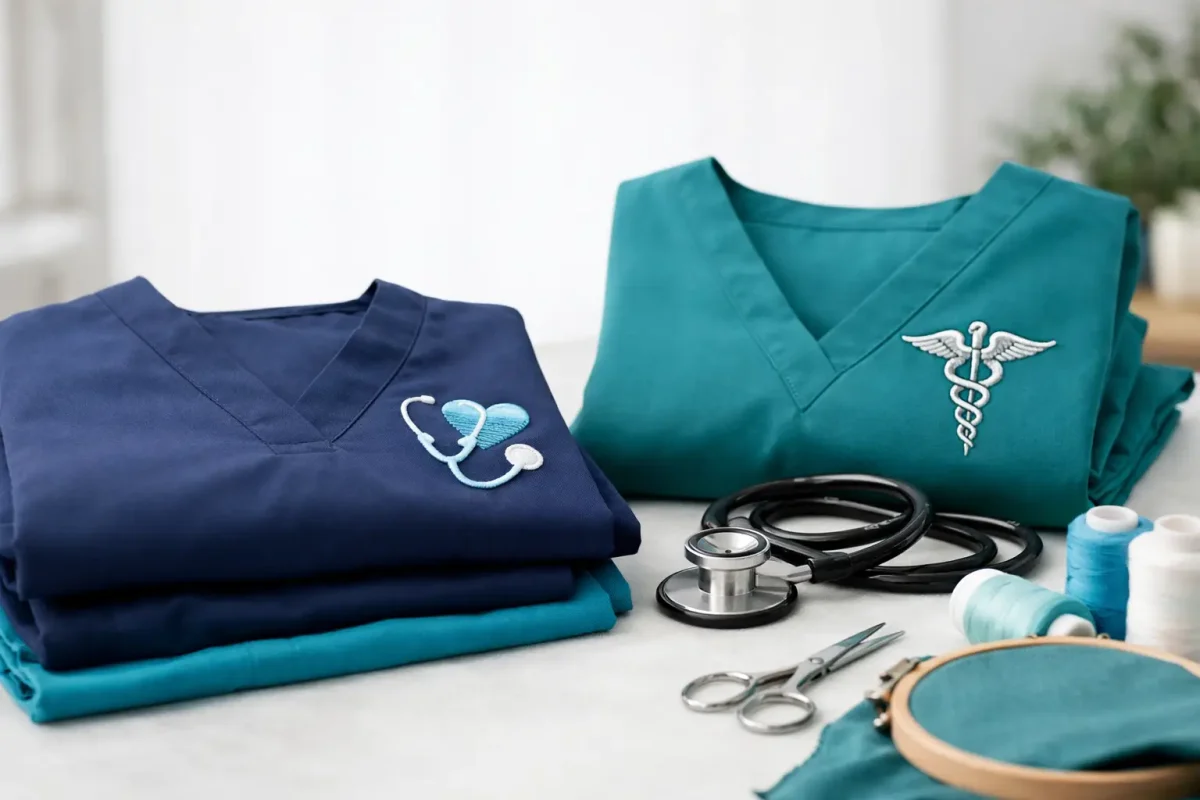
Embroidery suits scrubs well because it gives a professional, durable finish that stands up to repeat wear and washing. For clinics, practices and care teams, it generally creates a smarter, more established look than print. But the logo still needs to be handled properly.
The first issue is placement. The left chest is the standard choice for most embroidered scrubs because it is visible, tidy and practical. It works for company logos, care home names and healthcare branding without getting in the way. Sleeve embroidery can work in some cases, especially for extra department detail, but it is usually secondary. Large back embroidery is less common on scrubs and can feel unnecessary in a clinical environment.
Logo size needs restraint. Buyers sometimes try to enlarge a logo for visibility, but on scrubs that can make the chest area feel heavy and look out of proportion. A smaller, clean embroidery usually works better. The garment is not a billboard. It is workwear.
Then there is the logo itself. Fine detail, tiny lettering and tonal colour changes do not always convert neatly into embroidery. What looks sharp in a digital file may not sew well onto fabric. A supplier with proper logo conversion experience should advise if simplification is needed so the finished result stays readable and consistent. This is one of those areas where getting the detail right upfront prevents disappointment later.
Thread colour should also be checked against the scrub shade. Contrast is important, but so is clarity. Navy embroidery on black scrubs may match a brand guideline on paper, yet it can disappear in practice. Likewise, a very bright thread on a softer healthcare uniform can look harsh. The best result is usually a balance between brand consistency and real-world visibility.
How to choose embroidered scrubs for team ordering
When ordering for a team, the garment itself is only part of the decision. You also need a process that makes issuing the uniform straightforward. That means thinking beyond style and into admin.
If you have multiple departments, decide early whether everyone will wear the same scrub range or whether colours and embroidery will identify different roles. Department colours can help with visibility and internal organisation, but they also make stock control and reordering more complex. A single core range is easier to manage. A department-based approach gives clearer visual separation. Neither is automatically better.
You should also decide whether names or job titles need adding. Embroidered names can help patients and residents identify staff more easily, especially in care settings. The downside is that personalised garments are harder to reissue if someone leaves. For businesses with high turnover, logo-only embroidery is often the more practical route.
Packaging and fulfilment matter more than many buyers expect. A bulk delivery of mixed sizes in plain cartons can create hours of sorting internally. For larger orders, it helps to work with a supplier that can organise garments by employee, team or site so the uniform is ready to issue. That is often where procurement teams save time, not just on the buying stage but on the rollout itself.
Price, durability and repeat ordering
Cheap scrubs rarely stay cheap if they need replacing too soon. The better way to judge value is to look at cost across the life of the garment. If a scrub set holds its shape, colour and embroidery after repeated washing, it is usually the better buy even if the unit cost is higher.
Consistency matters as well. If you plan to reorder every few months as staff join or departments expand, choose a range that is likely to remain available. Switching scrub styles mid-year often creates mismatch across the team. That can affect appearance and complicate embroidery setup, especially if the logo placement area changes from one garment to another.
This is why many buyers prefer to work with a supplier that can support repeat orders properly rather than treating each purchase as a one-off. Vivid Promotion works with organisations that need that kind of consistency, especially where embroidery quality, garment continuity and efficient packing all affect day-to-day operations.
Common mistakes to avoid
The biggest mistake is choosing on appearance alone. A smart product photo does not tell you how the fabric behaves after industrial washing or whether the fit suits a real team.
The second is overlooking the logo setup. Embroidery is durable, but only when the artwork is prepared properly and sized sensibly for the garment. If the logo is too detailed or the chest area too small, something has to give.
The third is ignoring the admin side. Uniform ordering tends to become a problem when sizes are collected badly, colour choices multiply unnecessarily, or deliveries arrive unsorted. Good scrub selection should reduce friction, not create it.
The right embroidered scrubs do not need to be flashy. They need to wear well, fit properly, represent your organisation clearly and arrive in a way that makes issuing them easy. If you keep that standard in mind, the buying decision becomes much simpler and the uniform works harder from day one.