No products in the basket.
Branded Workwear
Security Company Uniform Onboarding Example
26
Nov
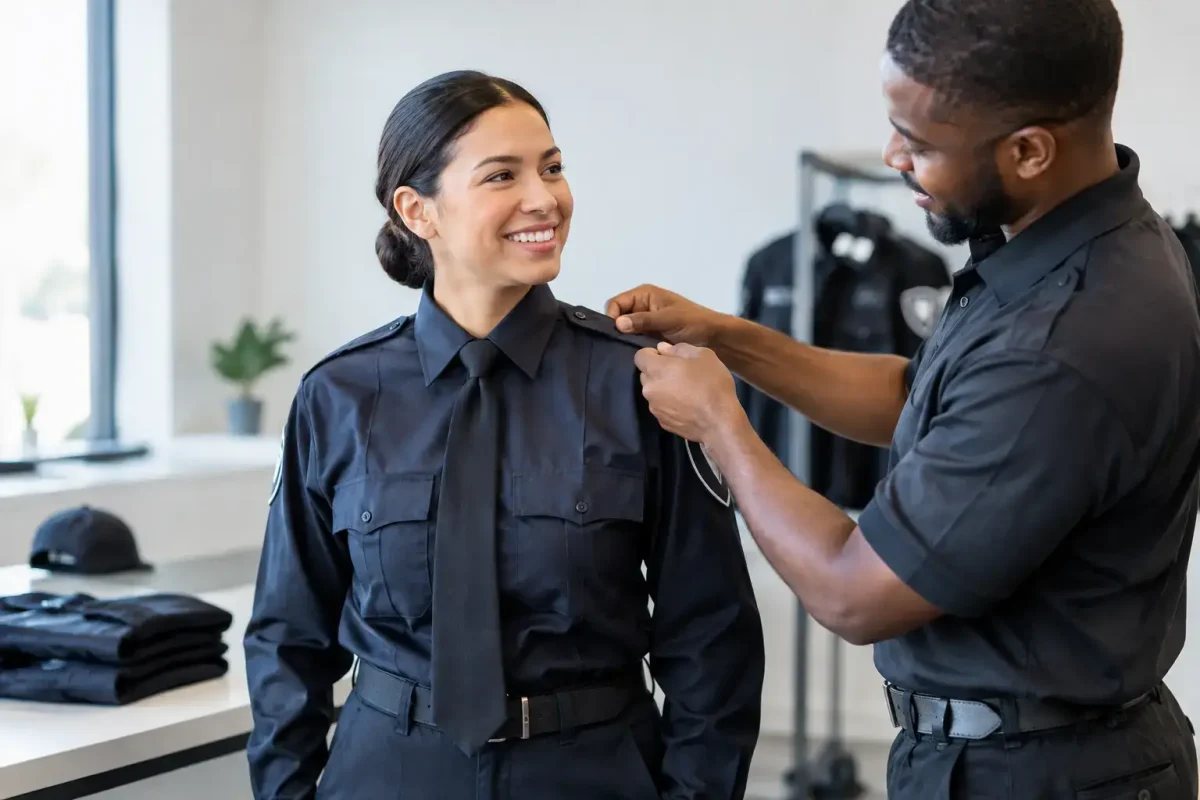
A new officer should not arrive for their first shift in an unbranded polo, borrowed jacket and wrong-sized trousers. This security company uniform onboarding example shows how to set up a practical issue process that gives each recruit the right kit before they report to site, while keeping supervisors, administrators and procurement teams out of a constant sorting exercise.
For contract security businesses, uniform is part of the service. It identifies officers clearly, supports a professional appearance in front-of-house roles and gives teams clothing suited to outdoor patrols, gatehouses, events and mobile response work. The right process also prevents an expensive problem: ordering a generic bundle for every employee, then having to replace unused garments when job roles or site conditions differ.
What a security company uniform onboarding example should cover
A workable onboarding process starts with the role and the site, not a standard clothing list. A concierge officer in a corporate reception needs a different presentation from an officer covering a distribution yard at night. A security steward on a temporary event site may need high-visibility layers and weather protection, while a control room team may require smart, comfortable branded polos and sweatshirts.
Before ordering, capture the employee’s name, job title, start date, work location, manager, approved garment sizes and any site-specific requirements. This information is enough to create an issue pack that can be picked, decorated and labelled for the individual.
The uniform specification should set out which items are mandatory, which are seasonal and which are optional. It should also state the logo position, garment colour, decoration method and replacement rules. That prevents different departments ordering near-matching garments that gradually weaken the company standard.
Example: a new static security officer
A security provider has won a contract to cover a logistics site. Officers will work a mixture of gatehouse duties, vehicle checks and external patrols, including early mornings and winter evenings. The onboarding record for a new starter might look like this in practice:
The officer is issued two branded navy polos, one branded sweatshirt, two pairs of black cargo trousers, a black softshell jacket and a navy cap. Because the role includes vehicle movements and external patrols, the site risk assessment also requires a separately specified hi-vis vest or jacket. The officer’s name is added to the pack label, along with the site name and start date.
The company logo is embroidered on polos, sweatshirts and the softshell where the fabric and position are suitable. If a waterproof outer jacket is required, print is usually the better choice. Embroidery creates needle holes in the outer layer, which can compromise water resistance. That small decision matters when officers spend long periods outdoors.
The pack is delivered to the regional office or directly to the site manager, depending on the company’s preferred handover process. The officer signs an issue record on their first shift. Their uniform sizes and issued items are retained for future replacements, so repeat orders do not need to begin again from scratch.
Build uniform packs around security roles
Trying to put every employee into one bundle is simple at the point of purchase, but it often costs more over time. Excess clothing sits in cupboards, supervisors spend time swapping sizes and officers wear unsuitable layers because a better option was never included.
A more reliable approach is to create a small number of role-based packs. Most security companies can cover their workforce with packs for front-of-house and concierge staff, static guarding and patrol officers, mobile response teams, event security and supervisors. Each pack can share core garments while allowing for the conditions of the job.
Front-of-house staff may need smart polos, knitwear, tailored trousers or formal outerwear in company colours. Static guarding packs are usually more hard-wearing, with polos, sweatshirts, cargo trousers, fleeces and softshells. Mobile teams may need additional weather protection and layers that work comfortably in and out of vehicles. Event teams often benefit from clearly branded, high-visibility options that can be issued in volume and returned or replaced after a season.
Hi-vis clothing should never be selected solely because it looks suitable. Where high-visibility PPE is required, the garment needs to meet the standard identified by the risk assessment, including the appropriate class and specification. Branding must also be positioned carefully so it does not reduce the required fluorescent or reflective area. A uniform supplier can advise on decoration placement, but the employer remains responsible for defining the site requirement.
Get the branding method right before production
Security logos need to stay legible after regular washing and heavy use. A small, detailed crest may reproduce well in embroidery but become unclear in print at a small chest size. A large back logo may be more cost-effective and visible when printed. The fabric, logo artwork and intended position should be assessed together rather than treating decoration as an afterthought.
Embroidery gives a durable, professional finish on polos, sweatshirts, fleeces, caps and many softshells. It is a common choice for chest logos and name or role identifiers. Print is particularly useful for larger designs, fine detail, high-visibility garments and waterproof fabrics. It can also be the practical option when the logo uses multiple colours or needs to cover a larger area.
Send the best available version of the logo at the start. A clear vector artwork file is ideal, although a quality image may be usable depending on the decoration method. Artwork should be checked and converted for embroidery or print before a full order is produced. This avoids the common issue of a logo that looks sharp on a screen but loses detail when stitched onto a garment.
Keep identification clear without overloading the garment
Security clothing has to be recognisable at a glance, but too much information can make it look cluttered. In most cases, a chest logo and a clear back marking are enough. Where roles need to be visible, such as supervisor, steward or response officer, the wording should be agreed as part of the standard rather than added ad hoc by individual sites.
Consider confidentiality too. Some contracts may require a neutral uniform, a client-specific logo or no visible site name. The onboarding record should identify which specification applies before the order is released.
Make sizing and fulfilment part of onboarding
Sizing is where many uniform programmes lose time. Asking a manager to estimate sizes, or issuing a standard large to every new starter, creates unnecessary exchanges. Give recruits a size guide during pre-employment checks and, for larger intakes, arrange sample sizes or fitting opportunities where practical.
Allow for the fact that officers may layer garments underneath. A polo should fit comfortably on its own, while a softshell or jacket may need room for a sweatshirt beneath it. The correct answer depends on the garment cut, the season and whether staff are regularly working outdoors. Recording actual sizes after the first issue helps make the next order quicker and more accurate.
Per-employee packing is particularly useful for security firms with several sites or regular recruitment. Rather than receiving cartons of mixed garments, each employee’s items can be packed together, labelled and ready to issue. It reduces the time spent sorting stock in an office, and it makes missing items easier to identify before a starter reaches site.
For large contract mobilisation, delivery can be organised by depot, region, site or intake date. A business may need a pallet delivery for a major event or new contract, whereas a smaller operation may prefer individual named packs sent to a central office. The best option depends on who is responsible for issuing uniform and how much secure storage is available.
Set a replacement process before uniforms start disappearing
Onboarding is only the first issue. Officers will need replacement polos, damaged trousers, winter layers and occasionally a complete reissue when they move roles or transfer contracts. Without a clear route for replacements, managers often place one-off orders with inconsistent sizes, colours or branding.
Set approval levels for routine replacements, define which items are chargeable after loss and keep a basic issue history. It does not need to be complicated. A record of garment type, size, date issued and reason for replacement gives procurement a clearer picture of usage and helps prevent over-ordering.
It is also sensible to keep a small reserve of undecorated core garments for urgent starters, but avoid building a large stockpile of personalised items. Named or client-specific clothing is harder to reuse if an employee leaves quickly. Standard branded items are more flexible, while personalisation should be used where it genuinely supports the operation.
A practical handover that protects the standard
The final handover should be simple: confirm that every item is present, check the officer can wear the layers comfortably, explain any PPE requirement and obtain a signed issue record. If the uniform is prepared in named packs, that conversation takes minutes rather than becoming a search through mixed cartons.
Vivid Promotion can support this type of programme with branded garment selection, embroidery or print advice, and per-employee packing for straightforward distribution. The objective is not to make uniform ordering more complicated. It is to ensure every new officer starts work looking prepared, identifiable and properly equipped for the conditions they will actually face.