No products in the basket.
Branded Workwear
Embroidered Tunics for Care Agencies That Work
19
Oct
Oct
A care uniform has to stand up to far more than a quick shift change. It is worn through personal care, medication rounds, mealtimes, moving and handling, cleaning tasks and repeated industrial laundering. That is why embroidered tunics for care agencies need to be specified as working garments first, then branded correctly. A smart logo matters, but comfort, dignity, easy identification and a dependable reordering process matter every day.
For agency owners, care home managers and administrators, the right choice reduces avoidable problems: staff wearing inconsistent clothing, names and roles being unclear, garments fading early or new starters waiting too long for uniform. The aim is straightforward – a tunic that looks professional at the start of a shift and still performs after regular washing.
Start with the care setting, not the logo
There is no single tunic that suits every care agency. A domiciliary care team travelling between clients may prioritise a lighter, easy-care tunic with practical pockets. A residential care home may need colour-coded garments to distinguish care assistants, senior carers, housekeeping and catering staff. A specialist service may have its own infection prevention policy, modesty requirements or colour standards.
Before choosing a garment, establish where and how it will be worn. Consider the expected wash temperature, whether staff need to carry gloves, keys or a mobile device, and whether the work involves frequent bending, reaching or assisting people to move. A tunic that is suitable for reception staff may not offer the range of movement needed on a busy care floor.
Fit is particularly important. Uniform should not be restrictive, overly loose or prone to riding up during practical work. Look for a sensible size range and, where appropriate, a choice of fitted and unisex styles. Giving staff a properly fitted garment is not simply a presentation issue. It helps them work comfortably and confidently over a long shift.
Choosing fabric for day-to-day care work
Most care tunics use a polycotton blend. This is often the sensible choice for high-use uniforms because it balances comfort with durability and is generally easier to care for than a purely cotton garment. The polyester content helps the tunic hold its shape and colour, while cotton adds a more comfortable feel against the skin.
The best fabric weight depends on the environment. A heavier garment can feel more substantial and may be useful where hard wear is expected, but it can be too warm for active staff in heated buildings. Lighter-weight tunics are more comfortable for busy shifts and travelling carers, though the fabric still needs to be durable enough for frequent laundering.
Check the care label against your laundering arrangements before placing an order. If uniforms are washed at home, staff need clear guidance on the recommended temperature and drying method. If garments go through a commercial laundry, confirm that the fabric, colour and embroidery are suitable for that process. Replacing uniforms early because the specification did not match the wash routine is an unnecessary cost.
Colour also needs a practical decision. White can give a traditional clinical appearance but may show marks quickly. Navy, royal blue, bottle green and burgundy can be more forgiving while still looking professional. If your teams work across multiple services, colour coding can make roles easier for residents, visitors and colleagues to recognise. Keep the system simple enough that new staff and agency workers can understand it immediately.
Embroidered tunics for care agencies: getting branding right
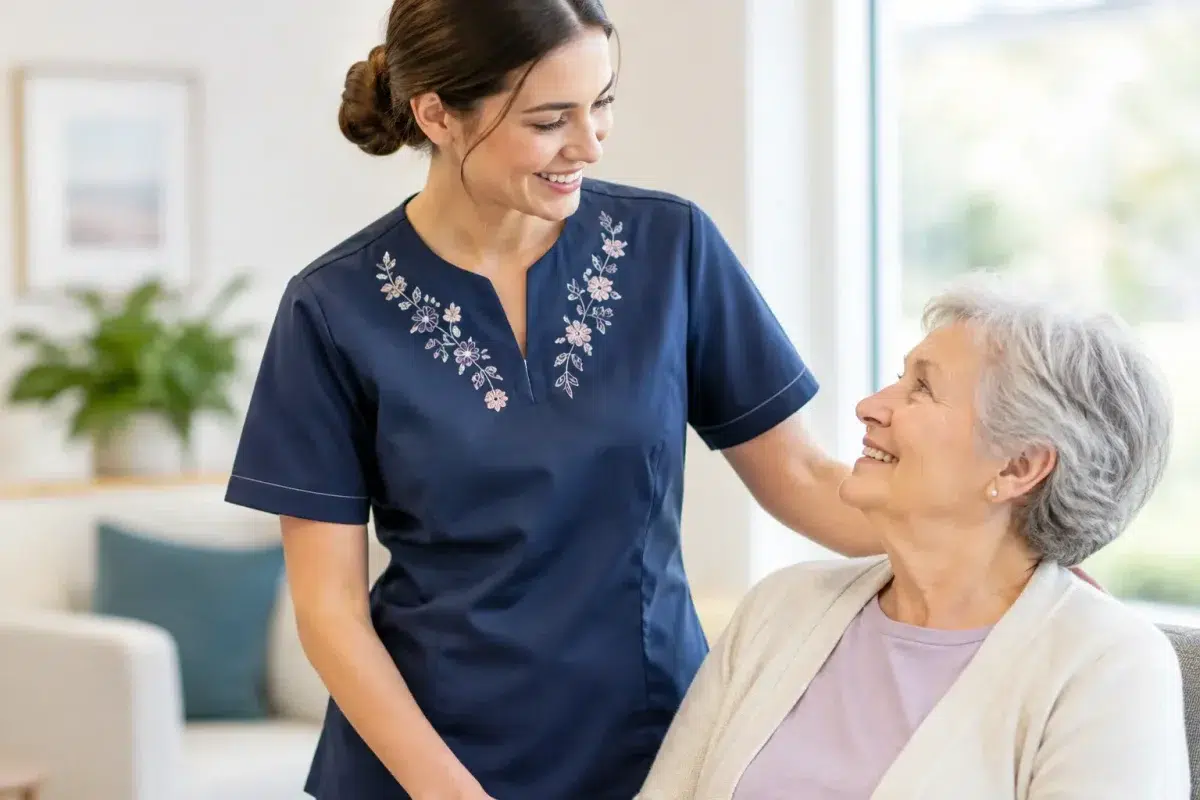
Embroidery is a strong choice for care tunics because it gives a neat, durable finish that remains clear through regular washing. It works well for company names, care home names and simple logos on the chest. Compared with a large printed design, embroidery tends to look more established and is less likely to become the focus of the garment.
That said, not every logo should be embroidered exactly as supplied. Fine lines, tiny lettering, colour gradients and very detailed artwork can lose definition when converted into stitches. A good embroidery setup simplifies the artwork where needed while keeping the key features recognisable. The result should be legible from normal conversation distance, not a dense patch of thread that is hard to read.
The left chest is the usual position for a company logo. It is visible when staff are facing residents and families, and it leaves room for a name or role on the opposite chest if your policy requires it. For larger organisations, an embroidered service name can sit beneath the main logo, but avoid making the area overcrowded. Clear identification is more useful than fitting every department detail onto one tunic.
Name personalisation has advantages and limits. It helps residents and relatives know who is caring for them, particularly in dementia care settings. However, it can make stock management more difficult and may not suit every organisation’s safeguarding approach. Some agencies use first names only, while others rely on photo ID badges. The right approach depends on your service policy, staff turnover and how frequently garments are reassigned.
Make the garment practical for the person wearing it
A well-chosen tunic supports the working day without getting in the way. Side vents can improve movement when walking and bending. Patch pockets offer useful storage, but their position and depth matter: shallow pockets are not much help for gloves or small work essentials, while large loose pockets can catch or pull when moving through tight spaces.
Fastenings deserve attention too. Stud fronts are quick to use and common on healthcare tunics. Concealed fastening styles can provide a tidier appearance and reduce snagging. Some staff prefer a slip-on style for speed and comfort, although this can be less flexible for different body shapes. Where possible, order samples or a small size set before committing to a full issue. The cost of checking fit early is lower than holding unwanted stock later.
Do not overlook what is worn with the tunic. Coordinated trousers, cardigans, fleeces or softshells can give travelling and outdoor staff a consistent appearance. These should follow the same colour and logo rules, but they serve different conditions. A fleece is useful for a cold journey between visits; it is not a replacement for a suitably washable tunic during care duties.
Plan your uniform issue before placing the order
Uniform purchasing becomes difficult when every item is treated as a separate one-off request. A clear issue standard makes ordering, budgeting and replacement simpler. Decide how many tunics each employee receives, which colours belong to each role, whether new starters receive trousers or outerwear, and who approves additional garments.
For example, staff may receive an initial issue of several tunics to allow for laundering between shifts, with replacements approved by a line manager. The exact quantity depends on shift patterns, wash arrangements and whether uniforms are worn every working day. A small domiciliary team may manage with a different issue level from a 24-hour residential service.
Accurate staff information is equally important. Collect names, job roles, sizes, garment choices and any embroidery requirements in one approved list. This prevents common errors such as a senior carer receiving the wrong colour, a misspelt name or a tunic ordered in a discontinued style. For larger orders, per-employee packing can save considerable time at your end, with each person’s garments sorted, labelled and ready to hand out.
At Vivid Promotion, this kind of order planning can be supported with embroidered healthcare workwear and practical packing arrangements for teams. It is particularly useful when you are onboarding several starters, opening a new service or replacing an entire uniform range.
Balance standardisation with staff needs
A uniform policy should create consistency without ignoring real people. Staff may need maternity options, extended sizing, modest-fit garments or adaptations that make dressing easier. Build these requirements into the range from the outset instead of treating them as exceptions after the main order has been placed.
It is also worth keeping a modest amount of unpersonalised stock for urgent starters and temporary cover. Personalised tunics look excellent, but they cannot always be reassigned when someone leaves. A combination of named garments for established staff and standard embroidered stock for rapid issue is often the most efficient approach.
When selecting embroidered tunics, ask for the information that affects real use: fabric composition, wash guidance, size chart, available colours, logo setup requirements and expected delivery timing. A uniform supplier should be able to help you choose the correct decoration method and flag issues before production, rather than after the order arrives.
The best care tunic is rarely the cheapest item on a price list. It is the one your staff are comfortable wearing, your residents can identify easily, and your administrator can reorder without starting the process again. Get the garment, embroidery and issue process right once, and every future uniform order becomes easier to manage.