No products in the basket.
Branded Workwear
How to Pack Uniforms by Employee Name Correctly
13
Oct
Oct
A delivery of branded workwear should not leave your office team facing a pile of polos, jackets and hi-vis vests to sort before the next shift. When you pack uniforms by employee name, every team member receives the correct garments, size and quantity in one clearly labelled pack. It removes a time-consuming job from site managers, administrators and supervisors, while reducing the risk of issue-day mistakes.
For businesses ordering uniforms across several departments or locations, individual employee packing is not a minor extra. It is a practical fulfilment method that keeps the order usable from the moment it arrives. The difference is especially clear when a team has a mix of garment types, personalised names, role-specific colours or PPE requirements.
Why pack uniforms by employee name?
A standard bulk delivery may be suitable for a small, single-site order of identical T-shirts. It becomes less practical when 30 employees each need different sizes, garments and logo positions. Add coats, trousers, fleeces, headwear or healthcare tunics, and sorting the order internally can take hours.
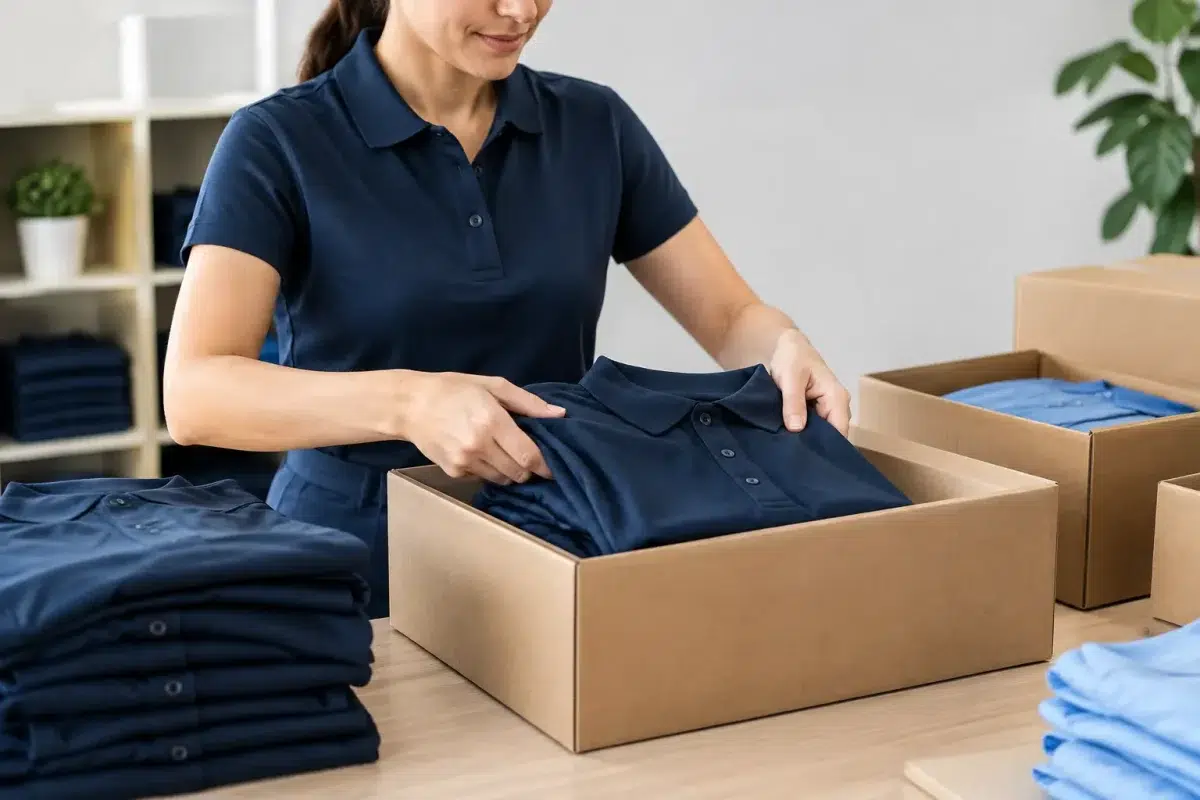
Packing each uniform issue by name gives the recipient one package containing their allocated kit. A warehouse operative, office administrator or school contact can issue the packs directly, rather than checking size labels against a spreadsheet while staff wait.
This approach is useful for construction firms mobilising a new site, care providers issuing department uniforms, event teams preparing crew clothing and businesses opening a new branch. It also works well for staff refreshes, seasonal outerwear and larger recruitment rounds.
There is an accountability benefit too. If a team member reports a missing hoodie or has received medium trousers instead of large, the packing record can be checked against their allocation. That is far easier than tracing a short item through several open cartons.
Start with a clean employee packing file
The packing process is only as accurate as the information supplied. Before production begins, prepare one agreed file with a row for each employee. Use the person’s preferred name or a clear employee reference, their department or site, and every item they should receive.
For each garment, include the product, colour, size, quantity and required personalisation. If different staff need different logo treatments, state that clearly. For example, a front-of-house polo may carry an embroidered chest logo and staff name, while a waterproof jacket may need printed branding because embroidery can create needle holes in the fabric.
Avoid sending several versions of the size list by email. One final, dated packing file gives production and dispatch teams a single source of truth. It also makes later additions clearer. If two new starters are added after approval, they should be listed as a separate amendment rather than inserted into an older version without explanation.
Use consistent names and garment descriptions
Small inconsistencies cause avoidable delays. “Sam Jones”, “Samuel Jones” and “S. Jones” may all refer to one person, but they can be treated as separate entries during checking. Use the same format throughout the file and flag any employees with identical names.
The same applies to garments. Identify the exact product or agreed description rather than using broad terms such as “jacket”. A softshell, padded jacket and waterproof shell are different items with different decoration options, stock positions and sizes. Clear descriptions help make sure the pack matches the job role.
Separate what goes on the garment from what goes on the pack
An employee name on a pack is not necessarily a name printed or embroidered on the garment. Many employers need named packaging for distribution, but only want the company logo on the uniform itself. Others want individual names on tunics, chef jackets or customer-facing polos.
Confirm both requirements at the outset. This protects privacy, avoids unnecessary personalisation charges and prevents a production error that cannot simply be put back into stock. Where names are printed on outer packaging, keep labels practical and limited to the information needed for issue.
Build each employee pack around the role
A named package should contain a complete, usable allocation, not just a random selection of garments from the order. A site operative may need two polos, a sweatshirt, hi-vis waistcoat and work trousers. A care worker may need several tunics and matching trousers. An events crew member may only need a branded T-shirt, hoodie and cap.
Grouping these items by employee lets the recipient check their issue at a glance. It also helps managers see whether the allocation is sensible before distribution. If every winter starter pack should include a fleece but one named package does not, the omission is easier to spot while the order is still at the packing bench.
For PPE and hi-vis orders, do not let the convenience of named packs replace compliance checks. The specified garment class, size range, colour and any required protective features must be agreed before packing. A correctly labelled bag is of little use if it contains a garment unsuitable for the working environment.
Check the order at the right stages
Good named packing relies on staged checks rather than one final look at the dispatch table. The first check is against the approved employee file before garments are picked. The next takes place after decoration, confirming that logo placement, colours and personalisation match the job specification. The final check verifies that each pack contains the correct items and quantity before it is sealed and labelled.
This matters most on mixed orders. A team may use the same black polo in several departments but need different back prints, different names or different companion items. It is easy to see why a bulk carton alone does not provide enough control.
A practical label should identify the employee and, where helpful, the department, site or cost centre. Keep it legible and consistent. For larger roll-outs, adding a pack number can make handover quicker, particularly if the receiving manager has a matching issue sheet.
Plan delivery around how uniforms will be issued
Named packs can be sent to one central address for internal distribution, or arranged by location where an organisation has several sites. The best option depends on who will issue the uniforms and how quickly staff need them.
A central delivery works well when one administrator controls stock and new starter allocations. Site-by-site delivery is often better for construction groups, care providers and multi-branch businesses where local managers need to issue uniforms immediately. Large orders may require cartons grouped by site, or pallet delivery where volume and access make that more practical.
Tell your supplier about delivery restrictions early. Site opening times, goods-in procedures, limited storage space and vehicle access can all affect the dispatch plan. A named-pack service is most effective when the delivery method supports it, rather than leaving cartons in the wrong place for someone else to redistribute.
When individual named packs are not the best option
Individual packing is not always necessary. For a small order of identical branded garments, bulk packing may be quicker and more cost-effective. The same can apply to stock held for future starters, where sizes are not yet known, or to promotional merchandise intended for general distribution.
A hybrid approach is often the sensible answer. Issue complete named uniform packs for current employees, then receive a separate bulk carton of spare garments for replacements and new starters. This keeps the main roll-out organised without creating named packs that may sit unused.
It is also worth considering the number of garments per person. If each employee receives a substantial kit, stronger packaging or cartons grouped by department may be more suitable than small individual bags. The packing format should protect the garments, remain easy to handle and make handover straightforward.
Make repeat orders easier
Once the first uniform issue has been packed accurately, retain the approved format for future orders. The same employee fields, department references, garment descriptions and label layout can be used for replacements, seasonal additions and new starter packs.
At Vivid Promotion, per-employee packaging can be planned alongside garment selection, embroidery or print requirements and delivery arrangements. That means the practical detail is considered before dispatch, not after hundreds of garments arrive on site.
The best named uniform packs are the ones nobody has to think about. Staff receive the right kit, managers can issue it quickly, and the business gets on with the work the uniform was bought to support.