No products in the basket.
Branded Workwear
Printed Workwear Near Telford: What to Check
03
Jul
Jul
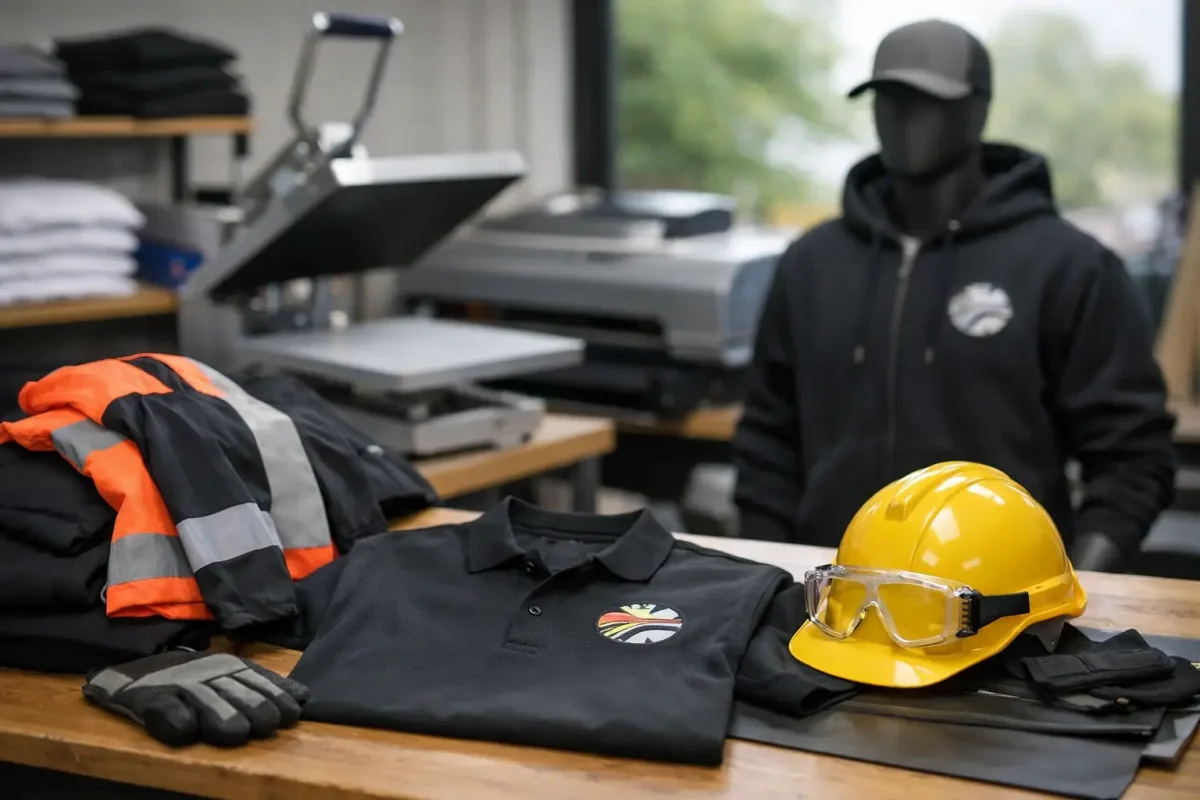
If you are sourcing printed workwear near Telford, the pressure usually comes before the order is even placed. New starters need uniform quickly, site teams need the right garments for the job, and someone in the office is left chasing sizes, logos and delivery dates. That is why the real question is not just who can print a logo – it is who can supply the right garments, apply the right decoration method, and get the order out without creating more admin for your team.
What businesses actually need from printed workwear near Telford
For most organisations, printed workwear is not a one-off marketing purchase. It is part of day-to-day operations. Construction firms need branded hoodies, polos and hi-vis that can be reordered without starting from scratch each time. Warehousing and logistics teams need consistent garments across departments. Events businesses often need bulk quantities delivered on a deadline. Healthcare and care providers may need tunics, polos or scrubs sorted by role, wearer or location.
That changes how you should judge a supplier. Price matters, but so do garment suitability, print quality, lead times and packing options. A cheap printed T-shirt becomes expensive if it wears out quickly, arrives unsorted, or uses a print method that cracks after a few washes.
A good supplier should help you narrow down the order properly. That means choosing garments by working environment, budget and expected wear, not simply putting a logo on the first product in the catalogue.
Print is not always the right method – but often it is
Printed branding works well on a wide range of workwear, especially when you want a clean, visible logo on T-shirts, polos, sweatshirts, hoodies and event garments. It is often the practical choice for larger chest prints, back prints, sponsor logos and designs with multiple colours or finer detail.
It also makes sense where embroidery would add bulk or cause problems with the garment itself. Waterproof outerwear is a good example. If you stitch through the fabric, you create needle holes. In that case, print can be the better option.
That said, print is not automatically best for every role. If a garment is going through heavy industrial wear, or if you want a more formal finish on fleeces or premium polos, embroidery may still be the better fit. The right answer depends on the garment, the logo and the job the wearer is doing.
Choosing the right garment before you think about the logo
One of the most common ordering mistakes is approving branding before the garment choice is settled. In practice, the garment matters more than many buyers expect.
A trades team working indoors and outdoors through the week may need layered uniform rather than one standard item. Printed T-shirts for warmer conditions, sweatshirts for general wear and softshells or coats for site travel is often a more sensible setup than trying to make one garment do everything. If your team works in public-facing roles, fit and presentation may matter more than it would on a factory floor. If you are buying for events, lightweight garments with bold print are often the priority because visual impact matters more than long-term heavy wear.
Hi-vis adds another layer. Visibility standards, background fabric colour and print positioning all need checking so branding does not interfere with compliance. In some cases, the logo size or placement needs adjusting to keep the garment practical and compliant.
This is where a catalogue-led supplier earns its keep. You should be able to shop by garment type, by job role or by compliance need, then match the branding method to the product rather than forcing the same solution onto every item.
Print quality depends on artwork, not just machinery
A lot of buyers assume that if they send over a logo file, the job is ready to go. Often it is not. Low-resolution images, old screenshots and files lifted from social media do not produce clean, consistent printed workwear.
The artwork needs to be prepared properly so edges stay sharp, colours reproduce accurately and the logo remains legible at the size required. Small text, fine lines and gradients all need checking before production. A logo that looks fine on screen can become unreadable when reduced for a left chest print.
This matters even more if you need repeat orders. Once the artwork is set up properly, future orders are easier to process and more consistent from batch to batch. For organisations issuing uniforms over time, that consistency matters. The print on a new starter’s polo should match the one worn by the rest of the team, not look like it came from a different supplier entirely.
Lead times matter, but order handling matters more
When buyers ask about turnaround, they usually mean one thing – how fast can we get the order? That is fair enough, but speed on its own is not the full picture.
A supplier can print quickly and still create problems if the order arrives in a single mixed batch with no sorting, no wearer breakdown and no clear labelling. For a business managing multiple staff, branches or departments, that creates extra handling in-house. Someone then has to open boxes, split garments by person and sort missing items.
For larger uniform programmes, fulfilment is part of the service. Per-employee packaging can save a lot of time when issuing workwear to staff. Bulk pallet delivery can be the better route for events, schools or trade customers working to distribution schedules. If your team is ordering at scale, ask how the supplier packs, labels and dispatches the order, not just when it leaves production.
Local coverage helps, but systems matter too
There is a reason businesses search for printed workwear near Telford. Local coverage can make communication easier, support repeat ordering and give buyers confidence that the supplier understands the needs of firms across Telford, Market Drayton, Stafford and the wider Midlands.
But local only works if the operation behind it is reliable. You still need structured ordering, dependable production and clear dispatch processes. A supplier with proper systems can support local businesses while also delivering consistent lead times across Great Britain. That matters if your workforce is spread across more than one site or if you need repeat supply beyond a single branch.
In other words, proximity is useful, but process is what keeps uniform ordering under control.
How to avoid the usual ordering problems
Most uniform issues start with rushed decisions early on. A buyer chooses a garment based on price alone, sends over whatever logo file is available, and assumes every team needs the same item. That often leads to rework, replacement orders or staff refusing to wear the garments because they are not suitable.
A better approach is to work backwards from how the clothing will actually be used. Think about the environment, wash frequency, branding position and whether the garment is part of a wider uniform range. Consider whether departments need different colours, whether supervisors need identifying separately, and whether outerwear should match the base layer branding.
It is also worth planning for reorders from the start. If your staff count changes regularly, you need a supplier that can handle top-up orders without changing products, shades or print quality every few months. Consistency is part of cost control.
For that reason, many buyers prefer working with a supplier that can cover more than one garment category at the same time. A single source for printed hoodies, polos, hi-vis, healthcare wear and accessories keeps branding more consistent and ordering simpler. Vivid Promotion works in that way – as a production and distribution partner rather than just a print source – which is often what growing organisations need.
What good printed workwear should achieve
Printed workwear should do three jobs at once. It should present your business properly, stand up to the working day, and arrive in a way that does not create extra admin for your team.
If the branding looks good but the garment is wrong, staff will not wear it consistently. If the garment is fine but the print fails after repeated washing, you end up replacing stock sooner than planned. If the order is produced correctly but packed badly, the time saved in buying it disappears when it reaches your premises.
That is why the best buying decisions are practical ones. Choose garments that suit the role. Choose print where it is the right method, not just the cheapest one. Make sure artwork is production-ready. And pay attention to fulfilment, because that is where many larger orders succeed or fall apart.
When you are buying printed workwear near Telford, the strongest option is usually the supplier that gets the operational detail right first. The logo matters, but the real value is getting branded uniform into the hands of the right people, in the right format, without slowing your business down.