No products in the basket.
Branded Workwear
Polo Embroidery Versus Chest Printing: Which Works?
30
Aug
Aug
A polo shirt is often the uniform item staff wear most often: on site, at reception, on deliveries, in showrooms and when meeting customers. The decision on polo embroidery versus chest printing affects more than appearance. It changes how clearly your logo is seen, how the garment feels in daily use, how it stands up to laundering and what the finished order costs.
For most organisations, there is no single correct answer. A small, simple logo on a hard-wearing cotton-rich polo may suit embroidery for years. A detailed design, a larger chest graphic or a lightweight performance polo may be better printed. The right choice starts with the garment, the job and the way your team will wear it.
Polo Embroidery Versus Chest Printing: The Main Difference
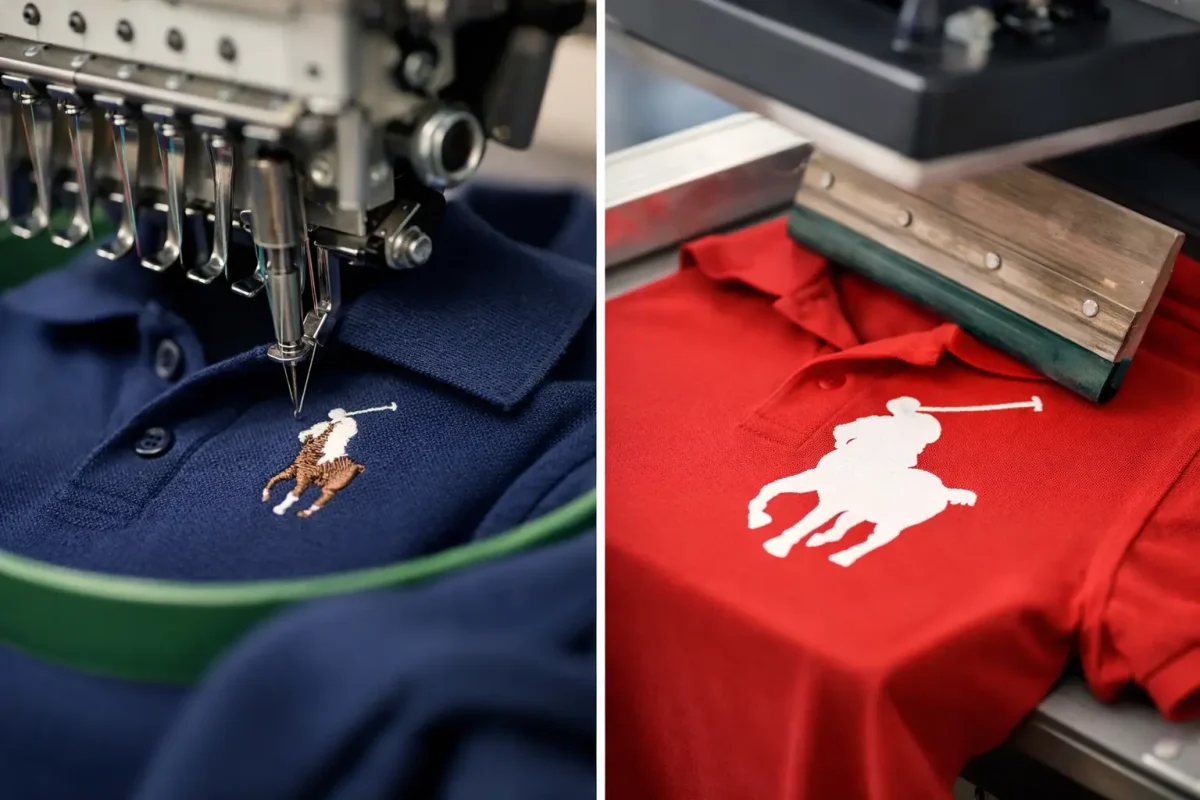
Embroidery builds your logo from coloured thread stitched directly into the garment. It gives a raised, textured finish that is familiar on corporate and trade uniforms. On a polo, it is usually placed on the left chest, although right-chest positions can work where a name, department or another logo needs to be accommodated.
Chest printing applies your artwork to the fabric surface. The precise method depends on the artwork, fabric and order requirement, but the result is generally smoother and flatter than embroidery. Printing can reproduce fine lines, gradients, small text and a wider range of colours more accurately than thread.
The key distinction is simple: embroidery is a durable stitched badge effect, while printing is a flexible graphic finish. Neither is automatically better. They perform differently, and choosing by habit can leave you with a logo that is too bulky, too small to read or unsuitable for the polo fabric.
When Embroidery Is the Better Choice for Polos
Embroidery is a strong choice for businesses that need a traditional, established uniform finish. Construction firms, facilities teams, dealerships, hospitality staff and office-based customer-facing teams often choose embroidered polos because the finish looks smart and remains recognisable after repeated wear.
It works particularly well for logos with solid shapes, clear lettering and a limited number of colours. A company name in a clean typeface, a simple icon or a bold trade logo will usually convert well into stitches. Embroidered chest logos also have good visual presence on heavier pique polos, fleece-lined work layers and cotton-rich garments.
Durability is a major factor. Quality embroidery is stitched through the fabric rather than sitting on its surface, so it does not fade in the same way as a print. For uniforms that are washed regularly, this makes it a dependable option. It is especially practical where staff receive a core issue of polos intended to last through a busy season or a full year of routine work.
There are limits. Small text can become difficult to reproduce in thread, and very detailed logos may need to be simplified. Thread colours are selected from an available range rather than mixed like ink, so exact tonal transitions and photographic artwork are not suitable. The backing used behind embroidery can also make a light polo feel slightly firmer at the chest, particularly when the design is large or densely stitched.
Embroidery can also cost more on complex designs because stitch count matters. A small logo may be economical, but a large filled-in crest or detailed multi-colour artwork takes longer to produce. This is why supplying a clear logo file at the outset is useful. It allows the artwork to be prepared correctly for embroidery and avoids surprises once production is under way.
Best uses for embroidered polo logos
An embroidered finish is usually the practical route when you need a compact left-chest logo, a professional traditional look and long service life. It is well suited to standard work polos for engineers, builders, supervisors, warehouse managers, grounds teams and front-of-house staff.
It also works well where the polo is only one part of a consistent uniform. Using the same embroidered logo across polos, sweatshirts, fleeces, softshells and bodywarmers creates a coherent issue for staff working across changing conditions.
When Chest Printing Is the Better Choice
Chest printing gives more freedom with the artwork. If your design includes fine lettering, colour fades, multiple shades, small detail or a precise brand colour requirement, print is often the safer option. It can reproduce a logo as it was designed rather than forcing it into the limitations of thread.
Printing is also better suited to larger chest designs. While most polo logos are kept modest, some event teams, promotional staff and retail campaigns need a prominent logo or message across the front. A printed design stays flatter and lighter than a large embroidery, which makes it more comfortable on lightweight or moisture-wicking polos.
This matters for active teams. Sports-style polos, technical fabrics and lightweight polyester garments are commonly used by events crews, delivery teams, leisure staff and warm-weather site teams. A suitable print can move more naturally with the fabric and avoid the heavier feel of a densely embroidered area.
Print can be a cost-effective route for certain designs, especially when the artwork is detailed and would require a high stitch count in embroidery. It is also useful for individual names, job roles, campaign wording or short-term branded clothing where the message may change between departments or events.
The trade-off is that printed areas need the right care and the right application method for the garment. A poor-quality print, or one applied to an unsuitable fabric, can wear prematurely. Workwear laundering, abrasion from seatbelts or tool belts, and frequent drying can all affect surface decoration over time. Good production decisions reduce those risks, but it is sensible to match the expected garment life to the decoration method.
Best uses for printed polo chests
Choose printing where logo accuracy, fine detail or a larger visual area matters most. It is particularly useful for promotional polos, event uniforms, technical fabrics, detailed school or club artwork, and designs containing gradients or small lettering that embroidery cannot reproduce clearly.
Printing can also be the more appropriate route if the polo has a very lightweight knit. On these garments, a large embroidered logo may pull at the fabric or create an uncomfortable patch on the inside of the chest.
What to Check Before Choosing a Decoration Method
Start with the logo itself, not the garment catalogue page. A design that looks sharp on a screen may not work at a small embroidered chest size. Fine outlines may close up, narrow letterforms may need adjusting and tiny text may be removed to keep the logo readable. A print can retain those details, but that does not mean a large, complicated logo is always best for a uniform. At normal conversation distance, simple branding usually works harder.
Next, consider the polo fabric and construction. Classic pique polos are usually very suitable for embroidery. Lightweight performance polos may suit print better, particularly for larger designs. If you are ordering a mix of polos and outerwear, the same artwork may need separate preparation so it performs properly on each garment.
Then look at the role. A reception team, sales staff or site supervisors may benefit from the premium, traditional appearance of embroidery. An events crew that needs a bold sponsor graphic or campaign message may need print. For a care provider or healthcare team, comfort and easy identification can matter more than a raised finish, particularly where staff wear uniforms through long shifts.
Quantity and repeat ordering should also influence the decision. For a standard logo used year after year, embroidery can be a sound long-term uniform choice. For changing promotions, seasonal events or department-specific messages, print may offer more flexibility. Ordering the same approved garment and logo setup for future starters also helps keep your team looking consistent.
Do Not Treat Left-Chest Placement as Automatic
Left chest is the standard position because it is easy to see and works with most uniforms. However, a polo may need more than one marking position. A small embroidered logo on the left chest can be paired with a printed website, department name or larger branding on the back. This combination is common for trades, installation teams and event staff because it keeps the front professional while making the brand visible from a distance.
It is worth checking what employees carry or wear over the polo. A hi-vis vest, harness, radio strap or name badge can hide chest branding. In those cases, a back print or sleeve marking may provide better visibility. For hi-vis clothing, decoration must also be positioned thoughtfully so it does not interfere with required reflective bands or reduce the garment’s practical function.
Artwork Preparation Makes the Difference
The decoration method is only as good as the artwork supplied. A low-resolution image copied from a website can produce poor print edges and makes accurate embroidery conversion difficult. Vector artwork is normally preferable, but a high-quality original file can also be assessed and prepared for production.
For embroidery, artwork is converted into a stitch file that tells the machine how to build the design. This process determines stitch direction, thread changes, density and how small details are handled. For print, the artwork must be sized and colour-checked for the chosen garment and placement. Treating these as separate production steps, rather than simply placing a logo on a shirt, gives a more reliable result.
For larger uniform issues, approval before the full run is particularly useful. It confirms logo size, placement, thread or print colours and garment choice before hundreds of items are packed for distribution. Vivid Promotion can also pack orders by employee or department, which helps when polos are part of a wider uniform rollout rather than a simple bulk delivery.
A well-chosen polo decoration should make issuing uniform easier, not create questions after delivery. Choose embroidery when the logo and garment suit a durable stitched finish; choose chest printing when detail, flexibility or a lighter result is needed. The practical next step is to assess your actual logo on the polo your team will wear, then approve the finish that will still look right after the working day is done.