Branded Workwear
How to Organise Employee Uniform Packing Properly
Aug
A uniform order is only finished when the right garments reach the right person. Twenty boxes of branded polos, fleeces and trousers may look like a completed delivery, but they still create work if somebody on site has to sort every item by name, size and department. Knowing how to organise employee uniform packing properly turns a bulk order into a straightforward handover, whether you are equipping a new construction crew, care staff or an events team.
The key is to decide the issue process before garments go into production. Accurate employee data, clear pack rules and a final check at dispatch prevent the familiar problems: missing hoodies, duplicate sizes, logos on the wrong garment and a manager spending half a day on the warehouse floor sorting bags.
Start with a usable employee uniform list
Uniform packing starts with the information supplied at ordering stage. A rough total by garment and size is enough for a bulk delivery, but individual packing needs a row for every wearer. Use a simple spreadsheet or ordering template with one employee per line, rather than relying on email chains or handwritten notes.
Include the employee’s full name, department or site, role, garment type, size, colour and quantity. Add any specific requirements that affect the item supplied, such as a ladies’ fit, tall sizing, a job title below the logo, or PPE appropriate to the role. For large organisations, an employee ID or cost centre is useful where several people share the same name.
Keep the information consistent. If one person is listed as “J. Smith”, another as “John Smith” and a third as “Smith – John”, pack labels and issue records become harder to match. Agree one naming format at the outset and ensure all sizes use the manufacturer’s size system, not just S, M or L where chest or waist measurements are needed.
Before approving the order, ask the person responsible for each department to check their section. This is particularly worthwhile for healthcare uniforms, where tunic and trouser combinations can differ by role, and for mixed teams needing a combination of hi-vis, outerwear and standard workwear.
Set the packing method around how uniforms will be issued
There is no single best packing format. The practical choice depends on the number of wearers, the mix of garments and who will hand uniforms out.
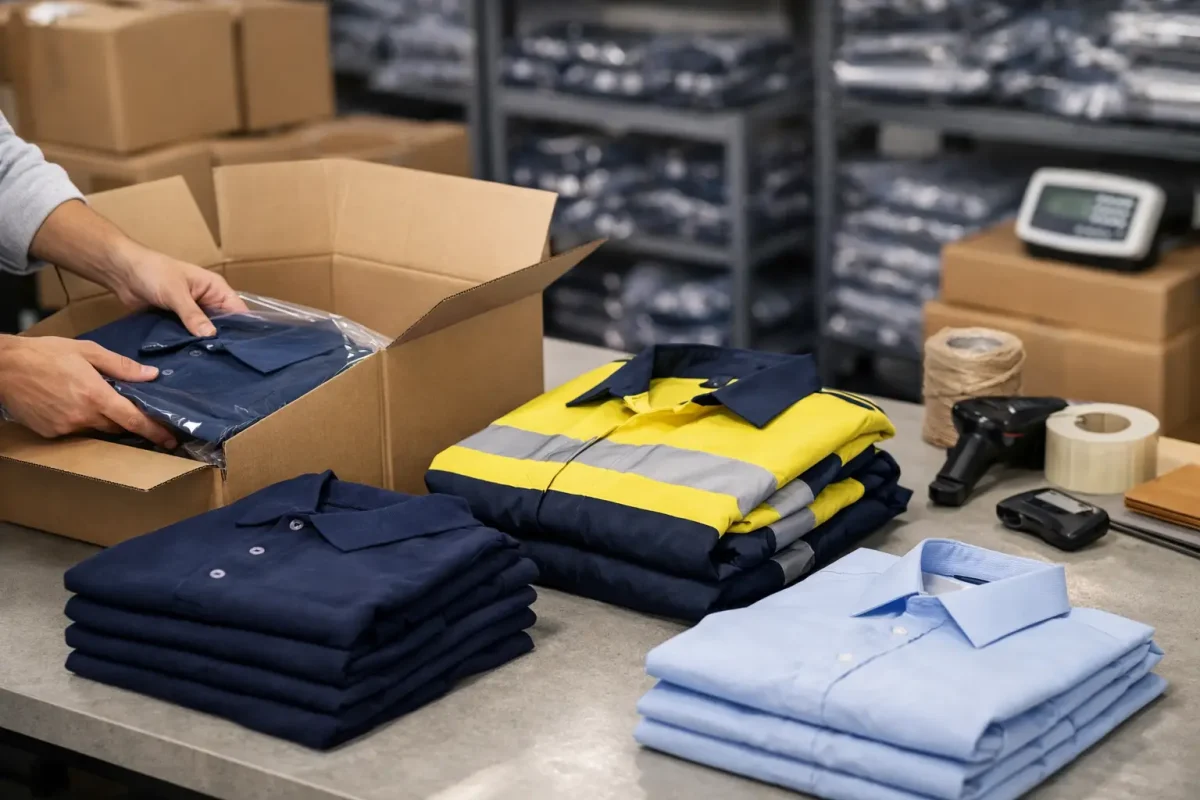
For a small team based at one location, individual named packs are normally the quickest option. Each employee receives a clearly labelled bag containing their full allocation – for example, three embroidered polos, one sweatshirt and a softshell jacket. The manager can issue packs without opening them, then record collection against the employee list.
For larger teams, individual packs still reduce internal admin, but department or site grouping makes delivery easier to manage. Packs can be boxed by location, shift or department, with an outer carton label showing the contents. This matters where a delivery is split between several depots, wards or project sites.
Bulk packing by garment type has a place too. It can be more cost-effective for event merchandise, spares stock or organisations with a central stores team. The trade-off is clear: the supplier sends fewer individual packs, but your staff take on the sorting and distribution work. Do not choose bulk packing purely because it appears simpler on the order form. Calculate the time needed to separate, check and issue the stock afterwards.
Build each employee pack from a confirmed specification
A pack should be based on an agreed uniform allocation, not on assumptions. A site operative may need two polos, a hoodie, work trousers and a hi-vis vest, while a supervisor may need embroidered shirts and a bodywarmer. Treat these as separate pack specifications even if both employees work on the same site.
This is also the point to make the right decoration decision. Embroidery is a durable, professional choice for polos, sweatshirts, fleeces, caps and many jackets. Printed logos can be better for lightweight garments, large designs or items where embroidery would be too heavy. On waterproof outerwear, printing is often preferable because embroidery requires needle holes that can compromise the fabric’s water resistance.
Once the garment and decoration choices are approved, avoid changing specifications halfway through an order. A late request to replace a fleece with a softshell, alter a logo position or add a second department name can create pack inconsistencies. Where changes are unavoidable, mark the affected employee rows clearly and issue a revised version of the packing list.
Use labels that work at the point of issue
A good label lets a manager identify the recipient and confirm the pack without opening it. At a minimum, show the employee name and pack reference. For multi-site orders, include the site or department. A short contents line is helpful for more complex packs, such as “2 polos, 1 hoodie, 1 hi-vis waistcoat”.
Avoid putting unnecessary personal information on external packaging. Names, departments and internal references are generally enough. If packs are being delivered to a public or shared area, keep the label functional and discreet.
A simple pack reference also makes discrepancies easier to resolve. Instead of reporting that “there is a bag missing for the Bristol team”, the manager can identify a specific pack number against the original schedule. That gives the supplier and customer a clear starting point for checking the order.
Put quality checks in before cartons are sealed
The most expensive packing error is the one discovered after uniforms have been handed out. Quality control should therefore cover both the garment and the pack as a whole. The person checking should compare the item, size, decoration and quantity against the employee line, not against memory or a general garment total.
A reliable final check covers four areas:
- the correct garment style, colour and size are assigned to the named employee;
- logos, names and job titles are positioned and spelled as approved;
- the pack contains every item in the stated allocation;
- the label, carton grouping and delivery address match the agreed issue plan.
For branded workwear, inspect logo quality as well as presence. A converted embroidery design should hold its shape and detail at the actual stitched size. Printed garments should have clean edges, correct colour reproduction and proper placement. A logo that looks acceptable on a proof can still be unsuitable if it is too small for a textured fleece or too detailed for the chosen decoration area.
Plan delivery around the first issue date
Uniforms often arrive just before a new contract starts, a site opens or seasonal staff begin. That leaves little room for repacking or chasing missing items. Work backwards from the first day uniforms are required, allowing time for artwork approval, garment production, dispatch, delivery and an internal receipt check.
Tell the supplier where the order needs to go and who can receive it. A named contact with a telephone number helps if a pallet delivery needs booking in or a lorry has site-access restrictions. If packs are split by location, provide every delivery address and carton allocation before dispatch rather than asking a receiving manager to forward stock onwards.
For larger orders, request carton or pallet information that supports your goods-in process. Knowing how many boxes are expected, what each one contains and whether they are grouped by department makes it easier to check the delivery quickly. Vivid Promotion can arrange per-employee packaging for organisations that want uniforms sorted and ready to issue, removing the need for internal teams to break down a mixed bulk order.
Keep a controlled record for replacements and repeat orders
Once uniforms have been issued, retain the final packing list. It becomes the reference point when an employee says a size is wrong, a new starter needs the same allocation or a department places a top-up order. Without it, every repeat purchase starts with fresh guesswork.
Record what was issued, the date, any returns and replacement reasons. Over time, this highlights useful patterns. If several people exchange the same trouser style, the size guidance may need improving. If outdoor teams consistently request extra layers, a seasonal bundle may be more suitable than issuing garments one at a time.
The best employee uniform packing process is not the one with the most labels or paperwork. It is the one that lets a manager receive a delivery, hand out the right packs with confidence and get the team properly equipped for work.