Branded Workwear
A Case Study in Bulk Uniform Fulfilment Done Right
Jul
A new team can be ready to start on Monday, but that does not help if their polos, hi-vis jackets and trousers arrive in mixed cartons on Friday afternoon. For this case study, bulk uniform fulfilment was the operational issue: getting a large branded order produced accurately, packed logically and delivered in a form the customer could issue without turning their office into a sorting room.
The example is based on a typical UK multi-site employer preparing uniforms for a growing field team. The requirement was not simply to buy workwear in quantity. It was to supply the right garments, in the right sizes, with the correct logo treatment, to people working from different locations. That distinction changes how an order needs to be managed.
The starting point: a bulk order with a distribution problem
The customer had a mixture of roles to kit out. Site-based staff needed durable polos, sweatshirts, trousers and weather protection. Supervisors required a more presentable layer for customer-facing visits. Some team members also needed hi-vis garments appropriate to their working environment.
Ordering by garment type alone would have created unnecessary work. A pallet of embroidered polos, another of jackets and several cartons of trousers may be efficient for warehouse storage, but it leaves someone at the customer’s end to count, sort and match every item to every employee. That takes time, creates room for error and often delays issue day.
The more useful question was not, “How many garments do you need?” It was, “How does each employee need to receive their uniform?” Once that was clear, the order could be built around individual wearers rather than stock lines.
Getting garment selection right before production
The first job in any large uniform order is to set a practical garment standard. This helps keep the team looking consistent while allowing for different job requirements. A lightweight polo may suit indoor staff and summer work, while a sweatshirt, fleece or softshell provides a better option for outdoor teams. For wet conditions, a waterproof outer layer needs particular care.
Decoration method matters here. Embroidery gives a hard-wearing, professional finish on polos, sweatshirts, fleeces and many jackets. It is often the sensible choice for a left-chest logo that will see regular wear and washing. However, embroidery on a waterproof garment can create needle holes in the outer fabric. Where water resistance is a priority, print is generally the better option.
The customer also needed logos to reproduce consistently across several garment types. A logo that looks clear on a white office document does not automatically work as embroidery or print. Fine detail, small text and tonal changes may need adjustment before production. Confirming an embroidery-ready or print-ready artwork file at the outset avoids surprises once garments are on the production line.
How bulk uniform fulfilment was organised
With garment choices, sizes and decoration positions agreed, the order was structured by employee. Each wearer’s allocation was recorded against their name or employee reference, department and delivery point. This is where a bulk purchase becomes a fulfilment project rather than a straightforward carton shipment.
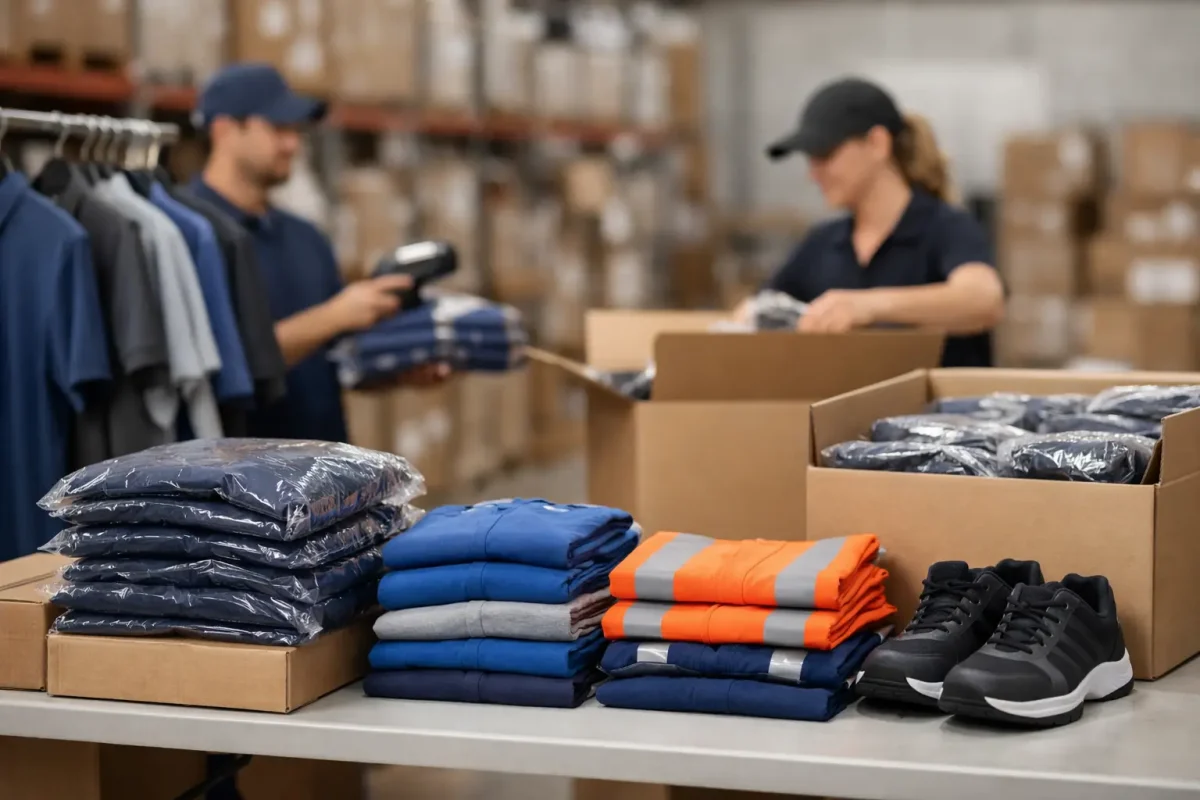
Instead of packing all matching garments together, each person’s items were picked into a named or clearly identified pack. A typical pack might include two embroidered polos, a sweatshirt, work trousers and a printed waterproof jacket. The contents were checked against the allocation before being sealed for delivery.
This approach has a simple advantage: the customer does not have to recreate the order after it arrives. A manager can hand each pack directly to the relevant employee, or send packs onwards to depot managers and site supervisors. For organisations with several locations, that can remove a substantial amount of internal handling.
Using delivery points that match the operation
There is no single correct delivery method for every business. A central depot delivery can be the most efficient option where a team is based in one place and has a planned uniform handout. Bulk pallet delivery is particularly useful for event operators, trade customers and organisations receiving high volumes at a warehouse or distribution site.
For a dispersed workforce, it may make more sense to send grouped employee packs to regional sites. That allows each site manager to issue uniforms locally while retaining control over who has received what. Direct-to-home distribution can also be suitable in some circumstances, although it depends on the employer’s data handling process, budget and how urgently replacements may be needed.
The key is to agree the distribution model before production starts. Changing packing requirements once a large order is complete can introduce delay and cost. A supplier should know whether the customer needs bulk cartons, palletised delivery, department packs or individual employee packs from the beginning.
The checks that prevented costly mistakes
Large uniform orders do not usually go wrong because of one dramatic failure. More often, small omissions build up: one missing size, a logo placed incorrectly, a pack sent to the wrong site or a hi-vis item that does not match the agreed specification.
In this case study, control points were used throughout the process. The order was checked against the approved garment list and size data. Decoration details were confirmed, including logo position, thread or print colour and which garments required a different method. Packing references were then matched to the employee allocation list before despatch.
This level of checking is especially valuable for organisations ordering across departments. Healthcare providers may need different scrub colours or tunic styles by role. Construction firms may require separate hi-vis and protective layers for specific site conditions. Schools ordering leavers’ hoodies need names, initials or artwork checked carefully before garments are personalised.
It is also worth allowing for size changes and new starters. Ordering a small, unbranded contingency stock can be practical for some employers, particularly where staff turnover is regular. Personalised garments cannot always be reassigned, so the right balance depends on the role, the uniform policy and how individual the branding is.
The result: uniforms ready to issue, not sort
When the delivery arrived, it was organised around the customer’s issue process. Rather than opening mixed cartons and building sets by hand, managers could distribute identified employee packs. Site teams received consistent branded clothing, while supervisors had the right outerwear and presentation layer for their work.
The benefit was not just a tidier delivery. It was less admin at a busy point in the business calendar. The customer avoided allocating staff to count garments, chase missing items and decide who each product was intended for. That is particularly useful when uniforms are needed for a new contract, a seasonal recruitment drive, an event programme or a company-wide rebrand.
For the supplier, the lesson is equally clear. Reliable fulfilment starts well before despatch. It depends on accurate garment advice, usable artwork, confirmed wearer data, sensible decoration choices and packing instructions that reflect the customer’s real working environment.
What to confirm before placing a large uniform order
A smooth bulk order starts with a clear brief. Confirm who is wearing each item, which roles need different garments, the required sizes, logo locations and whether the garments need embroidery or print. If hi-vis or protective clothing is involved, make sure the selected products match the workplace requirement rather than choosing solely on appearance.
It is also useful to set a realistic delivery date and work backwards. Production time, artwork approval, stock availability and the level of packing required all affect the schedule. For a time-critical rollout, do not leave employee size collection and logo approval until the final week.
Vivid Promotion can support this process with branded workwear, garment decoration and packing arrangements built around how your team will receive and issue the order. The objective is straightforward: workwear should arrive ready for work, not ready for another round of administration.
If your next uniform order involves multiple wearers, locations or job roles, treat the packing plan as part of the specification. It is one of the simplest ways to protect issue day and make a large order easier to manage.