No products in the basket.
Branded Workwear
Screen Printing vs Heat Transfer
20
May
May
When you are ordering branded clothing for a team, the print method is not a small detail. Screen printing vs heat transfer affects how the logo looks, how long it lasts, how the garment handles repeated washing, and how cost-effective the order is at your required volume. For businesses buying workwear, event clothing or uniform packs, the right choice usually comes down to use, quantity and fabric – not whichever method sounds newer.
Screen printing vs heat transfer: what is the difference?
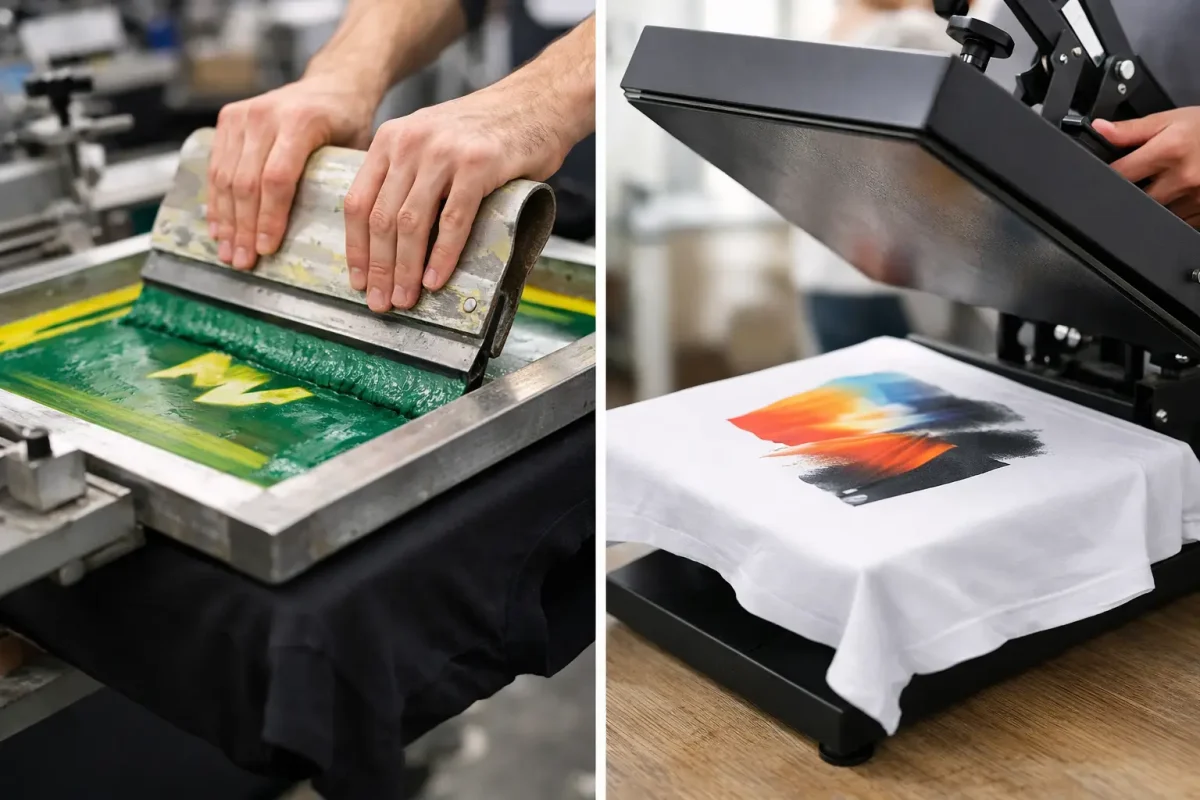
Screen printing applies ink directly onto the garment through a mesh screen. Each colour is usually applied separately, which makes it a strong option for simple logos, bold branding and larger runs where consistency matters.
Heat transfer works differently. The design is printed or cut onto transfer material and then applied to the garment using heat and pressure. That makes it more flexible for smaller quantities, individual names and numbers, and artwork with complex detail or multiple colours.
On paper, both methods can produce a clean result. In practice, they suit different jobs. If you are buying polos for engineers, hoodies for a college leavers order, or T-shirts for an event crew, the decoration method should match the garment, the working environment and the replacement cycle.
When screen printing makes more sense
Screen printing is usually the better fit where you need volume, durability and a straightforward logo. For businesses ordering large quantities of T-shirts, sweatshirts or hoodies with the same chest or back print, it is often the most cost-effective option once setup is spread across the run.
The print sits well on cotton and cotton-rich garments, and it gives solid coverage for bold shapes and block colours. If your logo is uncomplicated and brand consistency matters across dozens or hundreds of items, screen printing does that job well.
It also tends to wear in a more natural way over time, rather than peeling at the edges. That matters for workwear that sees regular laundering. In sectors like trades, warehousing, site work and events, garments are not treated gently. They are washed often, worn hard and replaced in batches. A print method that holds up under routine use is usually the sensible choice.
That said, screen printing is not automatically right for every large order. If the artwork includes gradients, photographic detail or frequent personalisation, the setup becomes less practical. It is best where the design stays consistent and the garment type is suitable.
Best uses for screen printing
Screen printing is a strong option for printed T-shirts, hoodies, sweatshirts and promotional garments used in volume. It suits event merchandise, staff uniforms with a standardised logo, and campaign clothing where visual consistency across the order matters.
It is less ideal where every item needs a different name or department marking, or where the garment fabric does not take the ink as cleanly.
Where heat transfer has the advantage
Heat transfer comes into its own when flexibility matters more than volume efficiency. If you need short runs, one-off garments, variable data or more detailed artwork, it gives you more control without the same setup demands.
This is why heat transfer is often used for sports-style numbering, staff names, role identifiers and smaller departmental orders. If ten jackets all need the same logo but different names, heat transfer is far easier to manage than preparing multiple screens.
It can also be the better choice for garments that are not ideal for other decoration methods. Performance fabrics, some outerwear and certain technical garments can suit transfer printing well, depending on the material and finish. In practical terms, that matters for organisations buying mixed uniform ranges rather than a single cotton T-shirt.
For hi-vis clothing, transfer methods are often used where precision placement and clean detail are needed, particularly on synthetic fabrics. The exact method still depends on the garment construction, compliance requirements and expected wash cycles, but transfer is often part of that conversation.
The trade-off is longevity. A good transfer can perform well, but it is generally more vulnerable to cracking, lifting or wearing out sooner than a properly produced screen print, especially under heavy industrial-style use. For occasional wear or controlled-use garments, that may be acceptable. For frontline teams wearing uniform daily, it needs closer consideration.
Best uses for heat transfer
Heat transfer suits short runs, personalised garments, names and numbers, and logos with fine detail or multiple colours. It is often a practical choice for sportswear, promotional clothing in low quantities, and mixed orders where not every garment is identical.
It can also help when turnaround needs to stay tight and the order would not justify screen setup costs.
Durability: the question most buyers actually care about
For most uniform buyers, durability matters more than print theory. The real question is simple: what still looks presentable after repeated washing and regular use?
In most like-for-like situations, screen printing has the edge for durability, particularly on suitable garments such as cotton T-shirts and hoodies. The ink bonds well and handles repeat wear without the same risk of edge lift that can affect transfers.
Heat transfer can still be perfectly workable, especially for lighter-use garments or where flexibility matters more than lifespan. But if the uniform is worn five days a week, washed often and expected to maintain a smart appearance across the team, transfer should be chosen carefully and for the right reasons.
This is where the garment itself becomes just as important as the print method. A print that performs well on a ring-spun cotton tee may behave differently on a softshell jacket or a moisture-wicking polo. Method and garment should always be considered together.
Cost depends on quantity, not just the method
Buyers often ask which is cheaper, but the honest answer is: it depends on how many garments you need and how the artwork is set up.
Screen printing usually carries more setup cost at the start because screens have to be prepared. That makes it less attractive for very small runs. Once the quantity increases, the cost per garment often drops and becomes more competitive.
Heat transfer usually works better for small quantities because setup is simpler. If you need a handful of printed items, or each item is different, transfer can be the more efficient route. It avoids the cost structure that makes screen printing harder to justify on low-volume jobs.
For procurement teams and business owners, this is where clear forecasting helps. If you are ordering ten garments now but will need another hundred next month, the right decision may not be the cheapest option on the first invoice. It may be the method that gives better consistency and value across repeat orders.
Artwork, detail and logo appearance
Not all logos behave the same way in print. A simple one-colour trades logo and a multi-tone academy design place very different demands on the decoration method.
Screen printing excels with bold, clean artwork. Solid shapes, text and uncomplicated branding usually come out strong and readable, especially at distance. For chest logos and large back prints, that is often exactly what a business needs.
Heat transfer can handle finer detail and more complex graphics more easily. If the artwork includes multiple colours, gradients or small elements that would be awkward to separate for screens, transfer may produce the cleaner result.
Still, visual detail is only one part of the decision. A method that reproduces a logo perfectly on day one is not automatically the best if the garment is destined for tough daily wear.
Choosing the right method for workwear and uniform
For workwear, the right choice usually starts with three questions. What garment are you branding? How often will it be worn and washed? How many units do you need?
If you are ordering standard cotton-rich T-shirts, hoodies or sweatshirts in larger quantities with the same logo, screen printing is usually the practical answer. It is reliable, cost-effective at scale and suited to repeat issue across teams.
If you are ordering smaller runs, individualised garments, or items with detailed graphics and variable names, heat transfer may be the better fit. It gives more flexibility and can keep smaller projects moving without unnecessary setup.
For mixed uniform programmes, there may not be one answer across the whole order. A business might use screen printing on event T-shirts, transfer on selected outerwear, and embroidery elsewhere in the range. That is often the most sensible approach because different garments have different technical limits.
At Vivid Promotion, that is usually where practical advice matters most – not forcing one decoration method onto every garment, but matching the method to the job, the wearer and the replacement cycle.
Screen printing vs heat transfer: the better choice is the one that fits the job
There is no blanket winner in screen printing vs heat transfer. One is not modern and the other outdated. They are simply different production methods with different strengths.
If you need scalable, durable branding on suitable garments, screen printing often comes out ahead. If you need flexibility, detail or personalisation in smaller quantities, heat transfer can be the better operational choice.
The best results usually come from deciding early how the garments will actually be used. A uniform that arrives on time, washes well and still looks consistent across the team is doing its job properly – and that starts with choosing the decoration method for the real working day, not just the artwork proof.