No products in the basket.
Branded Workwear
Telford T Shirt Printing That Works Hard
17
Mar
Mar
If you are ordering branded T-shirts for a team in Telford, the print is only half the job. The other half is choosing garments that suit the work, the logo application that will last, and a delivery setup that does not leave someone in the office sorting boxes for half a day.
That is where many orders go wrong. A cheap tee can look fine in a product photo, then lose shape after a few washes. A large chest print can look sharp on day one, then crack if the fabric and print method are not matched properly. And if twenty staff need different sizes by Monday, a single mixed carton is not much help.
What buyers actually need from Telford t shirt printing
For most organisations, Telford t shirt printing is not a one-off creative purchase. It is an operational one. You need branded clothing that arrives on time, fits the role, and still looks presentable after regular wear.
That applies whether you are buying for warehouse staff, event crews, trades, school leavers, hospitality teams or care settings. The priorities are usually the same – clear branding, reliable garment quality, consistent repeat orders and a process that makes reordering simple.
This is why the right supplier should ask practical questions early. Where will the T-shirts be worn? How often will they be washed? Do staff work indoors or outside? Is this for short-term event use, or for weekly uniform rotation? Those details affect the garment choice just as much as the print itself.
Start with the job, not the logo
A lot of buyers begin with artwork placement, but the better starting point is the working environment. A T-shirt for a summer promotion is a different purchase from a T-shirt used under a hoodie on a building site or in a stockroom.
For light promotional use, a standard cotton T-shirt can be the right fit. It keeps costs under control and gives you enough print area for front, back or sleeve branding. If the shirts are for regular staff uniform, heavier-weight cotton or a polycotton blend often makes more sense. You get better durability, more stability after washing and a smarter appearance over time.
Fit matters too. Unisex tees can work well for mixed teams and straightforward ordering, but some organisations need a wider size and fit range to keep staff comfortable. That is particularly relevant when uniforms are worn for full shifts. If the garments are uncomfortable or unflattering, they end up unworn, and that defeats the point of branding them.
Colour choice should be led by visibility, logo contrast and practicality. Black and navy are popular because they hide marks well, but they are not always the best option for every logo. A dark garment with a detailed dark print can lose impact quickly. On the other hand, white shirts may show dirt too easily in trade and site settings. There is no single best answer. It depends on how the T-shirts will be used day to day.
Choosing the right print method
This is where experience matters. Not every logo should be printed the same way, and not every garment responds the same way to the same process.
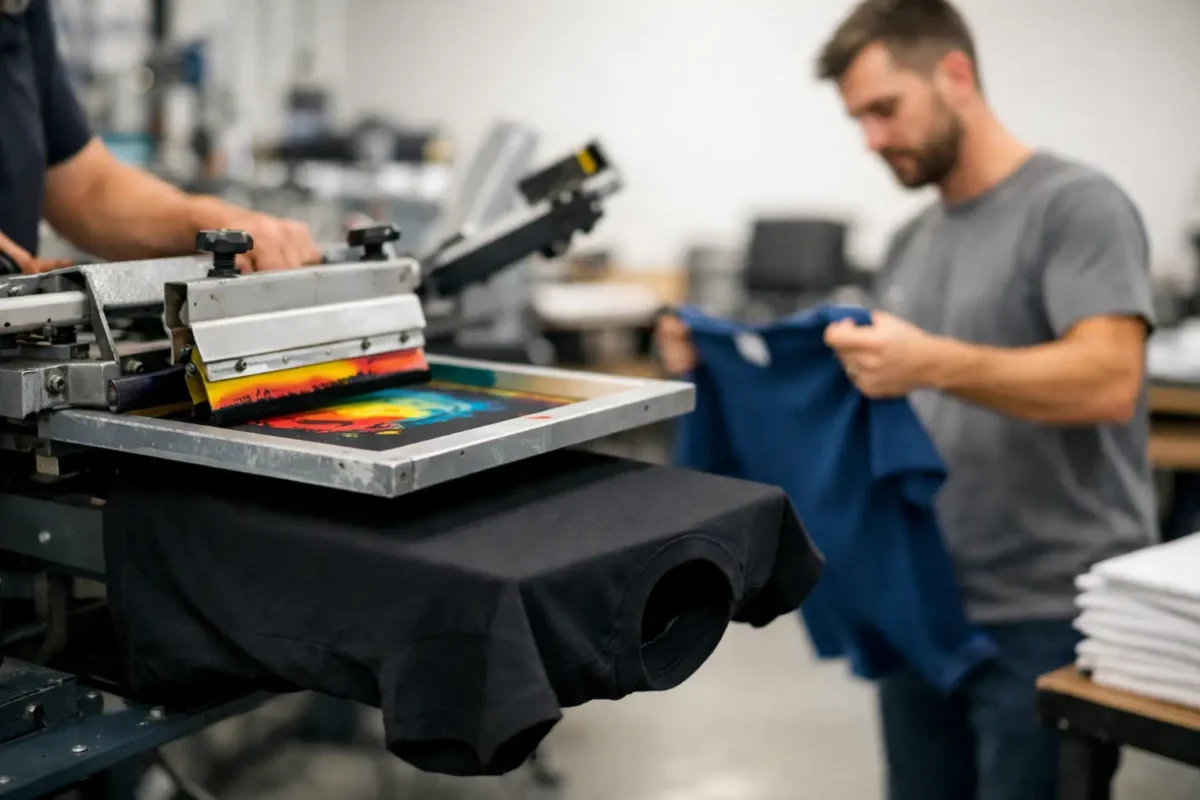
Screen printing is often the right choice for larger volume runs where you need strong, consistent results and solid value per unit. It works well for bold logos, event shirts and team wear where the design does not need lots of tonal detail. If you are ordering in quantity, it is usually one of the most efficient options.
Transfer printing can be better for smaller runs, names, numbers and designs that need flexibility across mixed garments. It is also useful when different departments or individuals need customised details. For example, one team may need the same front logo but different role titles on the back. That is often easier to manage with transfer applications.
Direct-to-garment style printing can suit highly detailed artwork on suitable fabrics, but it is not automatically the best route for hard-wearing uniform. Buyers should focus less on whichever print method sounds newest and more on whether it fits the garment, the artwork and the expected wash cycle.
Good Telford t shirt printing should also include artwork preparation that makes the logo reproduce cleanly. A poor source file can leave edges fuzzy, small text unreadable or colours inconsistent across repeat orders. Getting the logo set up properly from the start saves time and avoids disappointment later.
Uniform orders need a repeatable system
The first order gets attention. The second and third are where the process gets tested.
If you are buying for a growing team, repeatability matters. You want to know that the same logo position, print size and garment standard can be reordered without starting from scratch each time. That is especially important for businesses with multiple departments, changing staff numbers or site-based teams that need topping up throughout the year.
Consistency is not just about appearance. It affects purchasing efficiency too. If every reorder turns into another round of artwork checks, garment substitutions and delivery confusion, the admin cost rises quickly.
This is why structured ordering matters. Being able to buy by garment type, by role or by department makes life easier for procurement staff and office managers. It keeps approvals clear and reduces the risk of the wrong items being ordered for the wrong team.
Delivery and packing matter more than most buyers expect
Printing gets the attention, but fulfilment is where many uniform projects either stay under control or become a problem.
If your T-shirts are for an event, you may need bulk delivery palletised and labelled so stock can be moved quickly on arrival. If they are for staff issue, it is often more useful to have garments packed by employee, size or department. That cuts out internal sorting and helps teams issue uniform straight away.
For larger organisations, this is not a minor extra. It can save hours of handling time and reduce mistakes. A printed T-shirt order that arrives in the right quantities but in the wrong format still creates work for the customer.
Lead times should be treated the same way. Buyers need realistic production schedules, not vague promises. If shirts are needed for an opening date, a rollout, a school event or a site team mobilisation, reliability matters more than sales talk.
When printed T-shirts are the right choice
Printed T-shirts are not always the answer, but they are often the most practical one where clear branding and cost control are the priority.
They work well for event staffing, promotional campaigns, temporary teams, hospitality support staff, warehouse and logistics teams, school leavers, and general branded casual uniform. They also make sense where larger logos are needed on the back or chest, which embroidery does not always handle as effectively on lightweight garments.
That said, there are trade-offs. If you need a more formal finish or a decoration that suits repeated industrial laundering, polo shirts or sweatshirts may be a better long-term option for some teams. If garments will be worn outdoors or layered under outerwear, a broader uniform package often works better than relying on T-shirts alone.
In practice, many organisations do not buy just one garment type. They use printed T-shirts for warmer months, task-based roles or event use, then add hoodies, fleeces or jackets for the rest of the year. That approach keeps branding consistent while matching the clothing to real working conditions.
How to avoid common ordering mistakes
The biggest mistake is buying on unit price alone. A lower-cost shirt is not cheaper if it wears out quickly, shrinks, or needs replacing after a short period. The same goes for print. If the application is wrong for the garment, the job can look tired long before the clothing itself is finished.
Another common issue is underestimating quantity planning. It is usually more efficient to think ahead about starter stock, spare sizes and likely joiners rather than placing rushed top-up orders one week later. This is especially true for businesses with regular recruitment or seasonal staffing peaks.
Artwork approval is another area where delays happen. If multiple people need to sign off logo size, garment colour and print position, do that before production is booked. Small decisions held up at approval stage often cause bigger timing issues than production itself.
For organisations buying local or regional supply with wider UK coverage, it also helps to work with a supplier that understands both production and distribution. Vivid Promotion supports businesses across Telford and the wider Midlands with branded clothing that is set up for practical ordering, reliable decoration and delivery processes that reduce admin rather than add to it.
A better way to approach Telford t shirt printing
The best T-shirt printing jobs are not just well printed. They are properly specified from the start. The garment suits the role, the print method suits the fabric, the logo has been prepared correctly, and the order arrives packed in a way that people can actually use.
That is the difference between buying branded clothing and putting a workable uniform system in place. If your team needs T-shirts that look right, wear well and turn up ready to issue, it pays to treat the order as an operations job, not just a branding job.
Get those details right at the start, and the next order becomes much easier.