Branded Workwear
T-Shirt Printing for Workwear Orders
Mar
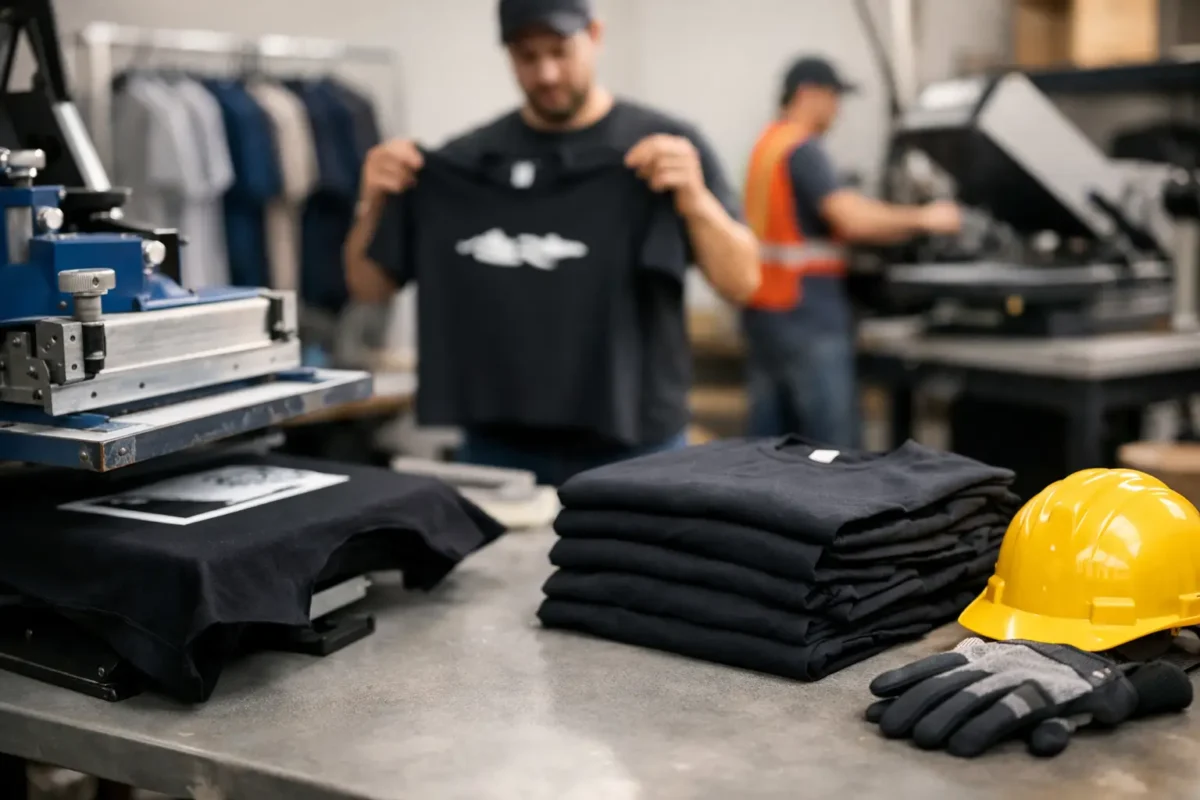
If you are ordering branded T-shirts for a team, the print itself is only half the job. The other half is making sure the garment, logo application and delivery process all suit how that clothing will actually be used.
That matters whether you are buying for a trade counter, a care provider, a school event or a nationwide field team. A good-looking print on the wrong T-shirt will not stay good-looking for long. Equally, a perfectly suitable garment can still create problems if sizes, names, departments or issue points are not planned properly.
What t-shirt printing needs to achieve in a working environment
For business buyers, t-shirt printing is not just about putting a logo on the chest. It needs to hold its appearance through repeated washing, suit the fabric, stay comfortable in daily wear and support a consistent brand image across different roles and sites.
In practice, the right result depends on a few operational questions. How often will the garment be worn? Is it for light promotional use or daily workwear? Will staff be indoors, outdoors or moving between both? Does the design need a small left chest logo, a large back print, staff names or department identification?
These details affect the decoration method from the start. A print option that works well for event merchandise may not be the best choice for warehouse staff or engineers. Likewise, a T-shirt chosen on price alone may end up costing more if it loses shape, fades quickly or needs replacing early.
Choosing the right t-shirt printing method
There is no single best print method for every order. The correct option depends on artwork, quantity, garment type and expected wear.
Screen printing for larger runs
Screen printing is often the sensible choice for larger quantities where the same design is repeated across many garments. It gives a clean, durable finish and is well suited to bold logos, back prints and straightforward branding. For teams, events and promotional distributions, it usually offers strong value once quantities increase.
The trade-off is setup. Screen printing is less efficient for very small runs or artwork that changes from garment to garment. If every shirt needs a different name or role title, another print method may be more practical.
Transfer printing for flexibility
Transfer printing is useful when you need flexibility, especially for smaller runs, mixed sizes or variable data such as individual names and numbers. It can work well for company uniforms, school leavers’ garments and department-specific clothing where personalisation matters.
It is also a practical option for certain fabrics and applications where direct methods are less suitable. The key is using the correct transfer material and applying it properly. Poor transfer work tends to show up quickly in washing performance, edge lifting or cracking.
Direct-to-garment and other specialist options
Some designs with more colour variation or finer detail may suit specialist print approaches. These can produce excellent visual results, but they are not automatically the best fit for every workwear order. Cost, lead time, garment compatibility and wash durability all need checking first.
For most business buyers, the best approach is simple – match the print method to the job, not the other way round.
The garment matters as much as the print
A printed logo can only perform as well as the T-shirt underneath it. Fabric weight, fibre mix, fit and finish all affect the end result.
A lightweight promotional tee may be perfectly adequate for a one-off event, summer campaign or giveaway. It may not be the right choice for decorators, warehouse staff or maintenance teams who need more structure and better durability. For everyday workwear, heavier cotton or polycotton options often make more sense because they tend to hold shape better and cope with repeated laundering.
Fit matters too. If you are issuing across a mixed workforce, a garment range with reliable sizing and repeat availability is usually more useful than chasing the lowest entry price. Repeat orders become easier, and staff are less likely to end up in inconsistent replacements a few months later.
Colour choice also has a practical side. Darker garments can hide marks in more demanding environments, but they can change how artwork appears. A white logo on navy behaves differently from a full-colour logo on heather grey. Good print planning takes garment colour into account early, rather than trying to fix visibility problems after approval.
When print is the better option than embroidery
For T-shirts, print is often the more natural choice. It keeps the garment lighter, allows larger artwork areas and generally suits bold branding on the chest, sleeve or back. It is also useful where the logo has fine detail, gradients or larger filled areas that would not translate as neatly in stitch.
There are also situations where print is the practical option for reasons beyond appearance. Some garments are simply better decorated without needle penetration. While that point is especially relevant on waterproof outerwear, the wider lesson applies across uniform buying – the decoration method should support the garment’s function, not interfere with it.
Embroidery still has its place in uniform ranges, especially on polos, sweatshirts, fleeces and outerwear where a stitched logo gives a durable, structured finish. But for T-shirts specifically, printing is often the cleaner and more cost-effective route.
T-shirt printing for different types of buyer
Not every organisation buys in the same way, so the order setup should reflect that.
For construction and trade businesses, the priority is usually durability, straightforward branding and reliable repeat supply. Staff need garments that are comfortable under layers, easy to replace and consistent across new starters and existing teams.
For healthcare and care settings, comfort and clear identification matter more than fashion-led styling. Department names, job roles and colour coding may be just as important as the main logo, particularly when garments need to support quick recognition on shift.
For events and promotional use, the decision often swings towards scale and speed. Bulk quantities, clear branding from a distance and delivery arranged around deadlines can matter more than long-term garment lifespan. In those cases, the right print method is the one that delivers a presentable result at the required volume without complicating fulfilment.
For schools and colleges, especially leavers’ garments and group orders, variable personalisation becomes more relevant. Names, initials or cohort details can affect the best decoration route and the way orders are packed and issued.
Fulfilment can make or break a uniform order
A lot of uniform problems happen after production, not during it. The print may be correct, but if cartons arrive unsorted and someone in the office has to separate hundreds of garments by site, employee or department, the job is only partly done.
That is why fulfilment needs thinking about at the same time as garment and print choice. Bulk pallet delivery may suit event stock, trade customers or central stores. Individual employee packaging may be the better option where garments need to be issued quickly across departments or multiple locations.
For larger organisations, that admin saving is not a minor extra. It reduces internal handling, shortens rollout time and lowers the risk of sizes or names going astray. Buyers who order regularly tend to value that just as much as the decoration itself.
Getting artwork and approvals right first time
Print quality starts with artwork quality. If a logo is supplied in the wrong format, poor results usually show up in fuzzy edges, weak line definition or colour inconsistency.
That is why artwork preparation matters. A proper print-ready file helps the logo reproduce cleanly and consistently across different garments and order cycles. It also avoids delays at approval stage, which is where many urgent uniform orders lose time.
Approvals should be clear and practical. Placement, size, garment colour and print colours all need confirming before production starts. If there are multiple departments or garment variations in the same order, each version should be checked properly. It is much easier to correct a proof than a finished run.
A sensible way to buy printed T-shirts
The simplest buying route is usually the best one. Start with the use case, narrow the garment range, choose the decoration method that suits the artwork and then set the delivery format around how the clothing will be issued.
That is how business buyers avoid common mistakes such as selecting a cheap garment for heavy daily use, choosing an unsuitable print method for a detailed logo or overlooking the amount of time needed to sort stock once it arrives. A dependable supplier should help with those decisions, not leave you to guess.
If you are reviewing options for branded uniforms, promotional clothing or team issue, it is worth dealing with a supplier that can support both decoration choice and fulfilment planning in one place, such as Vivid Promotion at https://www.vividpromotion.com.
The best t-shirt printing job is the one that still looks right after real use, arrives where it needs to go and saves your team work instead of creating more of it.