Branded Workwear
Security Staff Uniform Printing Services Guide
Apr
A security uniform has to do two jobs at once. It needs to identify your team instantly, and it needs to stand up to long shifts, mixed weather and repeated washing. That is why security staff uniform printing services are not just about putting a logo on a polo shirt. The real decision is choosing garments, print methods and fulfilment that work in day-to-day operations.
For buyers managing guards across retail, events, construction sites, logistics depots or reception points, the wrong setup creates problems quickly. Prints crack, waterproof jackets get damaged by the wrong decoration method, sizing becomes inconsistent and uniform issue turns into an admin task nobody has time for. A better approach starts with how the uniform will be used, not just how it will look in a product image.
What security staff uniform printing services should actually cover
If you are buying for a security team, printing is only one part of the job. The service around it matters just as much. You need clear advice on garment suitability, a print method that matches the fabric, consistent logo reproduction and a delivery process that does not leave your team sorting mixed cartons on site.
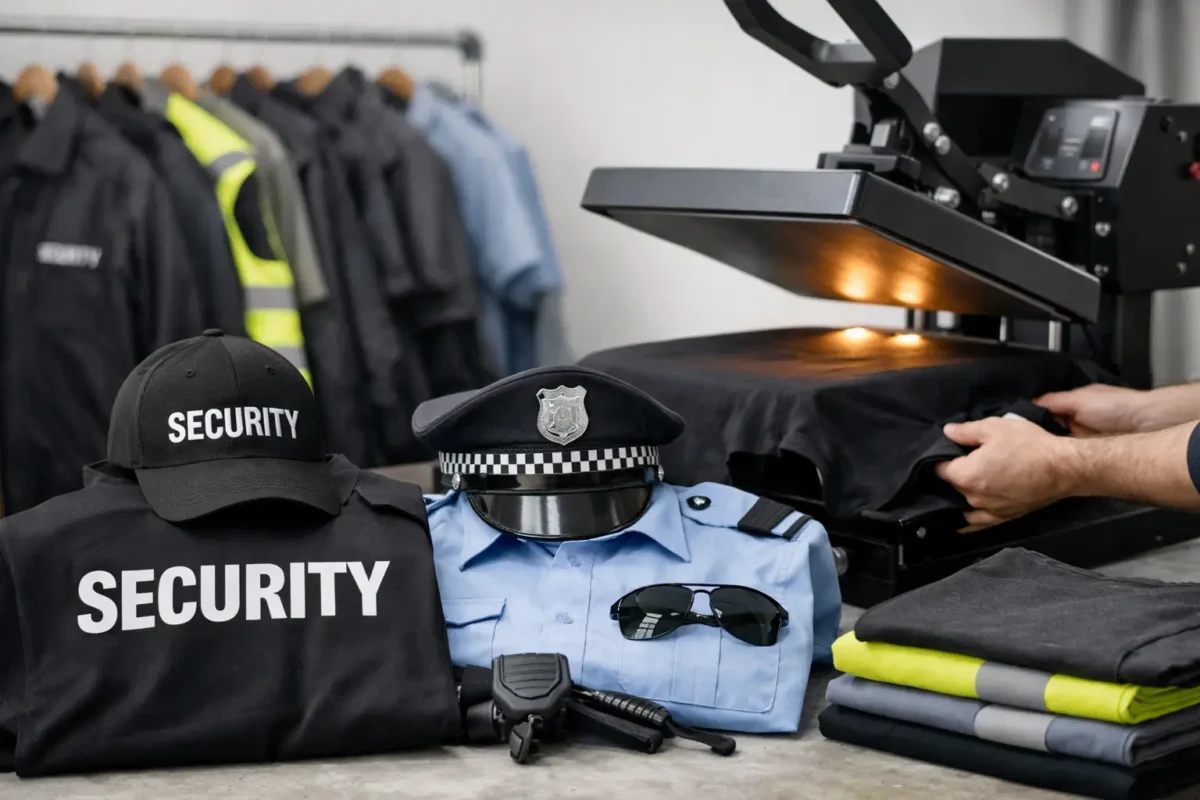
A proper uniform supplier should be able to handle common security clothing combinations, whether that means printed polo shirts for indoor retail guards, softshell jackets for mobile patrol teams, fleeces for warehouse security or hi-vis outerwear for gatehouse and traffic management roles. In many cases, buyers need a mix of all of these in one order.
That matters because security teams rarely work in one fixed environment. A front-of-house officer in a corporate building has different uniform needs from a guard working overnight at a distribution centre. The branding still needs to be consistent, but the garment choice cannot be one-size-fits-all.
Choosing garments for printed security uniforms
The best results usually come from starting with the job role and shift pattern. For indoor teams, printed polos and sweatshirts are often the practical base layer. They give clear identification, wash well and are easy to issue in volume. For outdoor work, you are usually looking at fleeces, softshells, bodywarmers and waterproof coats layered over branded basics.
This is where many uniform orders go wrong. Buyers focus on the chest logo and forget about wear conditions. Security staff spend time standing outdoors, moving between heated buildings and exposed areas, and carrying radios or ID. The garment has to cope with that. A cheap top that looks presentable on day one can lose shape or fade after a few wash cycles, which then affects how the whole team presents on site.
Hi-vis may also be part of the requirement. If your officers are working around vehicles, loading bays, event build zones or construction access points, branded hi-vis can be a sensible option. It gives visibility and identification in one garment, but only if the decoration is positioned properly and does not interfere with compliance features.
Print or embroidery for security uniforms?
This is one of the first questions buyers ask, and the honest answer is that it depends on the garment.
Print is often the better option for security uniforms when you need larger text, bold back prints or clear role identification such as SECURITY across jackets, polos or sweatshirts. It gives strong visibility at distance and works well for event security, stewarding support and teams that need to be recognised quickly in busy environments.
Embroidery still has a place, particularly on polos, fleeces, sweatshirts and caps where a stitched chest logo gives a more formal finish. It can suit concierge-style security roles or reception-based teams where presentation leans more corporate. But embroidery is not always the right choice for every item. On waterproof garments, for example, stitching can create needle holes, so print is often the more practical decoration method.
That kind of advice matters. Buyers do not need decoration for decoration’s sake. They need the method that protects the garment, keeps branding readable and lasts through regular use.
When print makes most sense
Printed branding is especially useful where visibility is more important than texture or a premium stitched finish. Large back prints, department labels and clear role wording are difficult to achieve as effectively with embroidery. Print can also be a better route when you are branding lighter garments in larger quantities and need a cost-effective result across multiple sizes.
For security teams, this is common on T-shirts, polos, hoodies, sweatshirts and some outerwear. If officers are working events, retail parks, campuses or logistics facilities, readable print on the back can do more operational work than a small embroidered chest logo.
When a mixed branding approach works better
In practice, many security uniform orders use both methods. A small embroidered logo on the chest for a smarter finish, combined with printed SECURITY wording on the back, often gives the best balance. The front looks tidy and professional. The back remains clear and functional.
That approach is especially useful for organisations that want one brand standard across different job types. Your reception officer, mobile patrol worker and event guard may not all wear the same garments, but they can still look like part of the same team.
Consistency matters more than most buyers expect
One of the main issues in uniform supply is inconsistency between orders. The logo size changes slightly. The print colour shifts. One batch is centred properly and the next is not. For a security team, that undermines the professional look you are paying for.
This is why artwork setup and logo conversion should not be treated as an afterthought. A supplier needs to produce print-ready and embroidery-ready files that hold up across garment types. The badge on a polo shirt, the branding on a softshell and the wording on a hi-vis vest all need to stay consistent even though the garments themselves are different.
It also helps to keep approved garment choices on file for repeat ordering. Once a business has settled on its preferred polo, fleece, outer jacket and hi-vis option, repeat purchases become faster and more reliable. That saves time for procurement teams and reduces the risk of staff turning up in mismatched uniform lines.
Fulfilment is a bigger part of the service than many people realise
Printing quality gets attention, but fulfilment is often what decides whether the order process feels easy or painful. If you are ordering for one site with a small team, bulk delivery may be fine. If you are issuing uniforms across multiple staff members or locations, sorted packing becomes far more useful.
For larger employers, per-employee packaging can remove a lot of internal admin. Each team member receives the correct garments and sizes ready to issue, rather than someone in the office opening boxes and sorting piles of clothing by hand. If you are managing new starters, seasonal staff or event teams, that can save hours.
Bulk pallet delivery also has a place, especially for events businesses, site rollouts and trade customers ordering in larger runs. The key point is that fulfilment should match how your organisation actually distributes kit. There is no point getting the print right if the delivery process creates extra work on your side.
Security staff uniform printing services for repeat orders
Most security uniform buying is not a one-off project. Teams change, headcount moves up and down, and replacement garments are part of normal operations. That is why repeat ordering should be built into the service from the start.
A dependable supplier should make it easy to reorder existing uniform lines without restarting the artwork and approval process each time. The more structured the buying path, the easier it is for office staff, operations managers and site managers to keep uniforms consistent across months rather than just one initial order.
This is particularly useful for organisations with several roles under one contract. You may need standard branded workwear for most staff, heavier outerwear for patrol teams, and hi-vis clothing for gate or traffic duties. Keeping those options organised by garment type or department makes reordering far simpler.
For businesses that need that level of control, Vivid Promotion works well as a practical supply partner because the focus stays on garment suitability, reliable branding and getting orders packed in a way that reduces work for the customer.
What to ask before placing an order
Before approving any security uniform print run, check a few basics. Ask whether the garments are suitable for the working environment, whether print or embroidery is the better method for each item, and how branding will be kept consistent across future orders. Also ask how the uniforms will arrive – bulk packed, site packed or sorted by employee.
Those questions are not about adding complexity. They are how you avoid waste. A security uniform order should support the job, look consistent on shift and arrive ready to issue.
The best buying decisions are usually the simplest ones after the groundwork has been done properly. Choose garments your team will actually wear, decorate them in the method that suits the fabric, and make sure the delivery process fits the way your organisation runs. That is what turns uniform printing from a purchasing task into something that genuinely helps operations.