Branded Workwear
How to Get a Logo on Workwear
Apr
A logo that looks sharp on a screen can fail badly on a polo, jacket or hi-vis vest if the setup is wrong. If you are working out how to get a logo on workwear, the real job is not just adding branding. It is choosing the right garment, the right decoration method and the right production process so your team gets uniform that wears well and arrives ready to issue.
Start with the logo file, not the garment
Most delays happen before production starts. A buyer sends over a screenshot, a website image or a small PNG pulled from an email signature, then expects it to be ready for embroidery or print. Sometimes that works for a quick visual, but it is rarely the right starting point for clean, repeatable branding.
For printed workwear, a high-resolution file is usually needed so edges stay crisp and colours reproduce properly. For embroidered workwear, the logo has to be converted into a stitch file. That process matters because thread does not behave like ink. Fine outlines, very small lettering and soft gradients often need adjusting to work on fabric.
This is why the best first step is to send the clearest version of your logo you have, ideally in an original design format or a large, high-quality file. If your branding includes specific Pantone references or strict brand colours, send those too. It reduces back-and-forth and helps keep your uniform consistent across repeat orders.
How to get a logo on workwear: choose embroidery or print
The decoration method is the main decision. In most cases, the choice comes down to embroidery or garment printing, and each suits different jobs.
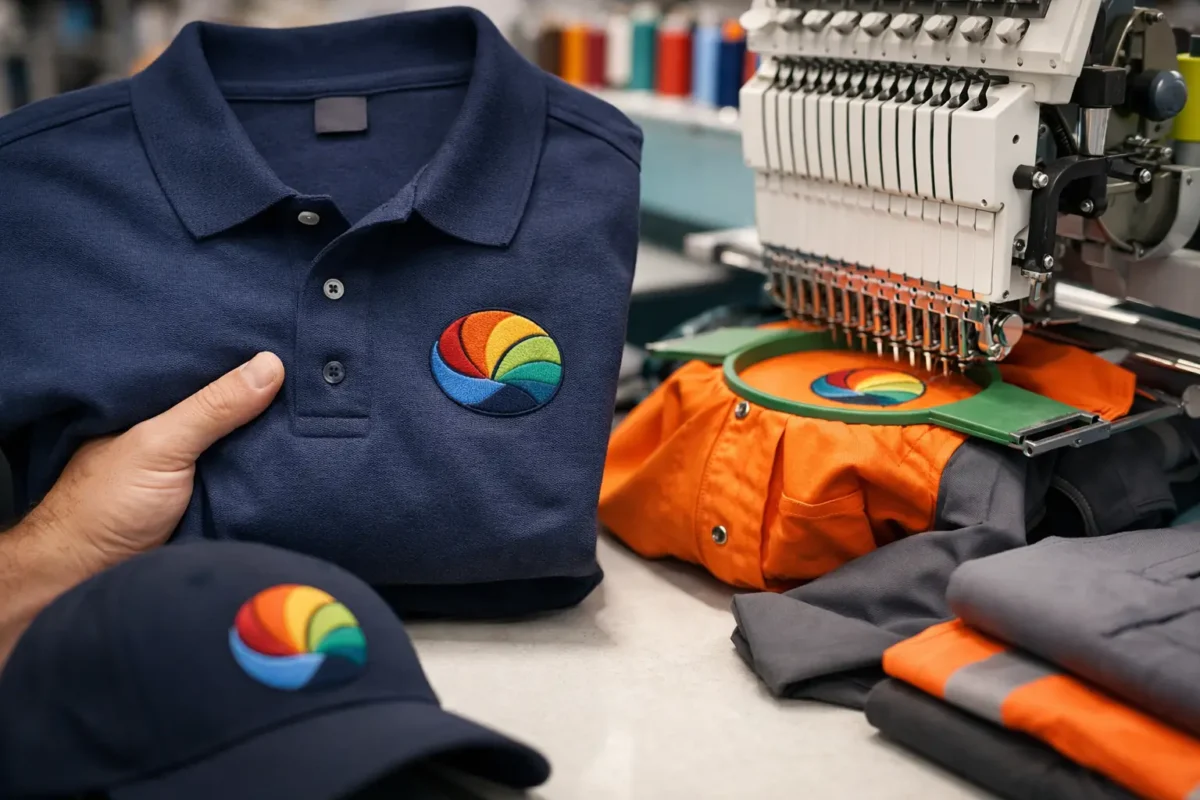
Embroidery is usually the better option for polos, sweatshirts, hoodies, fleeces, bodywarmers and many jackets. It gives a durable, professional finish and holds up well to frequent washing. For trade teams, site staff, schoolwear and everyday uniforms, it is often the most practical choice because it stays smart over time.
Print is often the better fit when the logo is large, highly detailed or includes gradients and fine text that embroidery would struggle to reproduce. It also suits T-shirts and promotional clothing where a softer, flatter finish is preferred. If you need a large back print with a chest logo, print can be more economical and visually clearer depending on the artwork.
There are also cases where the garment decides for you. Waterproof jackets are a good example. If you embroider through a fully waterproof outer layer, you create needle holes. On some garments that is manageable, but on others it affects performance. In those cases, print is often the safer recommendation. A good supplier should flag that early rather than simply decorating whatever is ordered.
Match the garment to the job
Workwear is not one category. A warehouse picker, a care worker, a site foreman and an events crew all need different things from a uniform. That affects how your logo should be applied.
For everyday staff uniform, polos and sweatshirts remain the standard because they balance cost, comfort and durability. An embroidered left chest logo is the usual choice because it is smart without being overdone. If the role is customer-facing, adding a larger back print or company name can help visibility, but not every team needs it.
For construction, trades and logistics, garment choice often starts with practicality. Hi-vis clothing, softshells, fleeces, work trousers and outerwear need branding that does not interfere with performance or compliance. Placement matters here. A logo must sit well on the garment without reducing visibility or covering key reflective sections.
For healthcare and care settings, branding tends to be cleaner and more restrained. Tunics, scrubs and healthcare polos often work best with smaller embroidery because it withstands frequent laundering and gives a tidy finish. Department names, staff roles or individual names may also be added, but the more variables you introduce, the more important it is to manage artwork and ordering carefully.
Think about placement before you approve anything
Chest logos are standard for a reason. They are visible, practical and suit most garments. But they are not the only option, and the wrong placement can make otherwise good workwear look awkward.
A left chest logo works well on polos, fleeces, jackets and hoodies. Back prints are useful for contractors, events staff and teams that need to be identified at distance. Sleeve branding can work on premium uniform ranges, but only if the garment and logo scale suit it.
Size also needs controlling. A logo that looks neat on a polo may disappear on a padded coat. A large print that works on the back of a T-shirt may overpower the front of a scrub tunic. This is where visual proofs and experienced setup matter. You want branding that is consistent, but consistency does not always mean identical size across every garment.
Budget, quantity and lead time all affect the answer
If you are asking how to get a logo on workwear, you are usually also asking how quickly it can be done, how much it will cost and how much admin it creates internally. Those practical points shape the best route.
Embroidery generally has an initial setup cost because the logo must be digitised into a stitch file. Once that is done, repeat orders are straightforward if the artwork stays the same. Print can also involve setup depending on the method and quantity. For short runs, one approach may be more suitable than another. For larger orders, unit cost often improves, but only if garment selection is standardised.
Mixed orders also need thought. If you are ordering polos, hoodies, hi-vis vests and jackets together, it is sensible to confirm which items will be embroidered and which will be printed before final approval. That avoids surprises when the finished pack arrives.
Lead time depends on artwork readiness, stock availability, approval speed and order size. Buyers sometimes focus only on production time, but approval delays are just as common. If several managers need to sign off logos, colours and wearer lists, build that in from the start.
Get the ordering process right for larger teams
A small order for five embroidered polos is one thing. A rollout across multiple departments, sites or event teams is another. At that point, the workwear itself is only part of the job. Fulfilment becomes just as important.
If every item arrives in one bulk box, someone on your side still has to sort sizes, names and departments. That creates cost and delay internally, especially for schools, healthcare providers and businesses issuing uniform across multiple locations. For larger orders, it is worth asking about packing options, wearer allocation and delivery format at the start rather than treating them as extras later.
This is where an experienced supplier adds value. Vivid Promotion, for example, supports both bulk delivery and per-employee packing, which is useful when you need garments organised and ready to hand out rather than stacked in a storeroom waiting to be sorted.
Common mistakes when getting a logo on workwear
The biggest mistake is choosing on price alone. Cheap garments can look acceptable on day one, then lose shape, fade or wear out quickly. That reflects on the business as much as the logo itself.
Another common issue is forcing one branding method across every garment. What works on a cotton polo may not be right for a waterproof coat. The better approach is to keep the branding visually consistent while allowing for method changes where fabric and use demand it.
There is also the problem of overcrowding. A chest logo, sleeve logo, back print, employee name and phone number can all be added, but that does not mean they should be. Uniform works best when branding is clear and purposeful.
Finally, buyers often underestimate reordering. If you expect to add starters regularly, standardise the garment range and logo setup from the beginning. That makes repeat purchases faster and helps maintain a consistent look across the team.
What you need to send a supplier
To move quickly, provide the logo file, preferred garment types, likely quantities and where the branding needs to go. If there are wearer names, departments, site codes or mixed delivery points, include that upfront. The more complete the brief, the more accurate the recommendation.
It also helps to explain the working environment. Say if the clothing is for outdoor use, frequent washing, healthcare settings, front-of-house staff or hi-vis compliance. A decent supplier will use that information to steer you away from poor garment choices or unsuitable branding methods.
If you are unsure, ask for guidance instead of guessing. A practical recommendation now is cheaper than replacing a full order later.
Getting a logo onto workwear is straightforward when the process is handled properly. Start with usable artwork, choose garments that suit the job, and let the decoration method follow the fabric and working environment. Do that, and the finished uniform will not just carry your logo – it will actually work for the people wearing it.