Branded Workwear
How to Prepare a Logo for Embroidery
Apr
If you are ordering branded uniforms, knowing how to prepare a logo for embroidery will save time, avoid production delays and give you a cleaner result on the finished garment. A logo that works well on a website or business card will not always stitch well onto a polo, fleece or hi-vis jacket. Embroidery has physical limits, and the sooner those are accounted for, the smoother the order process becomes.
For most businesses, the issue is not the logo itself. It is the difference between digital artwork and stitched decoration. Embroidery uses thread, needle penetration and stitch paths, so fine details, tiny text and tonal effects often need to be simplified before production. That is normal. A good embroidery setup keeps the logo recognisable while making sure it can be repeated consistently across multiple garments and sizes.
How to prepare a logo for embroidery from the start
The best starting point is clean artwork. If you have a vector file such as AI, EPS or a properly built PDF, that usually gives the clearest base for conversion. These formats keep edges sharp and make it easier to identify shapes, text and colour areas. A high-resolution PNG can sometimes work, but a low-quality screenshot or image pulled from a website usually creates unnecessary problems.
The reason is simple. Before a logo can be embroidered, it needs to be digitised. That means converting the artwork into a file that tells the embroidery machine what stitch type to use, where stitches start and stop, and how the design should run on fabric. This is not the same as just resizing an image. If the original file is blurry, compressed or poorly built, the digitising stage takes longer and the finished result is less predictable.
If your logo has been used across printed stationery, vehicles and signage, it may include design elements that are fine in print but unsuitable in thread. Gradients, shadows, distressed textures and very thin outlines are common examples. On garments, those features either need simplifying or replacing with solid stitched areas.
What makes a logo suitable for embroidery
A strong embroidery logo is clear, balanced and built with stitch limits in mind. Solid shapes, readable lettering and defined contrast generally perform well. The more a logo depends on tiny details, the more likely it is that adjustments will be needed.
Text is often the first thing to review. Small lettering may look neat on screen but become hard to read once stitched. As a rule, if a line of text needs to be very small to fit the intended chest position, it may need removing, enlarging or separating from the main logo. This matters particularly for businesses that want a logo on left chest polos, softshells or healthcare tunics where decoration space is limited.
Line thickness matters too. Thin rules and narrow outlines can break up or disappear when embroidered, especially on textured garments such as fleeces. It is usually better to use bolder shapes and cleaner edges than try to force fine graphic detail into thread.
Colour choice also affects the result. Embroidery threads come in set shades rather than unlimited digital values. Most logos can be matched closely, but subtle tonal shifts may need approximating. If your brand uses several similar shades of blue, for example, they can merge visually once stitched at a small size. In that case, simplifying the palette often improves legibility.
Simplify before digitising
If you want the cleanest result, simplify the logo before it reaches production. Remove unnecessary taglines, merge tiny gaps, thicken delicate lines and reduce colour changes where possible. Every extra element adds stitch complexity, and complexity increases both production time and the chance of distortion on fabric.
That does not mean stripping the identity out of the logo. It means adapting it for the decoration method. In practice, the embroidered version of a logo is often a controlled, fit-for-purpose version of the main brand mark rather than a direct copy of every printed detail.
Size and placement affect the design
One of the most common problems with embroidered logos is trying to make the artwork too small. Standard left chest embroidery positions are compact. They suit a simplified logo, but not every full brand lock-up. If your logo includes a symbol, company name and small slogan, the slogan may need dropping for chest embroidery while the full version is reserved for larger back print or signage.
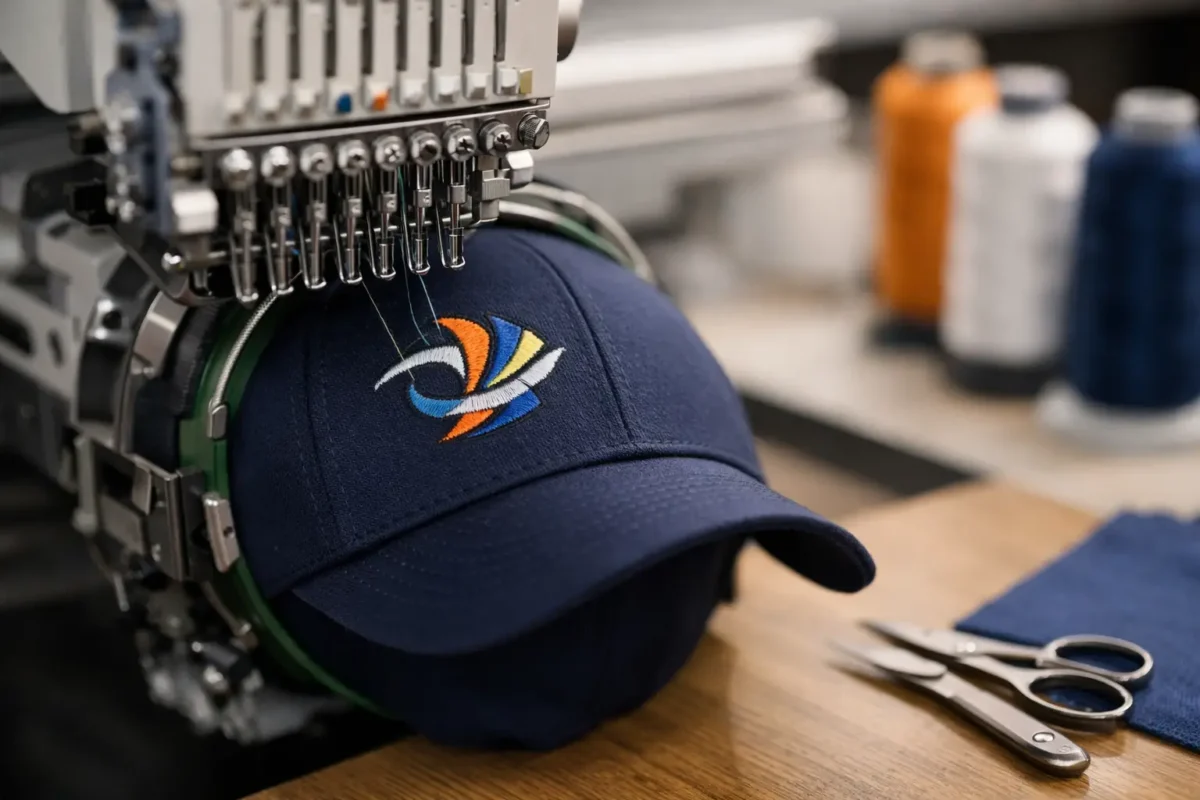
Cap embroidery is another area where size matters. The front panel gives less usable space than many buyers expect, and the curved construction can affect how a design sits. A logo that looks fine on a sweatshirt chest may need a different setup entirely for headwear.
Large embroidery on thicker garments such as hoodies, bodywarmers or jackets can work well, but stitch count climbs quickly with bigger filled areas. That affects cost and sometimes comfort, especially on garments worn all day. For some larger back designs, print is the better choice.
Match the logo to the garment
Garment fabric changes how embroidery behaves. A smooth polo shirt gives a different result from a high-pile fleece or a waterproof coat. On some waterproof garments, embroidery may not be the best option at all because needle holes can compromise the fabric. In those cases, print or another application method is often more suitable.
This is where operational buying matters more than appearance alone. A logo should not just look right on a sample. It needs to suit the job the garment is doing, whether that is site work, patient-facing healthcare, warehouse picking or outdoor event use.
Why digitising is not automatic
A common misconception is that software can convert a logo to embroidery at the press of a button. While automatic tools exist, reliable embroidery still depends on proper digitising by someone who understands stitch direction, underlay, pull compensation and fabric behaviour.
Two logos with the same artwork can stitch very differently depending on how they are digitised. A filled circle on a polo might need one approach, while the same circle on a softshell may need another. That is because fabric stretch, texture and garment construction all influence the finish.
Good digitising reduces puckering, keeps text cleaner and helps shapes hold their form after washing and wear. For uniforms ordered in volume, that consistency matters. You do not want one batch of polos looking sharp and the next batch looking heavy or uneven because the setup was not right.
Common issues when preparing a logo for embroidery
Most delays come from a handful of avoidable problems. The first is poor source artwork. If the only available file is a small JPEG copied from email signatures or social media, production starts on the back foot. The second is trying to keep too much detail at too small a size. The third is choosing embroidery for a garment or logo that would perform better with print.
Another issue is approving a design without thinking about repeat use across a uniform range. A logo may need to work on T-shirts, polos, fleeces, hi-vis waistcoats and coats. That does not always mean one single version fits every item. Some businesses are better served by having a standard embroidered chest logo and a separate print setup for larger or more detailed applications.
If you are ordering for multiple departments, it is also worth planning whether subtext, role names or department identifiers need to be stitched. Extra wording can be useful, but it needs enough size to remain readable and enough contrast against the garment colour.
A practical checklist before you send your logo
Before submitting artwork, check that you have the best original file available, confirm the intended garment types, and be clear about where the logo is going to sit. It also helps to state the approximate decoration size and whether the logo needs to include all wording shown in the master brand version.
If your business has strict brand guidelines, send those too. They help with colour matching and logo usage, but be prepared for a practical conversation if the guideline version is too detailed for embroidery. The best production outcomes usually come from balancing brand consistency with what will stitch cleanly in real-world use.
For larger uniform rollouts, especially where garments are packed per employee or split by team, getting the logo setup right early on avoids repeated amendments later. That is one reason many organisations treat embroidery preparation as part of the purchasing process rather than an afterthought.
Vivid Promotion works with businesses that need that process kept straightforward, particularly when the order includes mixed garments, role-specific uniform ranges or repeat supply over time. In those cases, reliable logo preparation is not just about artwork. It is about making reordering easier and keeping branded presentation consistent across the whole team.
A logo prepared properly for embroidery does its job quietly. It stays readable, suits the garment, holds up in wear and saves you from back-and-forth before production. If you start with clean artwork and make decisions based on stitch reality rather than screen appearance, you will get a better result the first time.