Branded Workwear
Per-Employee Uniform Packaging That Saves Time
Mar
If you have ever lined up a new starter on Monday morning with a pile of mixed sizes and a spreadsheet on your phone, you already understand the problem. Uniforms are rarely hard to buy – they are hard to issue. The cost is not the garments. It is the hour you lose matching polos to people, hunting for the right hi-vis class, or fixing the mistake when someone walks onto site in the wrong PPE.
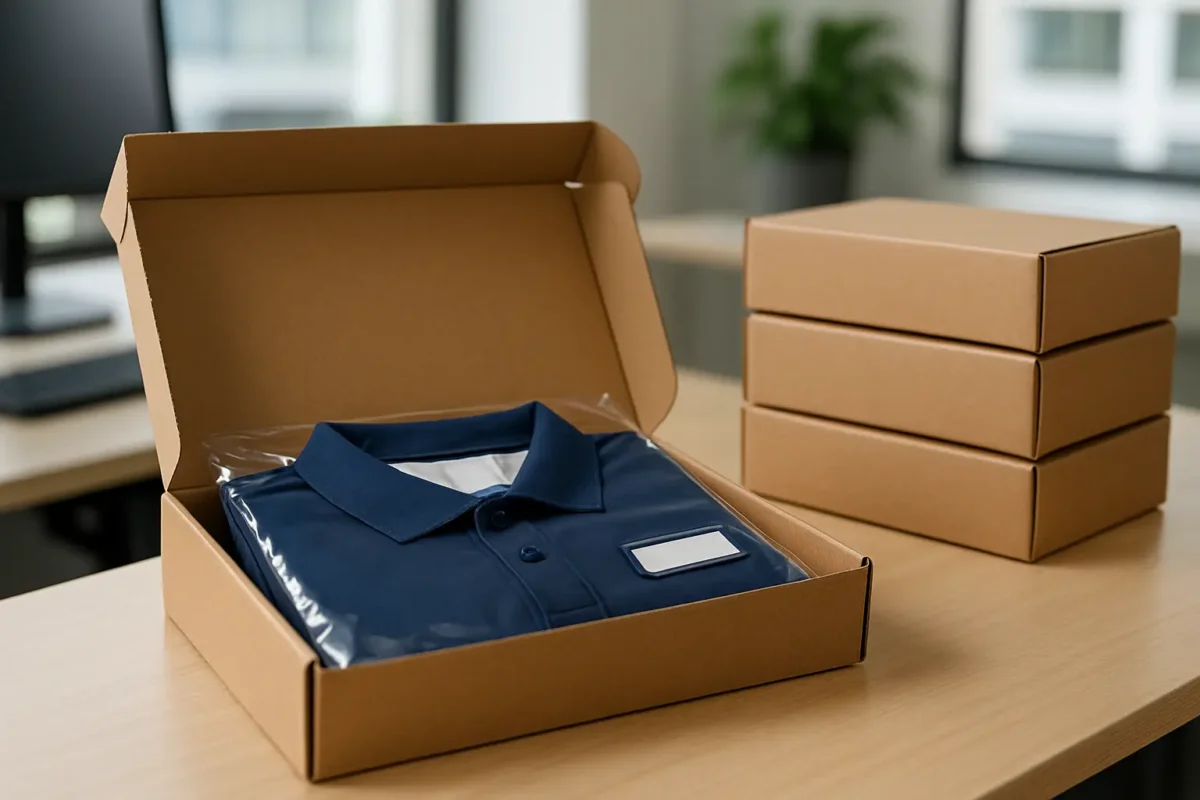
A per employee uniform packaging service is a simple operational fix: instead of receiving uniforms in bulk that you then have to split out, each person’s kit arrives as a named pack with the right sizes, colours and branded items already grouped together. For growing teams, multi-site organisations, or any business with regular churn, that one change removes a surprising amount of admin.
What a per employee uniform packaging service actually is
Per-employee packaging means your order is picked and packed by wearer, not by product line. So rather than a box of 50 polos, a box of 50 fleeces, and a box of trousers in mixed sizes, you get individual packs labelled for each employee. Each pack can include multiple garments and accessories – for example polo, sweatshirt, hi-vis vest, softshell, trousers and a beanie – depending on how you spec your uniform.
This matters because uniform issuing is a logistics task. If it lands as a mixed delivery, you end up doing a second round of picking, checking and labelling in-house. If it lands as individual packs, you can issue on day one, store spares properly, and handle leavers without the usual “what did they take?” confusion.
Where it pays off in real workplaces
Per-employee packaging tends to make the biggest difference in environments where the uniform is not just “something with a logo”. If your team needs compliance, consistency, or multiple garments, the service earns its keep quickly.
Construction and trades are an obvious fit. If you are issuing hi-vis PPE alongside branded layers, the risk of mismatched spec increases – wrong hi-vis class, wrong trouser length, wrong waterproof layer for the season. With named packs, your supervisor is not trying to remember who needs orange versus yellow, or who is on women’s fit.
Healthcare and care teams also benefit because uniforms are often role or department-specific, and sizes can vary significantly between tunics, scrubs and knitwear. Packs reduce cross-issue, which helps with infection control routines and overall presentation.
Events and frontline promotional teams have a different pressure: speed. If you are deploying staff to a venue, you want packs you can hand out at call time, not a heap of garments behind the registration desk.
Education sits in the middle. For leavers hoodies and society kit, named packaging avoids the classic end-of-term chaos of distributing the wrong size to the wrong person and then trying to swap after the fact.
The operational gains: fewer touches, fewer errors
Most organisations underestimate how much time goes into uniform handling because it is spread across different people and days. Someone receives the goods, someone checks them, someone sorts them, someone hands them out, someone fixes the mistakes. Per-employee packaging reduces the number of “touches” required.
It also lowers error rates in a practical way. When you pick by employee, you are checking the complete kit as a unit. That makes it easier to spot an obvious mismatch – a medium polo with an XXL sweatshirt – before it leaves production. It is not perfect, but it shifts quality control upstream.
The other gain is stock visibility. When you hold spares, it becomes clearer what you actually have: not “a random box of fleeces”, but “two spare packs for warehouse operatives, size L, plus three spare hi-vis vests in XL”. That is useful when you need to kit out a new starter quickly without placing an immediate top-up order.
What you need to provide for it to work
Per-employee packaging is not complicated, but it is only as accurate as the data you supply. Most problems come from last-minute changes or incomplete wearer details.
At minimum you need a wearer list with names and sizes. If you have multiple sites, include the delivery point and any internal reference you want on the label. If the uniform differs by role, department or compliance requirement, call that out clearly. You will also want to confirm colour choices, especially where the same garment comes in similar shades (for example, navy versus royal).
If you are ordering branded uniform, confirm decoration placement and method as well. Embroidery is ideal for polos, fleeces, sweatshirts and many softshells because it wears well and looks consistent. Print can be the better option for waterproofs and some hi-vis items where you want to avoid needle holes or where you need large back logos and reflective tape to remain compliant.
When per-employee packaging may not be worth it
It depends on how you issue uniform. If you are a small team ordering a single garment each, and everyone collects from one cupboard, you may not see much benefit. Bulk delivery might be fine.
It can also be less effective if your sizing data is unreliable. If you routinely order “guestimate sizes” and then swap half the items, individual packs just move the swapping problem into a different box. In those cases, it is worth sorting out a simple sizing process first – even if it is just having a set of sample sizes on site for a week.
There is also a trade-off with flexibility. Bulk stock lets you issue ad hoc – grab a hoodie when someone asks. Per-employee packs are best when you are issuing planned kits. Many organisations do a hybrid: named packs for standard issue, plus a small amount of bulk spares for urgent replacements.
How it fits with repeat ordering and ongoing uniform management
The real value shows up on repeat cycles. Once you have a standard uniform spec and a known decoration setup, reordering becomes straightforward. You are not rethinking the uniform each time. You are topping up by person, by role, or by site.
If you have seasonal needs, per-employee packs can reflect that too. Summer packs might focus on polos, lightweight trousers and caps. Winter packs might add sweatshirts, fleeces, softshells and insulated bodywarmers. You can keep the branding consistent across both and still issue appropriately for the job.
For leavers and replacements, named packing helps you control what goes out. If you use internal references on pack labels (employee number, cost centre, site code), it becomes easier to reconcile spend and reduce the “who ordered this?” chasing.
What to look for in a supplier offering it
Not all packing services are equal. You are looking for a supplier that treats fulfilment as part of the uniform job, not an afterthought.
First, check that they can handle mixed orders properly – multiple garment types, multiple decoration methods, and variable quantities per person. Some suppliers can only do named bags when every employee gets the same items.
Second, ask how they manage artwork and logo setup. Poor conversion creates delays and inconsistent branding across garments. You want a supplier that can advise when embroidery will look clean on small left chest logos, and when print is the sensible route for large back marks or technical outerwear.
Third, lead times and consistency matter more than promises. If you are planning a start date, a site mobilisation, or an event, you need confidence that a 100-person order will land when you expect it to.
Finally, consider how the packaging will be labelled and whether it suits your issue process. A clear name label is usually enough. If you are multi-site, add site or department. If you are issuing in waves, add a batch reference. The best systems are simple and readable at a glance.
A practical example: issuing without the Monday scramble
Imagine you have 25 new starters across two sites. Each needs a polo, sweatshirt, hi-vis vest, trousers and a softshell, with mixed sizes and two logo positions.
With bulk delivery, your admin team receives five boxes of mixed items. Someone spends time splitting by size, checking each person’s allocation, then bagging and labelling. If anything is missing, you only discover it when you reach that person in the queue.
With a per employee uniform packaging service, you receive 25 named packs. Site A gets 14 packs, Site B gets 11 packs. Each supervisor can hand out packs directly, and any queries are contained to a single pack rather than a full box of stock.
That is the difference: you are moving labour from your business to the fulfilment stage, where it is faster, more controlled, and repeatable.
Where Vivid Promotion fits
If you want this approach alongside embroidered and printed workwear, Vivid Promotion offers per-employee packaging as part of an end-to-end fulfilment setup, backed by a broad workwear catalogue covering hi-vis PPE, healthcare uniforms, and the usual core layers from polos through to coats.
The detail that makes it work: get the spec tight
Named packaging does not fix a vague uniform spec. The smoother your issue day, the more specific you should be upfront.
Be clear on garment choices by role, the required hi-vis standard, and whether you want men’s, women’s or unisex fits. Confirm logo placement once and stick to it unless there is a genuine reason to change. If you are mixing embroidery and print, make sure that decision is based on the garment – not just preference – because the wrong method can shorten garment life or compromise performance.
When you treat uniform as an operational system rather than a one-off purchase, per-employee packaging becomes an obvious step: it turns uniform delivery into uniform readiness, so the next time you are onboarding people, you can focus on the job instead of the sorting table.