Branded Workwear
Branded Workwear Bundles That Teams Actually Wear
Mar
Uniform ordering rarely fails because people don’t care. It fails because it becomes a pile of small jobs: chasing sizes, mixing departments, picking the wrong fabric for the work, then spending a Friday afternoon sorting bags before Monday starts.
That’s where branded workwear bundles for teams earn their keep. A bundle is not just “three items at a discount”. Done properly, it’s a repeatable kit that matches the job role, the site conditions and your brand rules – and it arrives ready to issue with minimal handling.
What a workwear bundle should solve (and what it shouldn’t)
A good bundle reduces decisions. It standardises what each role gets, limits sizing mistakes, and keeps your logo presentation consistent across garment types. It also makes re-orders straightforward because you are not rebuilding a uniform list from scratch every time a new starter joins.
The trade-off is choice. If every individual can pick any garment in any colour, you will spend more time approving and sorting. Bundles work best when you decide what “standard” looks like for each team, then allow only a few controlled options, such as two layers depending on season or site rules.
Another trade-off is that a bundle can hide weak items. If one garment is cheap but wears out quickly, you will keep paying for replacements and your team will stop wearing the kit. A bundle should be built from garments that can handle your wash cycle, your work environment and the reality of daily wear.
Designing bundles by role, not by catalogue
The most common mistake is building bundles by product type: “polo, hoodie, jacket”. That looks neat on paper but falls apart when one team works outside, another is customer-facing, and another needs hi-vis compliance.
Start with job roles and conditions:
Construction and trades typically need hard-wearing tops, layers that cope with changing weather, and trousers that don’t give up at the knees. Events crews need fast recognition and comfort for long shifts, often with quick turnaround and bulk delivery. Healthcare teams need easy-care fabrics, colour control by department and predictable sizing across repeat orders.
Once you plan by role, the bundle becomes simple: a base layer, a mid layer, and a weather layer if required. Add role-specific items like headwear, bodywarmers or coveralls only where it genuinely helps.
Example: a site-ready trades bundle
For many trades teams, a practical bundle is two polos or T-shirts for rotation, a sweatshirt or hoodie for daily warmth, and a softshell for outdoor work where you still need movement. If the site requires hi-vis, build that in from the start rather than bolting a vest on later.
If your team is on their knees, consider trousers with reinforcement and pockets that suit tools. If your team is in and out of vans all day, breathability and comfort matter as much as abrasion resistance.
Example: an events crew bundle
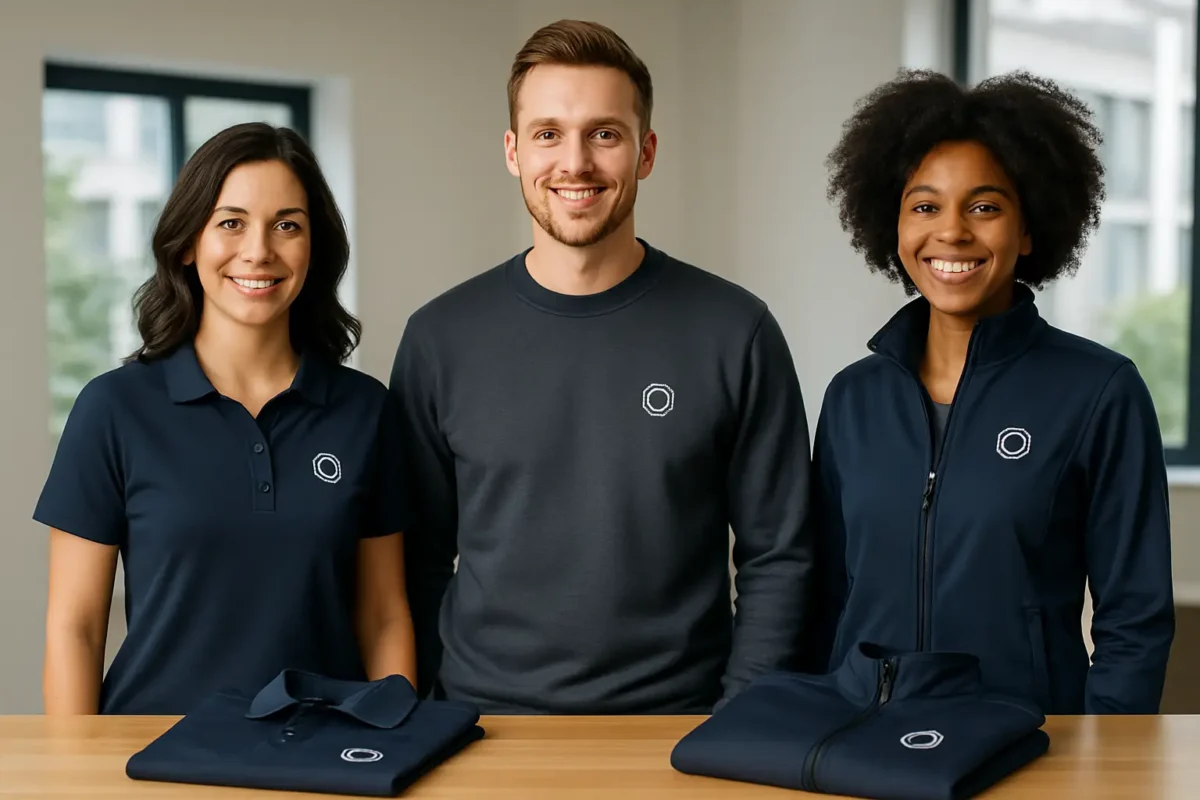
Events workwear tends to live or die on comfort and speed. A breathable T-shirt or polo, a lightweight mid layer, and a cap or beanie for outdoor builds can cover most shifts. The key is consistency: the same logo size, same placement, same garment colour. That’s what makes a crew look organised, even across multiple venues.
Events is also where packing and delivery method matters. Bulk pallet delivery is efficient when you are kitting out a large crew at once. Per-employee packaging is better when you are issuing kits across different locations or managers.
Example: a healthcare bundle
Healthcare uniforms are less forgiving. Fabric must wash well at the temperatures your policy requires, colour needs to stay consistent, and department identifiers matter. A bundle might be tunics and trousers, or scrubs, with optional fleeces or cardigans depending on the workplace. If your organisation uses colours by department, the bundle structure helps keep that control without relying on memory.
Embroidery vs print: bundle decisions that affect wear, compliance and cost
Decoration method is not a styling choice. It changes durability, comfort and suitability on different fabrics.
Embroidery is usually the first choice for polos, sweatshirts, fleeces and many softshells. It looks professional, lasts well, and copes with frequent washing. It is also a smart option when you want a consistent finish across a long-running uniform programme.
Print is often better for lightweight garments, large logos, and designs with gradients or fine detail. It is also commonly the right call for waterproof jackets where you want to avoid needle holes. On hi-vis, print can be useful for high-contrast visibility, while embroidery can work well for smaller chest logos depending on garment construction.
Cost can swing either way depending on stitch count, logo complexity and print area. If you are building bundles, decide what “standard branding” means – for example, left chest logo on every item and a larger back print only for specific roles. That keeps your per-person cost predictable and stops the bundle drifting into a different spec every time someone re-orders.
Getting sizing and garment consistency right across a team
Teams don’t fail sizing because people don’t know their size. They fail sizing because brands and fits vary. A medium in one polo is not the same as a medium in another, and unisex fits can frustrate wearers if you don’t provide a suitable range.
If you want branded workwear bundles for teams to reduce admin, lock down a garment range and stick to it. If you change the base polo every quarter, you will spend time resolving mismatched shades, inconsistent fits and replacement requests.
For organisations with a mix of body types and roles, it often works better to choose a core range for most of the workforce, then provide a controlled alternative fit where needed. That may be a women’s fit option for polos or a different trouser cut, without reopening the whole garment list.
Packaging and fulfilment: the part that saves you hours
The hidden cost in uniforms is the time you spend handling them. Sorting by name, matching sizes, separating departments, then chasing the missing item is where ordering “cheap” turns expensive.
A bundle approach gives you the opportunity to streamline issue. If kits are packaged per employee with their items grouped together, you reduce sorting time and the risk of handing out the wrong size. If you are supplying an event or a trade customer with a single drop, bulk delivery can make receiving easier and keep goods protected.
This is also where you can build your internal rules into the process. If managers know that “Warehouse Bundle A” always means the same four items with the same branding placements, issuing becomes routine rather than a one-off project.
Compliance and site rules: build them in early
Hi-vis and PPE needs should be decided up front. If a site requires specific classes or colours, that becomes the starting point for your bundle. Trying to retrofit compliance later usually leads to waste: you end up with perfectly good garments that cannot be worn on-site.
It also pays to think about the full working day. A hi-vis vest might tick a box, but if your team is outdoors in winter, you will quickly see a mix of personal coats over the top. A compliant hi-vis jacket or hi-vis softshell can be the difference between a consistent team appearance and a patchwork of layers.
When bundles make less sense (and what to do instead)
Bundles are not the answer for every organisation. If your workforce is highly variable in tasks and environments, you might be better with a core uniform plus add-ons by role. Likewise, if you have high staff turnover and only want to issue the basics until probation ends, it can make sense to offer a starter bundle first, then a fuller kit later.
Another scenario is heavy personal preference in fit and fabric. If comfort is your main driver and you have a wide range of acceptable options, a strict bundle may create friction. In those cases, setting a controlled “menu” can work better than a fixed kit – still standardised, but not identical.
A practical way to build your first bundle spec
If you are setting this up from scratch, keep the first version simple and repeatable. Decide the job roles you are covering, then write down what each role genuinely needs to get through a week of work without constant washing and without relying on personal outerwear.
Then set your brand rules: garment colours, logo placement, and whether you want names or role titles. Names can help in customer-facing environments and reduce kit loss, but they can also create waste if roles change frequently. For some teams, a department label or site label is a better compromise.
Finally, choose your fulfilment approach. If the aim is to reduce admin, per-employee packaging is usually worth it. If the aim is speed to site for a large deployment, bulk delivery may be the priority.
If you want a supplier who can handle the full process – garment selection across multiple ranges, embroidery and print, plus issue-ready packing – Vivid Promotion is set up for exactly that style of uniform ordering.
The detail that keeps teams wearing the kit
The best bundles are the ones your team stops thinking about. The zip that doesn’t snag, the hoodie that doesn’t twist after washing, the logo that stays sharp, the jacket that doesn’t feel like a bin bag in the rain. Those details are what turn “uniform” into “workwear”.
If you are building branded workwear bundles for teams, aim for a kit that survives real shifts and real laundering, not just a photo. When your people are comfortable and the uniform is easy to issue and replace, you get the outcome you actually want: less chasing, fewer exceptions, and a team that looks like one team the moment they step on site.