Branded Workwear
Custom Hi Vis Jackets Printed: Get It Right
Mar
A hi vis jacket is rarely “just” a jacket. It is the thing your site manager uses to spot supervisors at a glance, the layer that keeps a night crew seen in yard lighting, and the piece that ends up in every photo when a client visits. When you add branding, the stakes go up: the garment still has to do its PPE job, the logo has to stay readable after hard wear, and your team needs consistent kit without your admin staff spending a Friday afternoon sorting sizes.
This is where custom hi vis jackets printed properly makes a difference. Print can be the fastest and cleanest way to apply branding on hi vis outerwear, but the details matter – garment type, compliance markings, print method, placement, and how you want uniforms packed and delivered.
What “custom hi vis jackets printed” really involves
Printing on hi vis outerwear is not the same as printing on a cotton T-shirt. You are dealing with fluorescent fabrics, reflective tape layouts, and sometimes waterproof or breathable membranes. Your decorator needs to keep clear of tape, avoid distorting the garment, and ensure the branding does not compromise the visibility features.
It also involves practical decisions that buyers often only face once they have 40 people on site asking, “Where’s mine?” Do you want one logo on the left chest only, or do you need a big back print for marshals and traffic teams? Are you mixing roles and need different back text by department? Do you need individual name personalisation? Each choice affects cost, lead time, and how smooth issuing will be.
Picking the right hi vis jacket for printing
Start with how the jacket will be used, not the logo. A softshell used by a supervisor who is in and out of vehicles all day is different from a waterproof coat for highway maintenance or an insulated bomber for a yard team.
Waterproofs and why print often beats embroidery
On waterproof jackets, print is usually the safer option. Embroidery means needle holes, and needle holes can mean water ingress. You can sometimes mitigate this with backing and placement choices, but if the outerwear is genuinely relied on for weather protection, print is normally the cleaner, more functional route.
On the other hand, a fleece-lined hi vis jacket or a non-waterproof bomber can take embroidery well, and embroidery can look very tidy for small chest logos. It depends on the fabric, the performance requirement, and how hard the garment will be laundered.
Softshells, stretch and print durability
Softshell hi vis jackets are popular because they are comfortable and smart. The trade-off is stretch. Some prints handle movement better than others, and a poor match can lead to cracking over time. If softshell is your standard issue, make sure the print is specified for flexibility and that the logo artwork is suitable at the chosen size.
Two-tone, tape layouts and “printable real estate”
Many hi vis jackets have segmented reflective tape, contrast panels, and pocket flaps that reduce the clear space available for branding. This is not a problem, but it does mean you need to think about placement early. If you want a large back logo, choose a jacket with a generous clear panel and tape positioned to leave room. If the garment is tape-heavy, you might be better with a smaller back mark plus a clear chest logo.
Placement that works on site and stays compliant
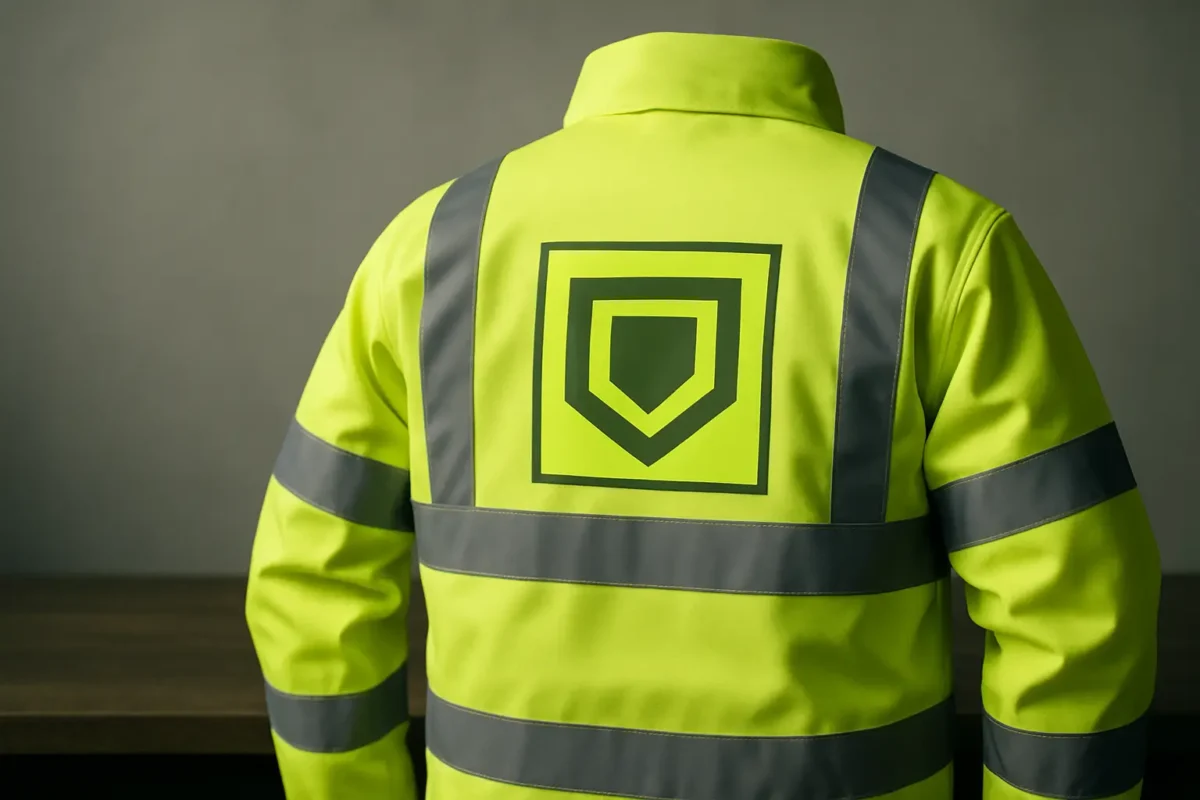
The most common placements are left chest and large centre back. That is common because it works – the chest is visible when someone is facing you, and the back is visible from distance and when people are working.
Where teams get caught out is when they want very large branding that overlaps reflective tape, or when they add too many elements and clutter the visibility zones. You do not want the logo to interfere with the reflective performance or create a busy back that is unreadable at 20 metres.
If you need role identification (for example “TRAFFIC MARSHAL”, “SECURITY”, “FIRST AID”), it is often clearer to keep the back text bold and simple, and move the company logo to the chest. You can still look professional without trying to make the back carry every message.
Print methods: what you are really buying
Most buyers simply want a durable logo that stays sharp. Under the hood, different methods behave differently on hi vis fabrics.
Transfer print for crisp logos and quick repeatability
Transfer printing is a common choice for hi vis outerwear because it handles detail well, works across a range of fabrics, and is practical for small to medium runs. It is also repeatable – if you are reordering quarterly, you want the same placement and size each time, not something that drifts.
The trade-off is that the quality depends on correct application: heat, pressure, dwell time, and the right media for the jacket fabric. Done correctly, it is a strong, clean finish that suits most operational uniforms.
Direct-to-film and other modern transfers
Modern transfer systems can produce full-colour logos with fine detail, which is useful if your brand mark is complex or has gradients. The key consideration is still durability and suitability for the jacket fabric and wash regime. If your jackets will be washed frequently or exposed to heavy abrasion, you want a finish that can take it.
Reflective print for branding that matches the garment’s purpose
If your priority is visibility, reflective branding can look very smart and functional. It is particularly useful for backs on night teams, logistics, and traffic environments. The decision here is whether you want the brand to be prominent in daylight (full colour) or primarily functional (reflective). Some organisations issue both types depending on role.
Artwork and logo setup: the bit that prevents rework
Most delays and disappointments come down to artwork. A logo pulled from an email signature is rarely print-ready, and a low-resolution image will look soft on a large back print.
If you want consistency across jackets, gilets, polos and hoodies, you need a reliable master file and clear rules: the same logo version, the same colours, and the same placement. It also helps to decide whether you will standardise on a left chest size (for example, a consistent width across all garments) so new starters can be ordered without a fresh round of approvals.
Sizing, issuing and avoiding the “pile of jackets” problem
Hi vis jackets are often ordered in a rush: a new contract lands, a team expands, or compliance checks force a refresh. The operational issue is not placing the order – it is issuing it.
If you are ordering for multiple sites or departments, ask yourself how you want it to arrive. Bulk boxes are fine if you have time and space to sort. If you do not, per-employee packing can remove a lot of internal admin. The cost of an extra hour of a supervisor’s time is usually higher than people expect.
It also helps to standardise garments by role. When everyone picks a different jacket, reorders get messy and the site looks inconsistent. A clear “standard jacket” and an “upgrade option” for certain roles keeps control without forcing one solution for every working pattern.
Lead times: what affects them and how to plan
Lead times are driven by three things: stock availability, artwork approval, and decoration capacity. The easiest win is to approve artwork once and reuse it. The second is to avoid changing garment models midstream. If you switch brands or styles, the printable areas and tape layouts change, and you may need a new proof.
Seasonality matters too. Autumn and winter are busy for outerwear, and large projects can soak up stock across the market. If you know you will need 80 jackets for October, ordering in late summer usually prevents compromises on colour, size range, or having to split deliveries.
When print is not the right choice
Print is not automatically best. If your team is doing heavy mechanical work and the jacket front is constantly rubbing against tools or equipment, embroidery on a suitable non-waterproof garment may outlast print for a small chest logo. If you need an ultra-premium look for front-of-house roles and the garment allows it, embroidery can look sharper up close.
There is also the question of repair and replacement. If your jackets get damaged often, you may prefer a simpler branding setup so replacements can be ordered quickly with minimal admin.
Ordering in a way that stays consistent
The organisations that get uniforms right treat hi vis like a system. They pick the garment style, standardise placements, lock the artwork, and then reorder without reinventing the decision every time.
If you want that kind of repeatable process with printing and embroidery options, and fulfilment that can be set up to reduce sorting time, Vivid Promotion is set up for exactly this kind of workwear ordering – across hi vis PPE, outerwear and the everyday uniform layers that sit underneath.
The practical goal is simple: your team stays compliant and recognisable, your branding looks consistent across jobs, and you are not stuck firefighting uniform issues when you should be running the site.
A useful way to sanity-check any order is to picture the jackets six months from now, not day one. If the logo still reads at distance, the jacket still performs in the rain, and reorders are a two-minute job rather than a chain of emails, you have made the right call.