Branded Workwear
Embroidery or Print on Workwear: Which Wins?
Feb
The first time a logo fails in the real world, it is rarely subtle. A print starts cracking after a few hot washes in the staff room. A stitched badge catches on a tool belt and pulls. Or a waterproof jacket starts leaking because someone stitched straight through a membrane.
If you are buying uniforms for a team, “embroidery vs printing on workwear” is not a design preference. It is a decision about durability, compliance, comfort, lead times, and what your staff will actually wear day after day.
Embroidery vs printing on workwear: what you are really choosing
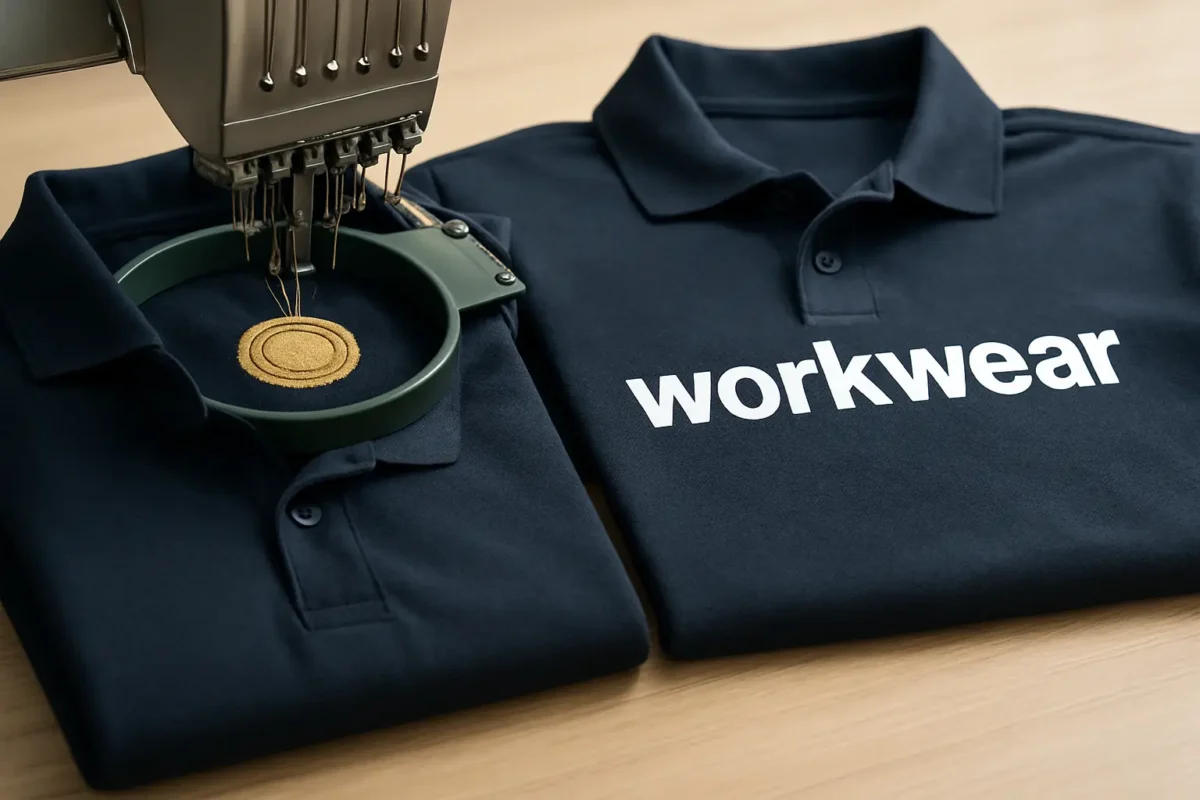
Embroidery is stitched thread. It is built into the garment surface, which is why it reads as premium and tends to last well on heavier items.
Printing is ink or film applied to the fabric. It can be extremely hard-wearing when matched to the right garment and wash routine, and it is usually the most flexible option for large logos, gradients, and bold back prints.
The practical question is not “which is better?” It is “which method suits this garment, this logo, and this job role?”
Durability and wash performance in day-to-day use
On most workwear, embroidery handles abrasion well. Thread does not crack like a poor-quality print can, and it stands up to contact points such as seat belts, harnesses, and repeated rubbing against fleece linings.
That said, embroidery can be damaged too. Fine details can fray if the garment is frequently snagged, and on very lightweight fabrics the stitching can cause puckering, which makes the logo look wavy over time.
Printing durability depends on the print method and the fabric. A correctly applied print on a stable fabric like a good polo or sweatshirt can last for a long service life. But if the garment is washed hotter than recommended, tumble dried aggressively, or ironed over the logo, print will show wear sooner than stitching.
If you have a mixed workforce, wash behaviour matters. Teams who take uniforms home will wash differently to a centrally laundered operation. If you cannot control washing, choose the method that tolerates variation best for that garment type.
Logo detail, sizing, and brand visibility
Embroidery has limits on fine detail. Small text, thin lines, and intricate crests can fill in when stitched, especially on thicker outerwear. For a simple chest logo, it is ideal. For a detailed mark with small lettering, you often need to simplify the artwork or increase the size.
Printing is more forgiving on detail. It suits gradients, photographic elements, and crisp small text when the garment and application are right. It is also the straightforward answer when you want big visibility – for example a large back logo on T-shirts for an events crew.
A useful way to think about it: embroidery is excellent for recognition at close range (front-of-house, client visits, depot collections). Print is excellent for recognition at distance (sites, events, roadside, teams spread across a venue).
Comfort and wearability on different garments
Embroidery adds weight and stiffness to the decorated area. On a polo or sweatshirt, most people do not notice it. On thin performance fabrics, it can feel scratchy without backing, and on fitted garments it can reduce stretch where the design sits.
Printing usually keeps the fabric’s drape, but large prints can reduce breathability. A big back print on a lightweight T-shirt can feel warmer, which matters for warehouse roles, summer events, or staff working indoors under lights.
For healthcare uniforms such as scrubs and tunics, comfort and ease of movement are usually higher priorities than “premium feel”. A tidy printed logo or a small, well-placed embroidery is common – but you want to avoid anything that makes the fabric less breathable across the upper back and shoulders.
The garment itself often decides for you
Some garments take embroidery brilliantly: fleeces, sweatshirts, hoodies, softshells, and many polos. The fabric is stable, the decoration area holds shape, and the finished logo looks clean.
Other garments need more caution. Waterproof jackets and many hi-vis outer layers can have membranes, coatings, or sealed constructions. Stitching through them can create needle holes. In those cases, printing is often the safer choice because it avoids puncturing the fabric and can be positioned to suit reflective tape layouts.
On bodywarmers and padded coats, embroidery is possible but it depends on the panels and thickness. If the chest area is heavily padded, stitching can sink and lose definition. Printing can sometimes sit flatter, but you must still consider fabric texture and any coatings.
Trousers, coveralls, and overalls sit in the middle. Embroidery can work well on stable panels like a thigh pocket, but you need to think about abrasion and frequent industrial washing. Printing can also be effective, especially for larger identifiers, but it must be specified for that wash environment.
Cost, minimums, and repeat ordering
For many organisations, the real comparison is cost over the life of the uniform – not the cheapest unit price today.
Embroidery typically has a one-off setup cost to convert your logo into a stitch file. After that, the cost per garment is driven by stitch count (how complex and large the design is) and placement. On repeat orders, embroidery becomes predictable, which procurement teams tend to like.
Printing setup is generally simpler for straightforward logos, and it can be cost-effective for larger designs and big runs. If you are ordering a large batch for an event, print often delivers the lowest cost per visible impact.
If you are issuing uniforms as starters join over time, both methods can work, but consistency matters. Embroidery is usually very consistent across batches. With print, consistency is still achievable, but you want a supplier who controls the artwork, colour matching, and garment substitution so a “top up” order does not look different to the original.
Lead times and operational planning
Decoration method affects production flow. Embroidery is machine time per item, so very complex designs or multiple locations can slow a large run. Printing can be fast for high volumes once set up, but curing and handling steps still need planning.
From an operations point of view, the bigger lever is not embroidery vs print. It is whether the supplier can process your order cleanly: correct garment selection, correct sizes, correct locations, and delivery that reduces your internal admin.
If you are kitting out multiple sites or issuing per person, ask about packing and sorting. Getting uniforms delivered labelled per employee or per department can save hours compared to opening boxes and sorting in the office.
Compliance and hi-vis considerations
Hi-vis is not just about colour. You have reflective tape layouts and garment standards to preserve. Decoration placement must not compromise reflectivity or reduce the visible area in a way that affects compliance.
Embroidery on hi-vis is common for small chest logos, but you need to avoid stitching through areas that should remain uninterrupted or where the fabric construction is sensitive. Printing is often used for larger identifiers on the back, especially where you need the message to be clear at distance.
If your teams are in construction, highways, logistics yards, or rail-adjacent work, do not guess. Choose placements that keep the garment doing its job first, then make the branding look tidy within those constraints.
Choosing the right method by job role
Client-facing trades and service teams often benefit from embroidery on polos, softshells, and fleeces. It reads professional, it wears well, and it suits garments that staff keep on all day.
Events teams usually lean towards print for T-shirts and hoodies because they want bold back logos and quick recognition across a site. Printing also makes it easier to include role labels like “CREW” or “SECURITY”.
Healthcare and care teams need comfort, easy laundering, and department clarity. A smaller front logo or department identifier tends to be more practical than heavy decoration. Printing often keeps the garment lighter, but a neat embroidery can also work if the fabric is suitable.
Education orders – especially leavers’ hoodies – are typically print-led because names, year groups, and large back designs are common. Embroidery is still used for a small front crest where the design is simple enough to stitch cleanly.
A practical way to decide quickly
Start with the garment. If it is waterproof, heavily coated, or highly technical, default to printing unless you have a clear reason to stitch.
Then look at the logo. If it is simple and you want a smart, durable left chest mark, embroidery is usually the right answer. If it is detailed, has thin text, or needs to be large, printing will normally reproduce it more accurately.
Finally, consider how the uniform is used and washed. Harsh washing, high abrasion, and uncontrolled laundry habits push you towards the most tolerant option for that fabric. And if your team mix includes outerwear, mid-layers, and T-shirts, it is completely normal to use both methods across the same uniform programme.
If you want a supplier who can advise on the decoration method per garment and handle the operational side – from logo setup through to sorted deliveries – that is the core service at Vivid Promotion.
Getting the details right so you do not reorder twice
Most uniform problems come from small mismatches: a logo sized for a T-shirt applied to a padded coat panel, a print chosen for a fabric that moves too much, or a placement that conflicts with pockets, zips, and tape.
Give your supplier three things up front: the job role, the garment type, and how the items are laundered. If you do that, the decoration choice becomes straightforward, and your team ends up with workwear that looks consistent, lasts, and turns up ready to issue – which is the part that makes uniform ordering feel under control rather than a recurring headache.