Branded Workwear
Printed workwear logos that stay sharp on site
Feb
A logo that looks fine on a screen can fall apart fast on a working week. The usual culprits are predictable: the wrong print method for the fabric, a tiny chest mark that gets lost on a hi-vis vest, or artwork that was never truly print-ready. If you are kitting out a team, you do not need “creative”. You need consistent results, clear lead times, and branding that survives real use.
This guide breaks down what a printed workwear logo service should actually do for you, how to choose the right approach by garment type, and what to check before you approve anything.
What a printed workwear logo service should cover
At its simplest, printing is applying your logo to the garment using ink or a film process. In practice, a proper service is closer to production management. It should help you choose the right decoration method, convert artwork into a usable format, place the logo correctly, and keep the outcome consistent across mixed garments and repeat orders.
It also has to work with how organisations buy. You might be ordering 15 polos for one crew and 60 hi-vis vests for another, then adding 10 more next month when you recruit. Your print setup needs to hold steady across all of that, so staff look like one team rather than a collection of “nearly the same” tops.
When print beats embroidery (and when it does not)
Embroidery is hard-wearing and premium, but it is not always the right call. Printing often wins in three common scenarios.
First, if your logo has fine detail, gradients, or multiple colours, print can reproduce it cleanly. Embroidery has limits on small text and sharp corners, and it can thicken or simplify a design.
Second, on waterproofs and some softshells, embroidery can introduce needle holes. That is not ideal on garments designed to keep wind and rain out. A print method suited to outerwear avoids compromising the fabric.
Third, if you need larger marks like a back logo for site visibility, printing is typically more cost-effective and lighter on the garment.
It depends, though. For heavy-duty sweatshirts, fleeces, and some work polos, embroidery can outlast print and still look crisp after repeated washing. Many teams use both: print for back branding and hi-vis, embroidery for a neat left chest on day-to-day layers.
The main print methods and what they are good at
Most workwear printing falls into a few established methods. A supplier should steer you based on durability, garment type, and how your logo is built, not just what is cheapest.
Vinyl and heat transfer (including cut or printed transfer)
This is common for workwear because it handles block colours well and can be very durable when applied properly. It is often used for names, numbers, and simple logos. It can also suit small runs, because setup is fast.
The trade-off is feel and breathability. On lightweight tees, large vinyl areas can feel heavy. On stretch garments, you need the correct material so it flexes without cracking.
Screen printing
For larger volumes of the same design, screen printing is a reliable workhorse. It is hard-wearing and usually cost-effective once you get beyond small quantities.
The limitation is setup time and the nature of the artwork. Each colour is typically a separate screen, so complex multi-colour designs can raise costs. It is brilliant for bold, simple logos and team tees for events.
DTF (direct-to-film) transfers
DTF is popular for full-colour logos and detailed designs. It can produce strong colour and fine detail and works across a wide range of fabrics.
Where it varies is in feel and the suitability for very large coverage. For many workwear logos, it is a solid, practical solution, especially when you want consistency across mixed garment types.
A good printed workwear logo service will explain these differences in plain terms and recommend what fits your use case: site wear, front-of-house uniforms, school leavers hoodies, healthcare tunics, or a one-off event drop.
Getting placement and size right first time
Most print “issues” are really placement issues. A logo can be perfectly printed and still look wrong if it is not sized correctly for the garment.
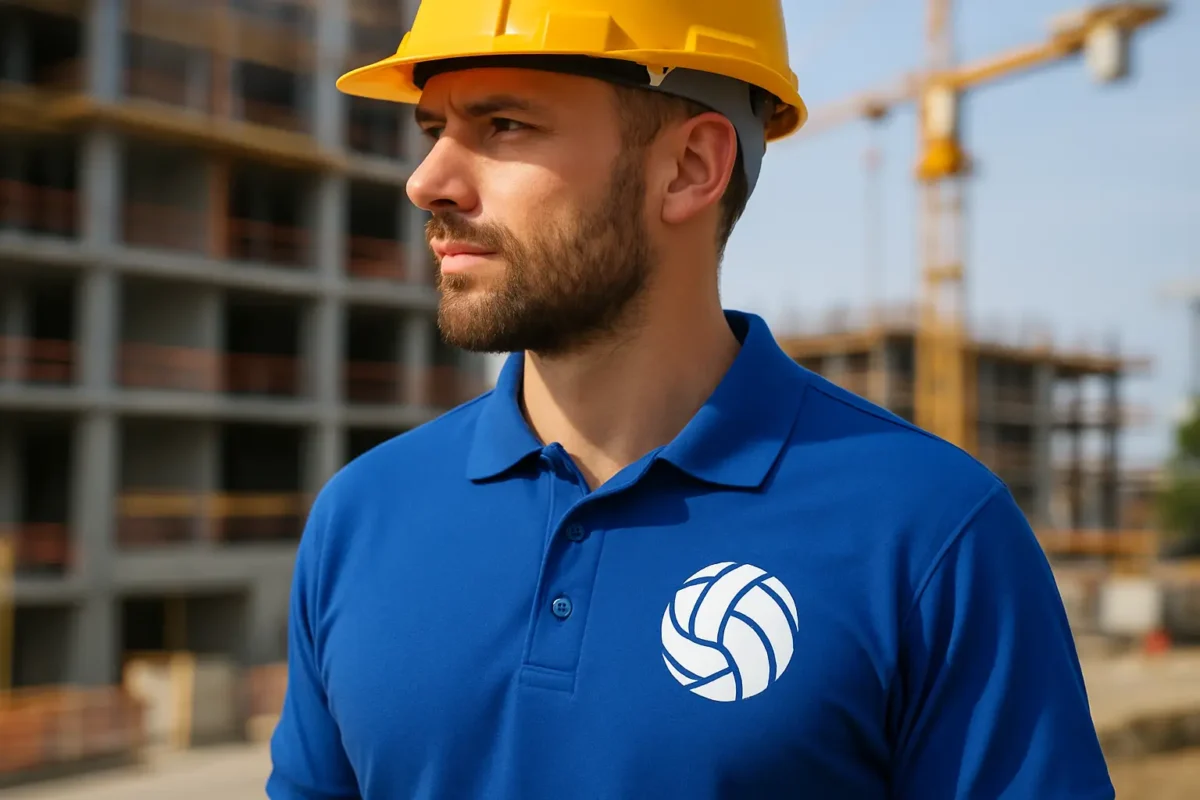
Left chest prints are common for polos, sweatshirts, fleeces and softshells. They should be sized for readability but not so large that they creep into the armpit area on smaller sizes. If you are ordering XS to 5XL, you may want a supplier that can advise on sensible scaling rather than forcing one size across everything.
Back prints matter on site, especially if you want people identifiable at a distance. If you are using hi-vis, check how the print will sit around reflective tape. The tape layout varies by garment style, and you do not want a back logo chopped in half.
Sleeve prints work well for certain trades and event staff, but they can be exposed to abrasion. If the sleeve is likely to rub against tools, straps or surfaces all day, you may prefer chest branding only.
Artwork: what you need to supply (and what your supplier should fix)
The fastest route to delays is “we only have a small JPEG from our email signature”. Many organisations are in that exact position, so it is not unusual, but the service has to handle it properly.
Ideally you provide a vector file (AI, EPS or PDF) with clean lines and correct colours. If you do not have that, your supplier should be able to convert your logo into print-ready artwork and confirm what will change. Sometimes that means re-drawing small elements so they do not blur. Sometimes it means agreeing a simplified version for small chest marks.
Colour is another common snag. Screen colours are not print colours, and fabrics are not white paper. A supplier should ask whether you need a specific brand colour match and advise if it is achievable on your garment choice. Printing a light logo onto a dark fleece may require an underbase layer, which affects cost and feel.
Matching print method to garment type
Workwear is not one fabric. A practical supplier will steer you based on the garment range you are ordering.
T-shirts, polos, hoodies and sweatshirts are typically straightforward. Most print methods will work, so the decision comes down to how hard they will be worn, whether the logo is complex, and whether you need multiple names or job roles.
Hi-vis PPE introduces rules and constraints. Reflective tape placement, compliance markings, and the need for visibility all affect where your logo can go and how large it should be. Some organisations also need department identifiers or site roles, so you might be mixing a company logo with text like “Supervisor” or “First Aider”. That is where transfer-based options can be useful.
Outerwear is where mistakes get expensive. Softshells, waterproof coats and bodywarmers can be branded, but you need to think about water resistance, fabric texture, and whether the garment will be machine washed frequently. Printing can be a safer option than stitching for certain waterproof garments, but the method needs to be chosen for the material.
Healthcare uniforms and scrubs are about wash performance and comfort. Prints must cope with regular laundering, sometimes at higher temperatures depending on policy. You also want a finish that does not feel stiff in movement-heavy areas.
Operational details that matter when you are ordering at scale
The branding itself is only half the job. For operations managers and admin teams, the biggest wins are often in fulfilment.
If you have multiple sites or departments, ask about split deliveries and per-person packing. It is one thing getting 200 garments delivered to reception. It is another getting them sorted by employee, labelled, and ready to issue without someone spending half a day matching sizes to names.
Repeat ordering is another pressure point. Your supplier should retain your print setup and placement notes so the “top-up order” looks identical to the original. If you are onboarding regularly, consistency is the difference between a uniform system and a constant rework.
Lead times should be realistic. Printing at volume takes scheduling, and mixed garments can add complexity. You want a supplier that gives a clear production window and sticks to it, rather than promising the fastest date and then slipping.
What to ask before you approve a proof
A proof is not just “does the logo look centred”. It is your last chance to prevent avoidable errors.
Confirm the garment colour and the print colours together. A navy polo with a black logo can disappear. If legibility matters, request a contrasting colour or outline.
Check placement measurements, not just a picture. Ask where the logo sits from the shoulder seam or placket, especially for left chest prints.
If you are printing on hi-vis, confirm that the print area stays within allowable zones and does not interfere with reflective tape. If you are unsure, say so. A competent supplier will guide you.
A practical route to ordering without admin drag
If you are buying through an ecommerce-led supplier, the smoothest approach is usually to standardise your “core set” first: pick the garments your team actually wears, decide on one chest logo placement and one back option (if needed), then add role text or names only where it provides operational value.
Once that is set, you can build bundles by job role or department, which makes ordering and onboarding far simpler. This is exactly the kind of workflow we support at Vivid Promotion – not just printing logos, but setting up repeatable uniform ordering with consistent branding and delivery options that reduce internal sorting.
The result is not glamorous. It is just reliable: the right garments, branded the right way, turning up on time, in the right quantities, ready to hand out.
A closing thought
Treat your printed logo like a piece of kit, not a graphic. If it is specified properly – method, placement, artwork, and fulfilment – it will quietly do its job for years while you get on with yours.