Branded Workwear
Embroidery or Print for Workwear?
Mar
A fleece for your site supervisor, polos for the office team, hi-vis for warehouse staff and waterproof jackets for engineers rarely need the same branding method. That is where many uniform orders go wrong. The garment gets chosen first, the logo second, and only then does someone ask whether embroidery or print will actually suit the job.
If you are comparing embroidery vs print workwear, the right answer is usually not about which looks better in general. It is about which method works better on that garment, for that role, under that level of wear, washing and weather exposure. A good decision saves money, avoids premature replacements and keeps your branding consistent across the whole team.
Embroidery vs print workwear – what is the difference?
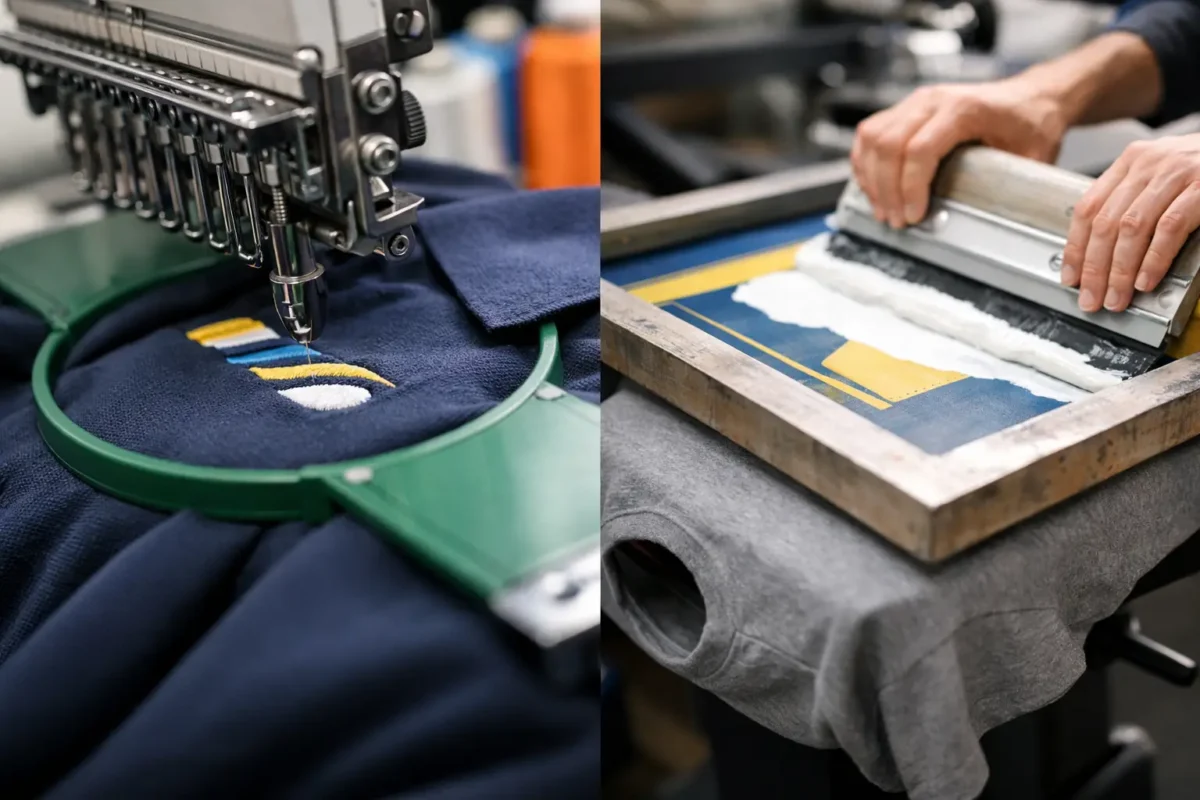
Embroidery stitches the logo directly into the garment using thread. It gives a textured, durable finish that is widely used on polos, sweatshirts, hoodies, fleeces, softshells, bodywarmers and heavier outerwear. It tends to suit company logos, names and department identifiers where a smart, hard-wearing result matters.
Printing applies the design onto the surface of the garment rather than stitching through it. Depending on the garment and artwork, that may be done through methods such as transfer or screen printing. Print is often the better choice for larger designs, detailed graphics, multi-colour artwork and garments where needle penetration is not ideal.
Both methods have their place. The issue is not which one is best overall, but which one matches the fabric, the environment and the way your staff use the clothing.
When embroidery is the stronger choice
Embroidery is usually the safer option when you want a professional finish on everyday uniform pieces that get repeated use. Polos, knitwear, fleeces and sweatshirts often take embroidery well because the fabric has enough structure to support the stitched design without distorting.
For trades, facilities teams, hospitality staff, schools and office-facing roles, embroidery gives a solid branded look that holds up over time. If your staff are wearing the same garments week after week, that durability matters. A stitched logo generally copes well with regular laundering and day-to-day abrasion.
It also works well for smaller chest logos. If you need a left breast logo on polos or fleece jackets, embroidery often looks sharper and more premium than print. Names and job titles can also be added neatly where required.
There are limits, though. Very fine detail can be lost in stitching. Small text, gradients and intricate artwork may need simplifying before they become embroidery-ready. That is normal, but it does mean the original logo file may need adjusting so the final result is clean rather than cluttered.
When print is the better option
Print comes into its own when the logo or graphic is too detailed, too large or too colour-heavy for embroidery to make sense. If you need a big back print on T-shirts or hi-vis vests, print is often the practical route. It can reproduce sharper detail and larger coverage without the weight or stiffness that heavy embroidery would create.
Print is also the right call on some technical garments. Waterproof coats are a common example. Stitching through a waterproof layer can create needle holes, which is not ideal when the garment is meant to keep the wearer dry. In those cases, print avoids compromising the fabric.
For promotional wear, event clothing, leavers hoodies and campaigns with bold graphics, print often gives more flexibility. It handles larger artwork and can be more economical on garments where visual impact matters more than a stitched finish.
This is also where role matters. If your event staff need highly visible branding across the back of a T-shirt, print usually does that job better than embroidery. If your engineers need a small chest logo on durable outerwear, embroidery may still be the more sensible choice.
Fabric and garment type matter more than many buyers expect
One of the biggest mistakes in embroidery vs print workwear decisions is treating every garment as if it behaves the same way. It does not.
A cotton T-shirt is very different from a softshell jacket. A healthcare tunic performs differently from a heavyweight hoodie. Hi-vis garments have their own compliance considerations, and outerwear often needs branding that does not interfere with weather resistance or garment performance.
Embroidery suits more structured garments because the stitching has something stable to sit on. Fleeces, polos, sweatshirts and bodywarmers are typical examples. Print tends to be more suitable for lightweight items, large branding areas and some specialist outerwear.
That is why mixed uniform ranges often use both. A company may choose embroidered polos and softshells for day-to-day wear, then printed T-shirts for events or printed waterproof jackets for field staff. Consistency in branding does not always mean using one decoration method on everything. It means applying the logo properly across each garment type.
Durability, washing and working conditions
For many organisations, durability is the main concern. Uniform has to survive repeated washing, regular wear and the realities of the job.
Embroidery has a strong reputation here because stitched logos are physically part of the garment. On standard uniform pieces, that is a major advantage. It is particularly useful where garments are worn for long periods, washed frequently and expected to keep a tidy appearance.
Print durability depends on the print method, the garment and how it is washed. Good quality print can perform very well, but it is still a surface application. On the right garment it lasts effectively, but it is not always the best fit for every environment. Heavy abrasion, harsh laundering or constant stretching can affect some printed finishes more quickly than embroidery.
That does not mean print is fragile. It means buyers should be realistic. If you are ordering for decorators, site teams or warehouse staff whose garments take a lot of punishment, durability should be discussed alongside artwork and budget, not after the order is placed.
Cost, order size and practical buying decisions
Budget matters, especially when you are buying for multiple departments or outfitting seasonal staff. The cheapest option on paper is not always the best value once replacements, presentation and suitability are taken into account.
Embroidery can be cost-effective for standard logo placement on core uniform garments, particularly where you want a long-lasting finish. Print can be more economical for large logos, larger print areas and campaign-style clothing, especially across bulk runs.
Order size also affects the decision. If you are buying a small run of embroidered fleeces for supervisors, the added durability may justify the spend. If you are ordering a high volume of event T-shirts with large back branding, print often makes better commercial sense.
The buying process should also be considered. If you are managing uniform issue across multiple employees, decoration choice is only one part of the job. Garment selection, logo setup, consistent repeat ordering and packing all affect how much admin your team has to absorb. That is why many organisations work with suppliers who can manage branding and fulfilment together, rather than treating customisation as an afterthought. At Vivid Promotion, that includes practical support such as logo setup, repeatable branding standards and packed-by-person uniform orders that are easier to issue internally.
How to choose between embroidery and print workwear
Start with the garment, not the logo. Ask what the item needs to do in the workplace. Does it need to be waterproof? Is it lightweight? Will it be washed heavily? Does it need a large back design or just a small chest logo?
Next, look at the artwork. If your logo has fine lines, small text or multiple colours, print may reproduce it more cleanly. If it is a simpler company mark that needs to appear smart and durable on polos, fleeces or sweatshirts, embroidery is often the better fit.
Then consider who is wearing it. Client-facing staff may benefit from a stitched logo on premium garments. Event teams, temporary staff or campaign wear may suit print. Healthcare, construction, education and logistics teams often need a mix, depending on the garment category.
Finally, think in ranges rather than individual items. Most organisations do not need one decoration method for everything. They need the right method for each garment in the uniform range, while keeping the logo consistent.
The best workwear branding decisions are usually the least complicated in daily use. Choose embroidery where durability and a smart stitched finish matter. Choose print where detail, scale or fabric suitability point that way. If you get that balance right at the ordering stage, the uniform works harder from the first wear.