Branded Workwear
Embroidered Workwear in Telford That Lasts
Mar
If your team is based in Telford, workwear is not a branding exercise first. It is a day-to-day operational requirement. Staff need garments that look consistent, fit the job, stand up to repeated washing and arrive on time without creating extra admin for whoever is issuing them.
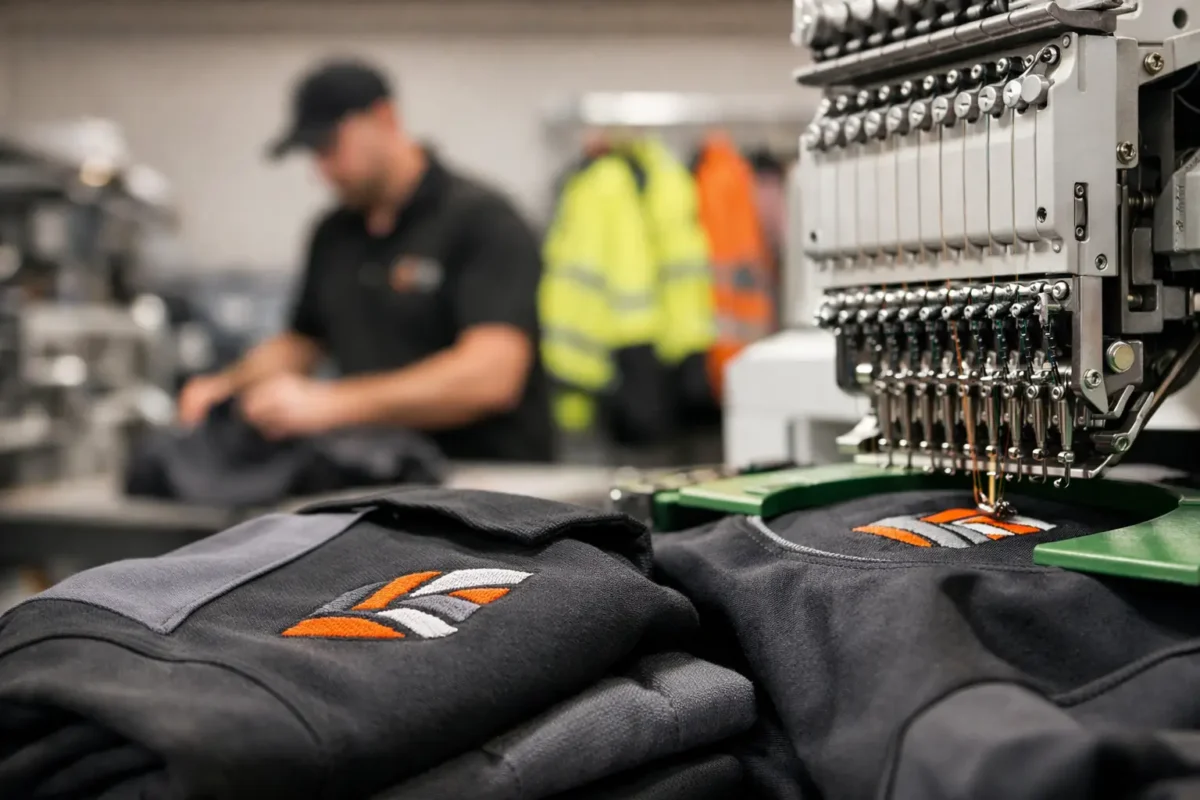
That is where embroidered workwear earns its place. For many businesses, embroidery gives a cleaner, longer-lasting finish than print on polos, sweatshirts, fleeces, bodywarmers and jackets. It helps teams look properly turned out in front of customers, on site, at reception desks and on service calls. Just as importantly, it keeps your logo legible after hard use.
Why embroidered workwear in Telford is a practical choice
Telford businesses cover a wide mix of sectors. Construction firms need durable layers for site staff. Warehousing and logistics teams need branded clothing that can cope with frequent wear. Care providers want uniforms that look professional and stay identifiable across departments. Schools and colleges often need staffwear or leavers’ garments ordered in batches without confusion.
In all of those cases, embroidery is often the safer option where appearance and longevity matter. A stitched logo does not peel, and it generally holds its shape well over repeated laundering. On garments like polos, sweatshirts and fleeces, it gives a more established finish than many printed alternatives.
That said, embroidery is not automatically the right choice for every item. Waterproof outerwear can be a poor match if needle penetration affects performance. Lightweight technical garments can also react differently depending on fabric weight and construction. Good suppliers will tell you when print makes more sense instead of forcing one method onto every order.
Choosing the right embroidered workwear for the job
The right garment comes before the logo. There is no point stitching a strong design onto a garment that is wrong for the working environment.
For trade and construction teams, the starting point is usually polos, sweatshirts, hoodies, softshells and bodywarmers. These are the core garments that get worn week in, week out. Embroidery works particularly well here because the fabric weight is usually stable enough to carry a chest logo neatly. Fleeces are another reliable option for staff who need warmth without the bulk of a heavy coat.
For office-facing teams, customer service staff and mobile sales crews, embroidered polos, knitwear and jackets create a sharper standard across the team. A left chest logo is usually enough. Overloading garments with too many decoration points can make them look cluttered and pushes up cost without much practical gain.
Healthcare and care settings need a slightly different approach. Tunics, scrubs, fleece layers and cardigans often benefit from embroidery for names, departments or business logos, but comfort, wash performance and role identification matter just as much as branding. If uniforms are split by department or responsibility, that needs to be reflected clearly and consistently across the order.
Hi-vis clothing needs even more care. Embroidery can work well on hi-vis polos, sweatshirts, waistcoats and some jackets, but logo size and placement must not interfere with compliance features. This is where product choice matters. The garment still has to do its primary job first.
What makes a logo work well in embroidery
A logo that looks good on a van or website will not always stitch well onto clothing without adjustment. Fine gradients, tiny text and very intricate detail often need simplifying for a clean embroidered result.
This is one of the areas where buyers save time by working with a supplier that handles logo conversion properly. The goal is not just to put a badge on a garment. It is to create an embroidery-ready version that keeps the brand recognisable while working within the limits of thread, stitch density and fabric movement.
Small chest logos usually perform best when they are kept clear and direct. If your logo includes a detailed strapline, there is a fair chance it will need to be removed or reworked at that size. That is normal. A tidy, readable mark is better than a technically accurate but messy one.
Colour matching also needs a practical view. Thread ranges are extensive, but they are not limitless. Most logos can be matched closely enough for consistent branded workwear, but if you need exact shade control across different garment colours and ranges, it is worth checking this before the full order is approved.
Embroidered workwear Telford buyers should think about before ordering
Most delays and mistakes happen before production starts. Sizes are unconfirmed, garment choices are too broad, or the team ordering has not agreed what different roles actually need.
The quickest route to a smooth order is to decide the essentials early. Which garments are mandatory for each job role? Which decoration method is being used on each item? Are there named garments, department variations or wearer-specific packs? If some staff need hi-vis and others need office wear, split that clearly from the outset rather than trying to fix it later.
This matters even more for larger organisations. A 20-person order can sometimes be sorted informally. A 200-person order cannot. If the garments are all arriving in bulk without any structure, somebody in-house still has to sort them, check names and issue them. That is time many businesses do not have.
That is why fulfilment matters as much as embroidery quality. For many employers, the real value is not only in stitched branding but in getting garments packed and delivered in a way that reduces internal handling. Per-employee packaging, clearly labelled orders and organised dispatch save a lot of friction once the uniforms land on site.
Bulk orders, repeat orders and consistency
A one-off order is easy to promise. Repeatability is what actually matters.
If you are buying embroidered workwear for a growing team in Telford, consistency across repeat orders should be high on the list. The same logo size, the same thread colours, the same garment range where possible and the same placement standards all help avoid that pieced-together look that happens when orders are handled differently each time.
This is especially relevant for multi-site teams, contractors, care groups and event businesses. You may need one batch now and another next month. If the ordering process is not controlled properly, the second order can arrive looking slightly off, even when the garments are technically correct.
A dependable supplier should be able to maintain artwork setup, decoration standards and lead times across repeat runs. That gives procurement staff and site managers one less problem to chase.
Local service matters, but only if the process is right
There is a clear advantage in working with a supplier that understands the Telford area and the pace local businesses work at. Local knowledge helps with practical recommendations, realistic lead times and understanding the kinds of sectors ordering regularly – trades, engineering, schools, healthcare and events among them.
But proximity on its own is not enough. You still need broad garment choice, reliable production and a straightforward ordering process. If the service is slow, the artwork handling is poor or the packing is disorganised, being nearby does not solve much.
That is why many buyers look for a supplier that combines regional coverage with structured fulfilment and nationwide distribution. Vivid Promotion supports organisations across Telford and the wider Midlands while keeping the ordering process focused on garment suitability, decoration quality and delivery that is actually usable when it arrives.
When embroidery is the wrong choice
A practical supplier should say this clearly. Not every garment should be embroidered.
If you are ordering waterproof jackets, certain shell garments or lightweight performance fabrics, printing may be the better method. Embroidery introduces needle holes and extra weight in the decorated area. On some garments that is fine. On others it affects comfort, performance or finish.
Large back logos are another area where print may simply work better. Embroidery on a left chest is often smart and durable. A large stitched design across the back can add cost and stiffness without improving the result. It depends on the garment, the logo and how the item will be used.
The point is simple. Good workwear decisions are based on use, not habit.
If you are sourcing embroidered workwear in Telford, start with the job the clothing has to do, then match the garment and decoration method to that. Get those decisions right early, and the uniforms you issue will work harder for your team from the first wear.