Branded Workwear
Choosing Branded Electrician Workwear
Mar
A sparky does not need telling when workwear is getting in the way. Hoodies that snag, polos that lose shape after a few washes, jackets with logos slapped in the wrong place – it all shows up fast on site. When you are buying for a team, branded kit needs to do two jobs properly: stand up to the work and represent the business without creating extra admin.
That is why choosing workwear for electricians with logo is less about picking a few garments and more about building a practical uniform range. The right setup gives your team comfortable layers for changing conditions, keeps branding consistent and avoids costly mistakes with decoration, garment choice and distribution.
What electricians actually need from branded workwear
Electricians work across domestic, commercial and industrial settings, and that changes what the clothing needs to do. A team doing first fix on a new-build site will not dress the same way as engineers moving between customer homes, schools and offices. One may need hard-wearing layers and hi-vis outerwear, while the other needs a cleaner, more customer-facing uniform.
The common requirement is durability without bulk. Electricians spend a lot of time bending, reaching, kneeling and carrying kit. Workwear has to move well, wash well and hold its shape. If branded garments start looking tired after a short run of use, the logo does not help – it makes the whole company look inconsistent.
There is also a practical branding point. Electricians are often working in occupied buildings where clients, tenants or facilities teams want to know who is on site. A clear company logo on the chest or back helps with identification and gives a more professional appearance. For larger firms, it also helps standardise presentation across subcontractors, engineers and supervisors.
Building a workwear for electricians with logo package
For most businesses, the best approach is not one garment but a layered range. That gives staff options without losing consistency.
Everyday tops
Polo shirts and T-shirts are usually the starting point. Polos tend to work better when your electricians are customer-facing because they look smarter while still being practical. T-shirts are often preferred for warmer weather, heavy physical work or as base layers under sweatshirts and fleeces.
For logo application, the chest is the usual choice because it stays visible when a tool belt, harness or jacket is in use. Back prints can work well too, particularly for larger teams or firms wanting clear identification on busy sites. The trade-off is that large back branding can wear faster if the garment sees constant friction from seats, walls or equipment.
Mid-layers for day-to-day site use
Sweatshirts, hoodies and fleeces are where many electrician teams get the most value. They are used heavily, worn across seasons and often become the core visible uniform on site.
A sweatshirt gives a neat, straightforward look and tends to suit a broad range of roles. Hoodies are popular with field teams because they are warm and practical, but they may not suit every environment, particularly where a smarter appearance is expected. Fleeces work well for lighter warmth and are often a good option for service engineers moving in and out of buildings.
Outerwear and weather protection
Electricians working outdoors, on exposed sites or between multiple jobs need reliable jackets and softshells. This is where decoration method matters. Embroidery is often the right choice for polos, fleeces and sweatshirts because it is durable and gives a tidy finish. On certain waterproof garments, though, print can be the better option. Stitching through fully waterproof fabrics may compromise the garment by creating needle holes, so this is not an area for guesswork.
A supplier should advise on that before production, not after the order is placed.
Trousers and coveralls
Branded tops do most of the visual work, but trousers still matter. Electricians usually need work trousers with practical pocket layouts, knee pad access and enough flexibility for regular movement. Coveralls can be useful in specific environments, though they are not the default for every electrical team. It depends on the type of work and whether quick changes between jobs are part of the working day.
Embroidery or print for electrician logos?
This is one of the main buying decisions, and the right answer depends on the garment, the logo and the way the clothing will be used.
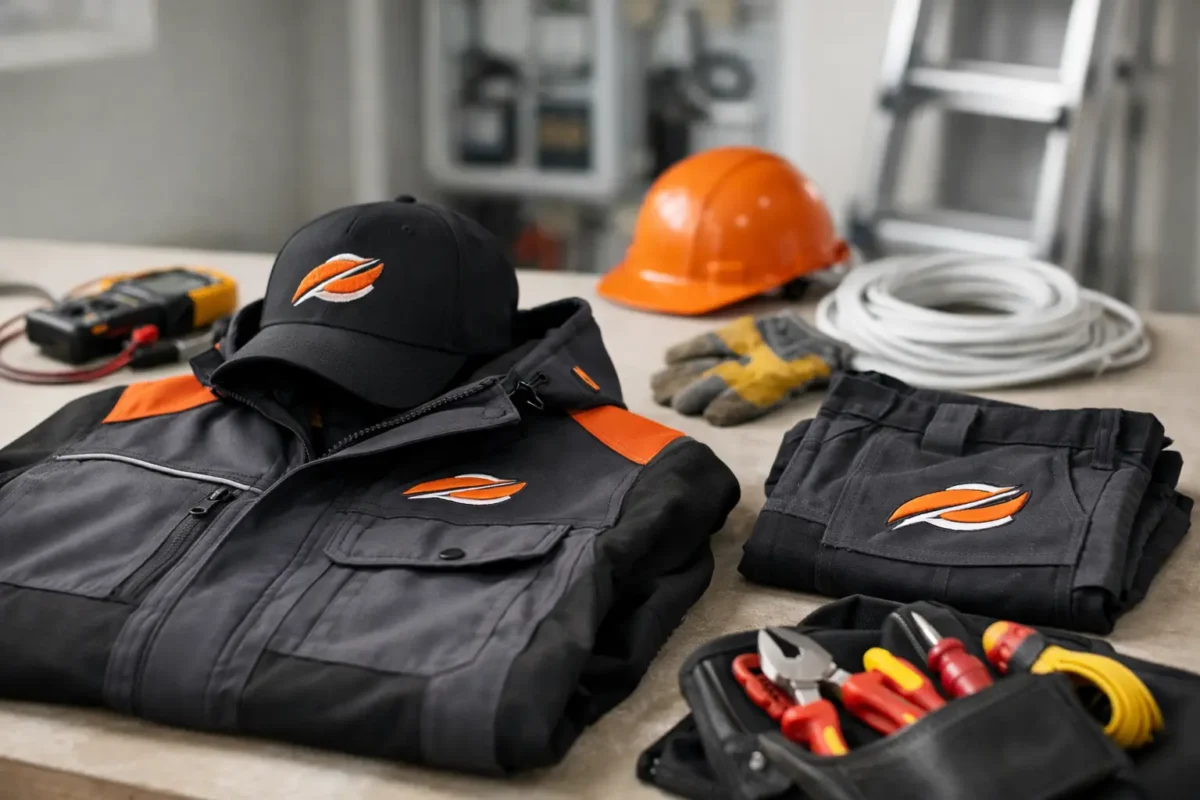
Embroidery is a strong choice for electrician workwear because it is hard-wearing and smart. It suits polos, sweatshirts, fleeces, bodywarmers and many jackets. If your logo is simple and you want a professional finish that holds up through repeated washing, embroidery is often the safer option.
Print works better when the design includes fine detail, larger back graphics or colour gradients that embroidery cannot reproduce cleanly. It is also often the practical choice for lightweight or waterproof garments where stitching is less suitable.
There is no value in forcing one method across every item just for consistency. A sensible workwear programme uses the decoration method that suits each garment. That gives a better finish and fewer issues in wear.
Hi-vis and compliance needs
Not every electrician needs hi-vis every day, but many do need it some of the time. New-build sites, infrastructure jobs and commercial projects often require hi-vis garments as standard. In those cases, branded hi-vis vests, polos, sweatshirts, coats and softshells can keep the team compliant while maintaining a consistent company identity.
The key point is not to treat branding and compliance as separate decisions. If a garment has to meet visibility requirements, the logo placement and decoration should be planned around that. Too much branding in the wrong area can interfere with the garment’s purpose or simply leave it looking cluttered.
This is where buying by profession and compliance need makes sense. Instead of ordering a generic uniform and adding hi-vis later, build the range around the actual environments your electricians work in.
Ordering for one electrician is easy. Ordering for twenty is not.
Most uniform problems do not start with the garment. They start with the process. Sizes are gathered badly, styles get mixed up, new starters need partial kits, and someone in the office ends up sorting boxes on the floor trying to match names to sizes.
If you are buying workwear for electricians with logo at team level, fulfilment matters just as much as product choice. Clear ordering by garment type, role and bundle reduces mistakes. Per-employee packing saves time when uniforms need to be issued quickly. For larger rollouts, bulk delivery planning matters too, especially if stock is being sent to sites, depots or trade counters rather than one office.
This is where an experienced supplier earns its keep. The value is not just adding a logo to a hoodie. It is getting artwork converted correctly, matching the right decoration method to the right garment and delivering the order in a format your business can actually use.
What to look for before you place the order
Price matters, but cheapest rarely means best value in workwear. If a garment shrinks, loses colour or twists after repeated washing, you will replace it sooner and the branding will stop looking consistent across the team.
Look at fabric weight, garment construction and whether the range gives enough choice for different roles. Ask how logos are set up for embroidery and print. Check whether waterproof items are being decorated appropriately. Make sure repeat ordering is straightforward, because electrician uniforms are rarely a one-off purchase.
It is also worth thinking about seasonality. A summer polo and a winter softshell may both need to sit under the same brand standard. If the logo size, position and finish vary too much between garments, the uniform starts to look pieced together instead of managed.
For businesses that need a reliable supply route, a partner such as Vivid Promotion can help organise that process through practical garment selection, correct branding advice and fulfilment options that reduce internal handling.
The best branded workwear is the kit people keep reaching for
That usually means it fits properly, feels right by mid-morning and still looks presentable after a hard week. Electricians do not need overcomplicated uniform schemes. They need dependable layers, sensible branding and an ordering process that does not create more work for the office.
Get those details right and the logo stops being an afterthought. It becomes part of a uniform that works as hard as the team wearing it.